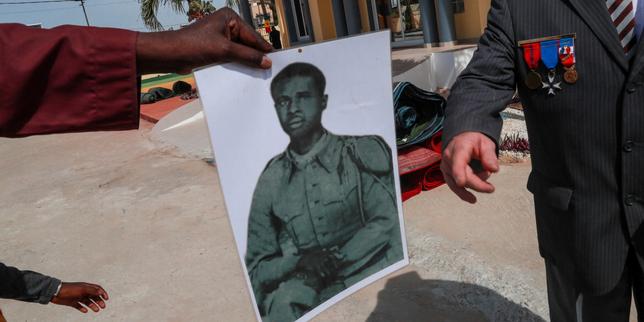
For eighty years, the French state maintained a rigid, blood-stained fiction regarding the events of December 1, 1944. The official story was a convenient lie designed to protect the military’s reputation. It claimed that West African soldiers, recently liberated from Nazi prisoner-of-war camps, had staged an armed mutiny at the Thiaroye transit camp near Dakar, forcing French officers to respond with lethal, albeit regrettable, force. This narrative has finally collapsed. A landmark ruling by the administrative court in Cergy-Pontoise has held the French state liable for the "voluntary concealment" of the circumstances surrounding the death of a Senegalese Tirailleur. This is not just a legal victory for one family; it is a forensic dismantling of a colonial massacre that France has spent nearly a century trying to erase from the ledger of history.
The court’s decision focuses on the case of Biram Sène, one of the hundreds of soldiers gunned down by their own brothers-in-arms. For decades, the Ministry of the Armed Forces insisted Sène was a deserter or a rebel. The reality was far more cynical. These men were veterans of the 1940 campaign against Germany. They had survived years in stalags, only to be denied their back pay and demobilization bonuses upon their return to Africa. When they demanded the money they had earned at the risk of their lives, the French command responded with machine guns. By ruling that the state intentionally hid the truth, the court has acknowledged that the "official" death toll of 35 was a fabrication and that the "mutiny" was a pretext for an execution.
The Arithmetic of Betrayal
To understand why Thiaroye happened, one must look at the ledger books. The Tirailleurs Sénégalais—a term that covered soldiers from across French West Africa—were owed years of accumulated wages. As the war wound down, the provisional government in Paris faced a massive financial crisis. Paying these men the same rates as their white counterparts was seen by the colonial administration as both a fiscal burden and a dangerous precedent for racial equality.
The military hierarchy viewed the soldiers’ demand for pay as an act of political defiance. In their eyes, an African soldier asking for his rights was no longer a soldier; he was an agitator. On that December morning, the French military turned 12-millimeter machine guns on unarmed men in a confined camp. The carnage was over in minutes.
The subsequent cover-up was as efficient as the massacre itself. Death certificates were falsified. Names were stricken from rolls. Families in Senegal, Mali, Burkina Faso, and Guinea were told their sons had disappeared or turned traitor. The Cergy-Pontoise ruling identifies a specific "fault" in how the state managed these records. By providing "manifestly erroneous" information to the heirs of Biram Sène, the state committed a legal wrong that transcends the statute of limitations. This is a crack in the "defense of the state" doctrine that usually protects historical military actions from judicial scrutiny.
The Myth of the African Mutiny
The "mutiny" label was the cornerstone of the French defense for eight decades. It allowed the state to frame the massacre as a necessary police action to maintain order in a volatile colony. However, archival research by historians like Armelle Mabon has long suggested that the soldiers were never armed. They were waiting for a train. They were waiting for their money.
The military reports from 1944, which the court has now effectively discredited, claimed the soldiers fired first. Yet, no French casualties from small arms fire were ever recorded. The only blood on the ground belonged to the veterans. The court’s recognition of "concealment" validates the theory that the military high command, including General Marcel de Boisboissel, orchestrated a narrative to justify the slaughter to Paris and the world.
This was a calculated liquidation of a debt. By killing the creditors, the colonial treasury saved millions of francs. The psychological cost, however, was the birth of the independence movements that would eventually tear the empire apart. Thiaroye became a martyr’s site, a symbol of the fundamental hypocrisy of a "Free France" that used African blood to liberate Paris but refused to use French coin to pay African heroes.
The Paper Trail of Erasure
The judicial breakthrough didn't happen because the state suddenly developed a conscience. It happened because of the persistence of the Sène family and their legal team, who bypassed the usual historical commissions to strike at the administrative failure of the government. They proved that the state had the correct information in its archives but chose to provide a lie to the family.
In administrative law, this is known as a "faute de service." It is the failure of a public institution to perform its duty honestly. By classifying the death of Biram Sène as something other than what it was—an execution by the state—the government deprived the family of their right to a pension and, more importantly, their right to the truth. The court awarded the family damage payments, but the precedent is the real prize. Every family of a Thiaroye victim now has a roadmap to challenge the official records.
Why This Matters in 2026
France is currently embroiled in a painful re-evaluation of its "Françafrique" legacy. From the return of looted art to the withdrawal of troops from the Sahel, the old structures of influence are failing. Thiaroye remains the open wound at the center of this relationship. For the current administration, the Cergy-Pontoise ruling is a nightmare. It moves the conversation from "shared memory" and "symbolic gestures" into the realm of legal liability and financial restitution.
If the state is guilty of concealing the deaths at Thiaroye, it is potentially liable for every colonial-era atrocity where the record was massaged. This includes the scorched-earth policies in Cameroon in the 1950s and the disappearance of dissidents in Algiers. The wall of silence isn't just being questioned; it is being litigated.
The Logistics of a Massacre
Military historians have noted that the weaponry deployed at Thiaroye was excessive for a "riot." The use of an M3 Stuart tank and heavy machine guns against a transit camp indicates a premeditated intent to destroy, not to disperse. The "circumstances of death" that the court says were hidden likely involve the mass graves that still haven't been officially excavated.
Estimates of the dead vary wildly because the state destroyed the primary evidence. While the official number stayed at 35 for years, President François Hollande acknowledged in 2014 that it was likely much higher, perhaps 70 or more. Independent researchers put the number closer to 400. The court's ruling on "concealment" suggests that the state knows exactly how many died and where they are buried, but continues to withhold the maps of the pits.
The Failure of Symbolic Politics
For years, French presidents have tried to "heal" the Thiaroye wound with speeches. They gave the "Mort pour la France" (Died for France) status to a handful of victims posthumously. They visited cemeteries. But they never opened the military archives without restrictions, and they never admitted that the legal basis for the soldiers' "rebellion" was a lie.
The Sène case proves that symbolic politics is no substitute for judicial accountability. The family didn't want a medal; they wanted the state to admit it lied about their father being a criminal. The court has now done what no politician was brave enough to do. It has branded the state's historical narrative as a deceptive act.
This shifts the burden of proof. It is no longer up to the families to prove their ancestors were innocent. It is up to the French Ministry of the Armed Forces to explain why it maintained a fraudulent history for eighty years. The defense of "national security" or "preserving the honor of the army" is no longer a valid excuse for administrative dishonesty.
The Ghost in the Archives
The most damning aspect of the investigative trail is the "missing" 1944 reports. Large tranches of colonial military police files regarding Dakar in late 1944 have remained "lost" or "unclassified" for decades. However, the Cergy-Pontoise court had access to enough peripheral documentation to see the pattern of deception.
When a state intentionally misclassifies a death to avoid paying a pension or to hide a war crime, it isn't just a historical footnote. It is an ongoing crime. Every day that the lie was maintained was a new instance of the "fault" identified by the court. This is why the statute of limitations didn't apply. The deception was active, continuous, and sanctioned at the highest levels of the bureaucracy.
The French government now faces a choice. It can appeal the ruling and continue to defend the indefensible, or it can finally initiate a full, transparent excavation of the Thiaroye site and a total release of the relevant archives. Anything less is a continuation of the 1944 crime. The families of the Tirailleurs are not looking for an apology; they are looking for a settlement of the debt that sparked the massacre in the first place.
The machine guns of Thiaroye have been silent for eighty years, but the echo of their fire is finally being heard in the halls of French justice. The fiction of the "mutiny" is dead. What remains is a documented state crime and a growing pile of legal claims that the Republic can no longer ignore.
The next step for the French government is the immediate declassification of the "Boyer" and "Boisboissel" files without redaction.