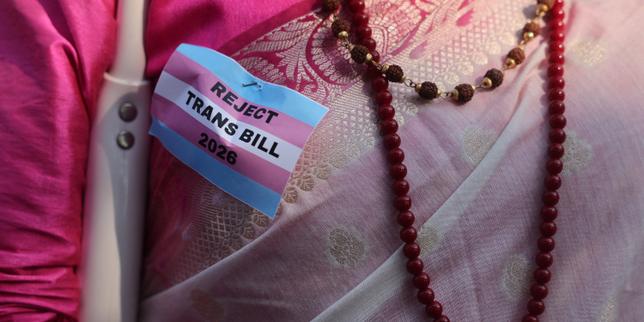
Anjali wakes up every morning in a small room in Mumbai, the air thick with the scent of jasmine incense and the low hum of a city that never sleeps. She looks in the mirror and sees a woman. Her friends see a woman. The community she serves as a social worker sees a woman. But according to a stack of legal documents currently being debated in the highest halls of Indian power, Anjali is a question mark that the state is trying to solve with a red pen.
Identity is often treated as a solid thing, like a mountain or a stone. In reality, for the transgender community in India, identity is a fluid, living breathing experience that is increasingly being boxed in by rigid legislative definitions. The Transgender Persons (Protection of Rights) Act was framed as a victory, a shield against discrimination. Yet, for those living its consequences, it feels more like a cage.
The heart of the friction lies in a single, clinical process: the requirement for a state-issued certificate of identity.
To understand why this matters, consider a hypothetical man named Arjun. Arjun has lived his entire adult life as a man. He has a beard, a deep voice, and a life built on that truth. Under the current legal framework, if Arjun wants the government to recognize him as male, he must first apply for a "transgender" certificate. He cannot simply be. He must be processed. If he later undergoes gender-affirmation surgery and wants his documents to reflect "Male" instead of "Transgender," he must submit proof of that surgery to a District Magistrate.
This is where the narrative of progress hits a wall of bureaucracy.
The law effectively creates a two-tier system of humanity. For the majority of the population, gender is an assumption the state accepts at birth. For the transgender person, gender is a permit that must be applied for, vetted, and signed off on by a government official who may have never met a trans person in their life.
It is a profound violation of the right to self-determination.
Critics and activists point out that this requirement ignores a landmark 2014 Supreme Court judgment—the NALSA verdict—which explicitly stated that the right to self-identify one’s gender is a fundamental part of the right to life and liberty. The court recognized that gender lives in the spirit and the mind, not just in the surgical records of a hospital. By mandating medical or administrative "proof," the new laws walk back a decade of judicial empathy.
Think about the sheer vulnerability of that moment. You are standing in a sterile government office. You are presenting the most intimate parts of your history to a clerk who might be bored, or worse, hostile. You are asking for permission to be the person you already are.
There is a specific kind of exhaustion that comes with having to prove your existence every time you open a bank account, apply for a job, or rent an apartment. When the law narrows the definition of who "counts" as transgender, or adds layers of scrutiny to the process, it doesn't just create paperwork. It creates fear.
In the hijra communities—ancient, traditional social structures in India—this legal shift feels like an erasure of history. For centuries, these communities existed on the fringes, governed by their own rituals and kinship systems. They didn't need a certificate from a magistrate to know who their sisters were. Now, the state is stepping into these sacred spaces with a clipboard, demanding that ancient identities fit into modern, restrictive boxes.
The statistics are often cited to show "reach," but they hide the human cost. Officials might point to thousands of identity cards issued as a sign of success. They don't count the people who stayed home because they were too terrified of the medical examination. They don't count the people who were rejected because their "performance" of gender didn't match a bureaucrat's stereotype.
The real danger of a narrowed definition is that it makes people invisible. If you don't fit the state's specific, clinical criteria for what a transgender person is, you lose access to the very protections the law was supposed to provide. You cannot claim protection against discrimination if the law doesn't recognize you exist. You cannot access healthcare quotas or educational scholarships. You are left in a legal no-man's-land.
Why does the state care so much about the "proof"? Usually, the argument is centered on preventing "misuse." It is a logic built on suspicion. It assumes that people would undergo the immense social, physical, and emotional burden of transitioning just to "game the system."
This suspicion is a heavy weight to carry. It tells a whole segment of the population that their truth is a lie until a doctor says otherwise.
Consider the physical reality of the medical mandate. In many parts of rural India, access to gender-affirming surgery is non-existent. For a trans man or woman living in a village, the law essentially says: You can be yourself, but only if you have the money to travel to a city, the resources to pay for a surgeon, and the physical health to survive the procedure. It turns identity into a luxury.
But the human spirit is notoriously difficult to legislate. In the face of these restrictions, a new generation of activists is rising. They aren't just fighting for better laws; they are fighting for a shift in the national imagination. They are demanding that India sees them not as a "problem to be solved" or a "definition to be narrowed," but as citizens with the inherent right to define their own lives.
The stakes are invisible until they aren't. They are visible when a trans woman is turned away from a hospital because her ID doesn't match her face. They are visible when a trans student drops out of university because they can't face the humiliation of a "gender screening" committee. They are visible in the eyes of Anjali, who still waits for a piece of paper to tell her she is allowed to be the woman she has been since she was a child.
Laws are meant to be the floor we walk on, a stable ground of rights and protections. When those laws are built on shifting definitions and gatekept by suspicion, the ground becomes a trapdoor.
We often talk about the "rule of law" as a cold, objective force. But laws are written by people, and they affect people. When we allow a government to define the boundaries of a person's soul, we lose something fundamental about our collective humanity.
Anjali turns off her light. The jasmine scent still lingers. Tomorrow, she will go to work. She will help others navigate their lives. She will exist, regardless of what the file on the District Magistrate's desk says.
The paper can say whatever it wants. The truth doesn't need a signature to be real, but it does need a society brave enough to stop asking for proof.
Imagine the quiet dignity of a world where a person's word is enough, and where the state's only role in identity is to celebrate it, not to police it. Until that day, the struggle continues in the gap between who people are and who the law permits them to be.