The United States Department of Homeland Security (DHS) operates as the primary gatekeeper for the nation’s $1.1 trillion travel economy, yet its funding mechanism remains susceptible to political brinkmanship that creates immediate, quantifiable disruptions in labor productivity and consumer confidence. When a funding lapse—or "shutdown"—occurs, the DHS does not cease operations; rather, it transitions into a state of "unfunded essentiality." This status forces approximately 85% of its workforce, including Transportation Security Administration (TSA) agents and Customs and Border Protection (CBP) officers, to perform high-stakes security functions without contemporary compensation. The resulting friction is not merely a political headline but a systemic stress test that exposes the thin margins of American logistical infrastructure during peak demand periods like Spring Break.
The Triad of Operational Degradation
The impact of a DHS shutdown on the travel sector is governed by three specific vectors of degradation: labor availability, psychological attrition, and secondary economic signaling.
1. The Labor Availability Bottleneck
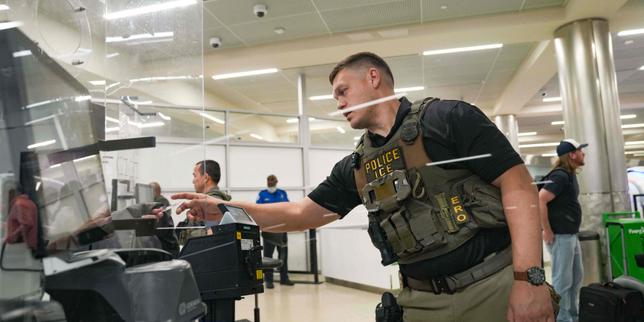
Security screening is a volume-sensitive operation. The TSA manages upwards of 2.5 million passengers daily. Because these employees are living paycheck-to-paycheck—federal data suggests a significant portion of the workforce maintains limited liquid savings—the absence of a timely deposit triggers a spike in "unscheduled absences."
This is not a strike in the traditional sense; it is a pragmatic response to financial insolvency. When an officer cannot afford childcare or fuel to reach their post, the "lane capacity" at major hubs like Hartsfield-Jackson Atlanta (ATL) or Orlando International (MCO) drops. A 10% reduction in available screening staff does not result in a linear 10% increase in wait times; it creates a logarithmic bottleneck. Processing times can jump from 15 minutes to 90 minutes as the system reaches a saturation point where the rate of passenger arrival significantly outpaces the rate of clearance.
2. Psychological Attrition and Vigilance Decrement
Security is a cognitive task. The "Essential Employee" designation requires staff to maintain peak vigilance under high-stress conditions while simultaneously managing personal financial crises. In a structured analysis of human factors, financial stress is a known correlative to cognitive load. When a CBP officer is distracted by the prospect of a missed mortgage payment, the probability of "Type II" errors—missing a prohibited item—increases, or conversely, the "Type I" error rate—false positives—rises as officers over-compensate, further slowing the line.
3. Secondary Economic Signaling
Travelers operate on a risk-mitigation framework. When news cycles dominate with images of three-hour security lines, the "intent to travel" metric for marginal consumers—those planning discretionary Spring Break trips—drops. This creates a "chilling effect" on the hospitality and aviation sectors. Airlines face increased rebooking costs as passengers miss connections due to security delays, while hotels in destination hubs see a spike in last-minute cancellations.
The Cost Function of Border Security Lapses
The Department of Homeland Security is responsible for more than just airport checkpoints; it manages the flow of legal commerce at land ports and maritime entries. A shutdown bifurcates the agency’s mission. While "life and safety" functions continue, "administrative and developmental" functions stall.
- Vetting Backlogs: The processing of H-1B visas, seasonal work permits, and Global Entry applications grinds to a halt. This creates a backlog that persists for months after the funding is restored.
- Infrastructure Stagnation: Procurement for new screening technologies—computed tomography (CT) scanners and biometric gates—is paused. This delays the long-term goal of reducing "friction per passenger."
- Border Management Logistics: CBP resources are diverted from trade facilitation to high-priority enforcement. The delay of a single cargo ship or a line of trucks at the San Ysidro entry point carries a specific hourly cost in lost trade value, often measured in the millions of dollars per day.
Dissecting the Essentiality Paradox
The term "essential" is an administrative classification, but it lacks a corresponding financial guarantee during a shutdown. Under the Anti-Deficiency Act, the government is prohibited from spending money it hasn't been appropriated. This creates a legal theater where the government commands labor but withholds the means of sustaining that labor.
For the travel industry, this paradox manifests as "Systemic Uncertainty." Travel thrives on predictability. Airlines schedule flights months in advance based on a predictable throughput at airports. A shutdown introduces a "variable of volatility" that the private sector cannot hedge against. Unlike weather events, which are transient and localized, a DHS funding lapse is systemic and open-ended.
Quantifying the Spring Break Nexus
Spring Break represents a critical liquidity event for the American travel industry. It is characterized by high-volume, family-oriented travel which is particularly sensitive to delay. Unlike business travelers, who are often solo and agile, family units require more time per passenger at checkpoints.
When the TSA workforce is depleted during this window, the "Mean Time to Clear" (MTTC) becomes the primary metric of failure. If the MTTC exceeds the typical "gate arrival window" (the 45-minute period before boarding), the system enters a state of cascading delays. One late departure from a hub airport like Chicago O'Hare (ORD) can trigger 20-30 subsequent delays across the domestic network as aircraft and crews are displaced.
Strategic Mitigation and Institutional Resilience
The current reliance on "retroactive pay" as a solution for federal employees is an inadequate stabilizer. While employees are eventually made whole, the immediate liquidity crisis causes the damage. For the private sector—airlines, travel agencies, and destination management companies—the strategy shifts from "growth" to "damage control."
Tactical responses include:
- Buffer Inflation: Recommending arrival times of four hours pre-flight, which further congests airport terminals and increases the load on airport facilities.
- Resource Reallocation: Airlines may choose to move staff to "pre-security" check-in areas to assist with crowd management, though they cannot legally assist with the screening process itself.
- Digital Communication Pivots: Real-time updates on security wait times become the most valuable data point in the travel ecosystem, often eclipsing flight status in terms of passenger anxiety.
The recurring nature of these funding lapses suggests that the DHS operational model is decoupled from its political reality. The agency is funded as if its operations are discretionary, yet it is managed as if its failure would be catastrophic. This misalignment ensures that as long as border policy remains a primary point of legislative contention, the American travel economy will remain a hostage to the calendar.
The most probable trajectory for a prolonged shutdown during a peak travel window is a sharp decline in TSA "presenteeism," leading to the closure of entire security checkpoints in secondary airports. This forces a consolidation of traffic into fewer lanes, creating a physical bottleneck that effectively caps the capacity of the U.S. aviation system regardless of how many planes are fueled and ready on the tarmac. To insulate the travel economy, the legislative framework must move toward "automatic stabilizers" or permanent appropriations for frontline security personnel, separating the human labor required for national safety from the broader debates over border policy and immigration reform.
The immediate strategic priority for travelers and industry stakeholders is to treat "funding status" as a primary weather variable—one that requires significant contingency planning, increased arrival buffers, and a shift toward off-peak scheduling to avoid the inevitable saturation of the security infrastructure.