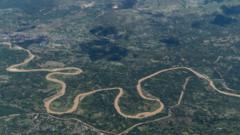
The morning air in the Artibonite Valley usually tastes of damp earth and the sharp, green scent of rice paddies. It is the kind of quiet that feels permanent, a stillness earned by generations of farmers who measure their lives by the tilt of the sun and the temperament of the soil. But last Thursday, the silence didn't break. It shattered.
When the Gran Grif gang descended upon the town of Pont-Sondé in the pre-dawn hours, they didn't just bring bullets. They brought the end of a world.
We often read about Haiti through the lens of statistics—numbers that feel safely distant, like coordinates on a map we will never visit. Sixteen dead. Thousands displaced. A percentage of a territory lost to "instability." These words are sterile. They are bandages applied to a gaping, pulsing wound. To understand what happened in the rural heart of this nation, you have to look past the tally and see the kitchen tables left mid-meal, the abandoned sandals on a dirt road, and the terrifying speed at which a home becomes a memory.
Consider a woman we will call Darlène. She is not a statistic; she is the person who keeps the local market alive with her laughter and her sharp eye for quality grain. At 3:00 AM, she wasn't thinking about geopolitics or the Kenyan-led security mission in Port-au-Prince. She was sleeping. When the first pops of gunfire echoed off the hills, she thought it was a celebration. Then came the screams.
The Gran Grif did not come for a skirmish. They came for a harvest of fear. They moved through the streets with the practiced indifference of predators, setting fire to homes and shooting at anything that moved. Darlène grabbed her youngest son, leaving behind the small wooden box where she kept her life savings, and ran into the darkness. She didn't look back. She couldn't. If she had, she would have seen her neighbor's roof collapsing in a plume of orange sparks, a funeral pyre for a life built one brick at a time.
The Geography of a Collapse
For years, the violence in Haiti was a creature of the capital. Port-au-Prince was the cage, and the gangs were the lions within it. But cages break. The Artibonite Valley is the breadbasket of the country, a vital artery of food and commerce that connects the north to the south. When the gangs move here, they aren't just seizing land. They are seizing the throat of the nation.
The Gran Grif gang, led by a man whose name is whispered more than spoken, has turned this fertile valley into a laboratory of extortion. They control the roads. They tax the harvests. They decide who lives to plant and who dies to serve as an example. This isn't "unrest." It is a feudal nightmare reconstructed in the 21st century.
When sixteen people die in a rural village, the impact is seismic. In a place like Pont-Sondé, everyone knows everyone. A death isn't a data point; it’s the loss of the only midwife within ten miles, or the primary school teacher who knew how to fix the communal water pump. The social fabric doesn’t just tear. It unravels.
Why does this keep happening?
The reality is as cold as the steel of an automatic rifle. The Haitian National Police are outgunned and outnumbered. They are brave men and women holding back a flood with their bare hands. Despite the arrival of international security forces in the capital, the rural corridors remain wide open. The gangs know this. They are opportunistic, moving like water toward the path of least resistance. While the world debates the semantics of "intervention" in air-conditioned rooms, the people of Artibonite are learning the precise sound a burning house makes when the rafters finally give way.
The Long Walk to Nowhere
By noon on Thursday, the road leading away from Pont-Sondé was a river of humanity.
Thousands of people. Walking. Some carried mattresses on their heads, a desperate attempt to bring the comfort of sleep into a future that offered none. Others carried nothing but their children. This is displacement in its rawest form. It is the sudden realization that the ground beneath your feet is no longer yours.
The invisible stakes here are higher than mere territory. When a farmer is driven from their land, the cycle of poverty accelerates. They cannot plant. They cannot harvest. The rice that would have fed a family in Port-au-Prince stays in the ground or is stolen by gunmen. The displacement of thousands is a precursor to a famine that doesn't need a drought to begin. It only needs a rifle.
We see the images of the crowd and we feel a fleeting pang of pity. But pity is a cheap emotion. It requires nothing of us. What we should feel is a profound sense of vertigo. These people were us. They were people with errands to run, dreams of their children graduating, and a favorite spot to sit when the evening breeze kicked up. In the span of four hours, they became refugees in their own country.
The Silence of the Aftermath
The news cycle will move on. It always does. The "sixteen killed" will become a footnote in a quarterly report on Caribbean security. But for the survivors huddled in temporary shelters in Saint-Marc, the story is just beginning.
They are living in the "after."
In the "after," every loud noise is a threat. Every stranger is a scout for the gang. The psychological toll of this violence is a shadow that follows the survivors long after the smoke has cleared. You can rebuild a house. You can even replant a field. But how do you repair a soul that has seen its neighbors hunted like animals?
There is a specific kind of grief that comes with rural violence. It is the grief of lost heritage. The Artibonite is not just land; it is a legacy. It is the soil that fed the revolution that made Haiti the first free Black republic. To see it desecrated by internal predators is a betrayal that cuts deeper than any foreign intervention ever could.
The tragedy in Pont-Sondé isn't just about the lives lost. It is about the terrifying fragility of peace. It is a reminder that without the rule of law, the distance between a thriving community and a scorched-earth wasteland is only the time it takes for a truckload of gunmen to drive down a dirt road.
As the sun sets over the valley now, the shadows are longer than they used to be. The rice paddies reflect a sky that looks the same as it did a week ago, but the air is different. The green scent is gone, replaced by the lingering, acrid ghost of charcoal and cordite. Darlène sits on a borrowed mat miles away, her hand resting on her son’s head. She is alive. That is the victory. But she is looking at her hands, empty and shaking, wondering if the earth she left behind will ever belong to her again, or if the shadows have claimed it for good.