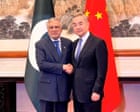
The ink on a diplomatic communique is usually cold before it even dries. It is the language of "reiterated commitments" and "shared perspectives," a dialect designed to say everything and nothing at once. But when the diplomats from Islamabad and Beijing sat across from one another this week, the air in the room didn't feel like a standard bureaucratic exercise. It felt heavy. It felt like a realization that the old ways of managing the Middle East—a cycle of reactive strikes and short-term truces—has finally hit a wall.
They didn't just talk about borders. They talked about a five-part blueprint for a region that has spent decades gasping for air.
Consider a family in Gaza, perhaps sitting in the skeletal remains of a kitchen, or a merchant in a tense neighborhood in East Jerusalem. To them, "geopolitics" is a terrifying, abstract monster that takes the form of falling concrete or sudden checkpoints. They don't care about the nuances of a joint statement. They care about whether the world has a plan that actually includes their survival.
The proposal put forward by Pakistan and China isn't a magic wand, but it is a radical departure from the "wait and see" approach that has defined the last year of escalating violence. It starts with the most basic, visceral human need: the cessation of fire.
The First Breath of Peace
You cannot build a house while the ground is shaking. The core of this new proposal begins with an immediate, unconditional, and permanent ceasefire. This isn't just about stopping bullets; it’s about stopping the psychological erosion of an entire generation. When a ceasefire is "tactical" or "temporary," nobody truly sleeps. Mothers keep one eye open. Children jump at the sound of a car backfiring.
By demanding a permanent halt to the violence, Pakistan and China are signaling that the era of "mowing the grass"—the horrific euphemism for periodic military escalations—must end. They are arguing that the world cannot keep hitting the pause button only to press play on the tragedy a few months later.
But a ceasefire without food is just a slower way to die. That is why the second pillar of their plan moves immediately to the gut. It demands the removal of all barriers to humanitarian aid. We are talking about trucks filled with flour, medicine, and clean water that are currently idling at gates while people starve. The plan insists that the dignity of a human life cannot be used as a bargaining chip in a high-stakes poker game.
The Architecture of a State
If you look at a map of the region today, it looks like a shattered mirror. Pieces of land are disconnected, separated by walls, settlements, and "security corridors" that make the idea of a cohesive nation feel like a fever dream. The third and perhaps most contentious part of the Pakistan-China plan is the unwavering demand for a sovereign Palestinian state.
They aren't just talking about a vague "pathway" to statehood, a phrase that has been used to delay progress for thirty years. They are calling for the 1967 borders, with East Jerusalem as the capital.
Why does this matter to someone living thousands of miles away? Because history shows us that displacement is a wound that never heals on its own. It festers. It creates a vacuum where hope is replaced by something much darker. By advocating for a "Two-State Solution" that actually functions, these two powers are trying to address the "why" behind the "what."
Critics will say this is an old refrain. They will argue that the 1967 borders are a ghost of a reality that no longer exists. But the counter-argument presented here is simple: without a physical space to call home, a people will never stop fighting to find one. The plan treats the Palestinian quest for statehood not as a radical demand, but as a fundamental requirement for global stability.
The Table Where Everyone Sits
For decades, the United States has been the primary architect of Middle Eastern peace. It was the sole gatekeeper, the only one who could bring the parties to the table. That era is over. The fourth pillar of this proposal calls for an international peace conference—one that is larger, more inclusive, and more representative of the modern world.
This is a subtle but sharp critique of the status quo. Pakistan and China are essentially saying that the current mediators have failed to deliver a lasting result. They want the United Nations to take the lead, but with a broader coalition of voices.
Imagine a room where the power isn't concentrated in one or two Western capitals, but distributed among nations that have different stakes in the region’s energy, security, and trade. There is a specific kind of pressure that comes when the "Global South" speaks in unison. It changes the gravity of the conversation. It makes it harder for any one side to ignore the consensus of the majority of the human population.
Breaking the Cycle of Revenge
The final piece of the puzzle is the most difficult to quantify, but perhaps the most essential for a human-centric peace: the rejection of double standards.
There is a growing, bitter resentment across the globe regarding how international law is applied. People see one set of rules for some and a different set for others. They see "war crimes" defined by the identity of the perpetrator rather than the nature of the act. The Pakistan-China plan leans heavily into the idea that international law must be a universal yardstick.
If it is wrong to target civilians in one part of the world, it is wrong in every part. If the occupation of land is illegal in one context, it is illegal in all. This isn't just a legal argument; it’s a moral one. It’s an attempt to restore the world's faith in the very idea of justice.
When people believe the system is rigged, they stop trying to work within it. They look for alternatives. Often, those alternatives involve more violence. By calling for a return to a singular, unbiased application of international law, the proposal is trying to pull the region—and the world—back from the edge of total cynicism.
The Invisible Stakes
Why are Pakistan and China doing this now? Some will call it a power play, an attempt to fill the vacuum left by a distracted West. Others will see it as a strategic move to protect trade routes and economic investments like the Belt and Road Initiative.
The truth is likely a mix of both, but there is a deeper layer. China and Pakistan represent two of the world's most significant cultural and political blocks. Pakistan, as a major voice in the Muslim world, and China, as an emerging global superpower, are forming a bridge that bypassed the traditional Western routes of diplomacy.
Their alliance on this issue reflects a shift in the world's tectonic plates. It’s a recognition that the Middle East’s instability is no longer a localized problem. It is a contagion that affects the global economy, fuels extremism across borders, and forces millions of people into the অনিশ্চয়তা (uncertainty) of migration.
The Cost of Silence
Imagine the alternative.
If this plan, or something like it, isn't adopted, we know exactly what happens next. We have seen the movie before. More headlines. More "unprecedented" numbers of casualties. More children growing up in the shadow of drones.
The dry text of the joint statement between Pakistan and China hides a very simple question: How much more can the human spirit endure before it breaks?
They are proposing a structure. It is a house built on five pillars: a stop to the killing, a way to feed the hungry, a home for the homeless, a table for the unheard, and a single law for everyone.
It is easy to be cynical. It is easy to point to the decades of failed peace talks and say that this, too, will end up in a dusty file cabinet in a basement in New York or Beijing. But look at the faces of the people who have to live through the "geopolitics" every day. Look at the eyes of a father who cannot find milk for his child. For them, a proposal like this isn't a political maneuver. It is a prayer.
The world is watching to see if anyone is actually listening.
The map has been drawn. The lines are clear. Now comes the hard part: finding the courage to walk the path.