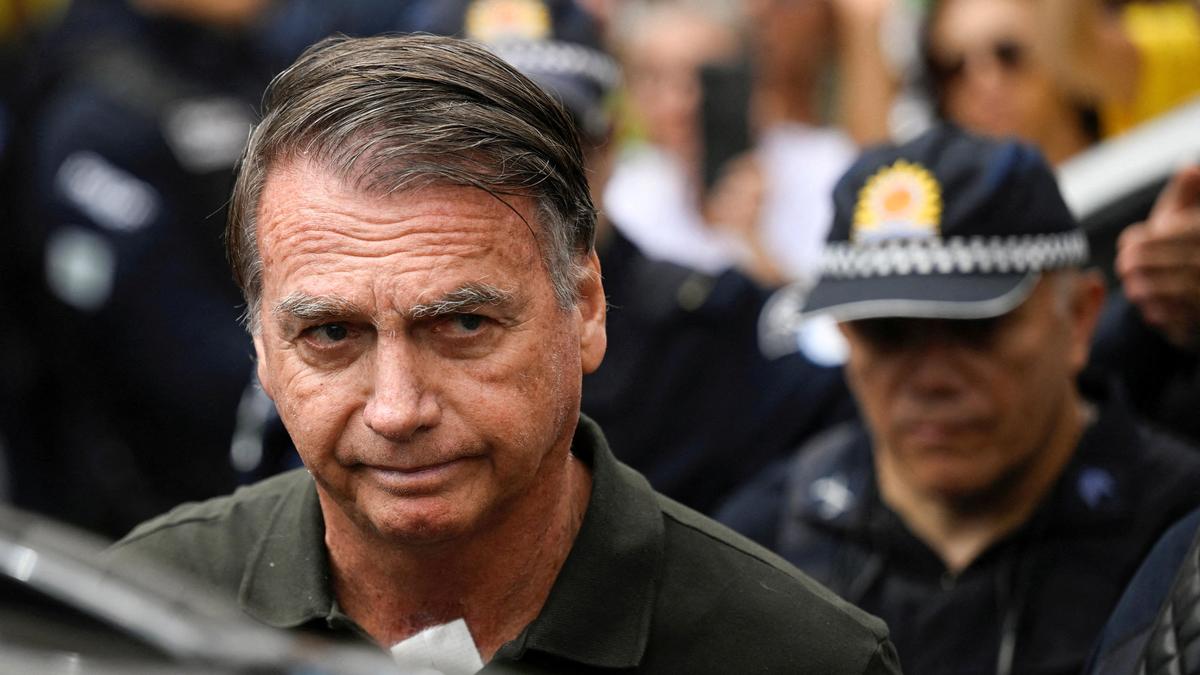
The air in Brasília carries a specific, heavy stillness during the transition between seasons. It is a city of concrete curves and vast, echoing distances, designed to make the individual feel small against the backdrop of the State. For Jair Bolsonaro, a man who once commanded the throngs of millions from the back of a motorbike, that distance has now shrunk to the perimeter of his own property.
A judge’s signature on a piece of parchment changed everything.
It wasn’t a dramatic sentencing in a crowded courtroom with cameras flashing and gavel strikes echoing against marble walls. It was a quiet, clinical assessment of biological reality. The former president of Brazil, a figure who defined himself through a relentless, hyper-masculine energy, has been ordered to serve his sentence at home. The reason is as human as it is mundane: his health is failing.
Imagine the silence of a house that used to be a nerve center. The phones stop ringing with the same frantic urgency. The advisors who once jostled for a moment of his time are now replaced by doctors carrying clipboards. This is the reality of home confinement, a legal mercy extended to those whose bodies can no longer endure the rigors of a standard cell.
Justice is often depicted as a blind goddess holding scales, but in the halls of Brazilian power, she is also a pragmatist. The judge overseeing the case didn't just look at the charges or the political fallout; they looked at a medical file. They saw a man whose history of abdominal surgeries—the lingering legacy of a 2018 assassination attempt—had finally caught up with him.
The law provides for this. It is a provision meant to ensure that a sentence does not become a death penalty by negligence. But for a political titan, the walls of a villa can feel narrower than the bars of a penitentiary. In a cell, you are a martyr. At home, you are a patient.
The Ninety Day Clock
There is a ticking sound in the background of this story. It isn't a bomb, but a calendar. The judge’s order isn't a permanent reprieve; it is a ninety-day window. Three months to stabilize, to recover, and to prove that the "ill health" cited in the legal brief is a persistent reality rather than a temporary shield.
Consider the psychological weight of that deadline. Every morning, the sun rises over the cerrado, and another day is crossed off. For the supporters who still gather at the gates, he remains a symbol of a movement. For his detractors, this is a maneuver to avoid the cold reality of accountability. But for the man inside, it is a period of suspended animation.
Medical reports are the new political manifestos. The specifics of his condition—intestinal obstructions, the inability to process food properly, the chronic pain—are no longer private struggles. They are matters of public record and judicial scrutiny. When your physical well-being becomes the primary argument for your freedom, your body is no longer your own. It belongs to the court.
The Invisible Stakes of a Medical Sentence
We often talk about the law in terms of "guilty" or "not guilty," but there is a vast, gray middle ground where the human condition intersects with the penal code.
Home arrest sounds like a luxury to someone working a double shift to pay rent. It sounds like a "get out of jail free" card. Yet, there is a specific type of erosion that happens when your home—the place of your greatest comfort—becomes your mandated cage. You are surrounded by your own things, your own memories, and your own family, but you cannot step past the driveway. The threshold becomes a cliff.
The stakes here extend far beyond one man. This case sets a precedent for how Brazil handles its former leaders. It asks a fundamental question: Does the state’s need for retribution outweigh its commitment to basic humanitarian standards?
If a man is too sick to be in a cell, is he too sick to be a threat? Or is the "threat" of a political leader found in their voice and their influence, both of which can travel through a Wi-Fi signal just as easily as they can from a podium?
The judge is essentially performing a high-stakes balancing act. On one side of the scale is the rule of law and the necessity of serving a sentence. On the other is the risk of a high-profile inmate dying in state custody, an event that could ignite a country already simmering with polarization.
The Geography of Power and Pain
Brasília was built to be a utopia of order. Its "Pilot Plan" layout resembles an airplane, symbolizing progress taking flight. But for Bolsonaro, the flight has been grounded.
History has a strange way of looping back on itself. The very system he often criticized, the judiciary he frequently clashed with, is now the system providing him with a reprieve based on the vulnerability of his own flesh. There is a deep, quiet irony in seeking protection from the institutions you once promised to dismantle.
The next three months will not be spent in legislative battles or on the campaign trail. They will be spent in the quiet rhythm of a convalescent.
- The morning vitals check.
- The restricted diet.
- The legal briefings.
- The wait.
The 90-day review looms like a shadow. When that clock hits zero, another judge will look at another set of medical charts. They will ask if the "ill health" has improved. They will decide if the transition back to a standard facility is feasible.
In the theater of global politics, we are used to the grand gestures. We look for the coups, the elections, and the massive protests. But sometimes, the most significant shifts happen in a quiet room, with the soft beep of a medical monitor and the scratching of a pen on a legal stay.
The man who once claimed he was "indestructible" is now officially, legally, fragile.
As the sun sets over the Planalto Central, the lights flicker on inside the residence. To the world, it is a fortress of a former president. To the law, it is a ward. And to the man sitting inside, watching the minutes of his ninety days slip away, it is the only world that is left.
The concrete curves of the city remain indifferent. They have seen leaders rise and fall, seen them shout from balconies and seen them retreat into the shadows. The state endures. The body, however, eventually breaks.