A mother in Isfahan adjusts the blue patterned rug in her living room, her fingers tracing the same silk threads her grandmother once spun. Outside, the air doesn’t carry the scent of spices or the cooling rain from the Zagros Mountains. It carries the vibration of a distant, mechanical hum. It is the sound of a world waiting for a match to drop.
We often talk about geopolitics as if it were a game of chess played on a polished board. We use cold terms like "strategic depth," "proxies," and "surgical strikes." But for the people living in the crosshairs of the Middle East’s most volatile rivalry, those words are empty. They are replaced by the heavy, physical reality of uncertainty. When Israel and Iran exchange threats, the price isn't paid in political capital. It is paid in the shuttered dreams of a generation that just wants to drink tea in a garden without looking at the sky in fear.
The current cycle of escalation between Jerusalem and Tehran has reached a point where the old rules of "shadow war" no longer apply. The shadows have vanished. The sun is out, and it is scorching everything in sight.
The Weight of a Phone Call
In Washington, a phone rings. It’s a transition of power unlike any other. Donald Trump returns to an Oval Office that looks out onto a world far more fractured than the one he left. He inherits a Middle East where the "Abraham Accords" were supposed to be the blueprint for a new, integrated era of trade and travel. Instead, that blueprint is singed at the edges.
The math is simple, even if the history is not. If the United States allows the current friction between Israel and Iran to ignite into a full-scale regional war, the "America First" agenda dies on the vine. You cannot rebuild a domestic economy while being sucked into a vacuum of trillion-dollar munitions and soaring oil prices.
Imagine a young entrepreneur in Tel Aviv. She has spent three years building a tech startup that uses AI to optimize water usage in desert climates. Her biggest market should be her neighbors. But today, her lead engineer is being called up for reserve duty. The venture capital is freezing. The "Startup Nation" cannot thrive in a bunker.
Peace is not a moral luxury. It is a biological necessity for a functioning society.
The Mirage of the Final Blow
There is a persistent, dangerous myth that one more strike, one more perfectly aimed missile, or one more cyberattack will finally "settle the score." It is the gambler’s fallacy applied to human lives.
Israel views Iran’s nuclear ambitions as an existential threat—a wall that cannot be allowed to stand. Iran views Israel as an illegitimate extension of Western power—a thorn that must be removed. These are not just political disagreements; they are deeply ingrained narratives of survival.
But consider the reality of a modern strike on Iranian soil. We aren't talking about a desert outpost. We are talking about hitting the infrastructure of a nation of 85 million people. When power grids fail, hospitals go dark. When refineries burn, the global economy shudders. The "surgical strike" is a medical metaphor used to sanitize the messy, bloody reality of kinetic warfare. There is no surgery that doesn't leave a scar, and in this part of the world, scars tend to itch for centuries.
The logic of the Trump administration’s previous "maximum pressure" campaign was to starve the Iranian regime into submission. It succeeded in hurting the Iranian people. It did not, however, stop the centrifuges from spinning. In fact, it accelerated them.
Pressure without a release valve creates an explosion.
The Silent Architects of the Middle Class
If you walk through the Grand Bazaar in Tehran, you don’t hear people chanting for war. You hear them haggling over the price of eggs. You hear them worrying about the value of the Rial. The greatest threat to any regime isn't a foreign bomber; it's a father who cannot feed his children.
By urging Israel to exercise restraint and simultaneously opening a credible, even if difficult, channel of communication with Tehran, the U.S. doesn't "lose." It wins the only thing that matters: stability.
Stability is the silent architect of the middle class. It allows a student in Shiraz to study medicine instead of ballistics. It allows a family in Haifa to plan a vacation instead of a displacement strategy.
The invisible stakes of this conflict are the millions of "ordinary" lives currently held hostage by the egos of men in high-ceilinged rooms.
The Cost of the Corridor
The Middle East is the world’s most important hallway. It connects the manufacturing hubs of Asia with the consumers of Europe. When that hallway is filled with smoke, everyone pays.
We see it in the shipping lanes of the Red Sea. We see it in the insurance premiums for cargo vessels. Every time a drone is launched, a family in a suburb of Chicago pays five cents more for a gallon of gas. Every time a cyberattack hits a port, a factory in Germany slows down.
The conflict is no longer contained. It is a digital and economic contagion.
The argument for Trump to step in and demand a "stand down" isn't about being "soft" on Iran. It’s about being hard-headed about American interests. The United States has spent twenty years trying to pivot to Asia, yet it keeps getting tripped up by the same patch of desert. The only way to move forward is to stop the bleeding.
A Different Kind of Strength
Strength is often mistaken for the willingness to pull a trigger. In reality, the greatest display of strength is the ability to hold a hand back.
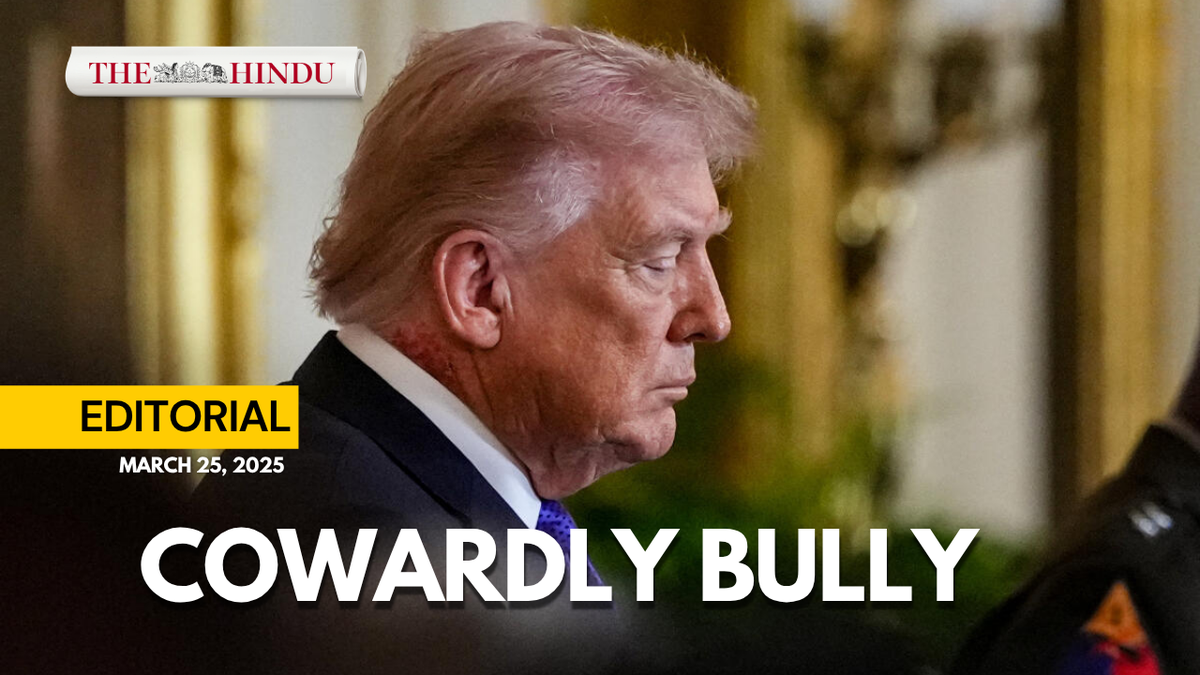
The Hindu Editorial rightly suggests that the cycle must end. But it ends not with a treaty signed on a lawn—those are for the cameras. It ends when the risk of war becomes more expensive than the pride of the leaders.
We are currently at that tipping point.
The Iranian leadership knows that a direct war with Israel, backed by U.S. might, would be the end of their era. The Israeli leadership knows that even a "successful" strike on Iran would invite a rain of fire from Hezbollah that would level their cities.
Both sides are standing on a cliff, looking down, and realizing the ground is crumbling.
The Garden and the Sky
There is an old Persian proverb: "A stone thrown at the right time is better than gold given at the wrong time."
Right now, the "stone" isn't a weapon. It is a clear, unambiguous signal from Washington that the era of blank checks for escalation is over. It is the realization that the security of Israel cannot be bought with the perpetual destabilization of Iran, and the sovereignty of Iran cannot be maintained through the constant threat of proxy violence.
The mother in Isfahan finishes smoothing the rug. She stands up and looks out the window. For a moment, the hum of the world seems to fade, replaced by the sound of her son laughing in the next room. He is building something with blocks, unaware that he lives in the most dangerous geography on Earth.
His future depends on whether the men in power decide that his laughter is worth more than their revenge.
The sun sets over the Zagros, casting long, purple shadows across the plains. Tomorrow, the sky might be clear. Or it might be filled with the streaks of falling stars that aren't stars at all. The choice isn't written in the stars; it’s written in the ink of a pen that has yet to touch the paper in the Oval Office.
One stroke of that pen can silence the drones. One word can turn the mechanical hum back into the rustle of leaves in a garden.
The world is holding its breath. It is time to let it out.