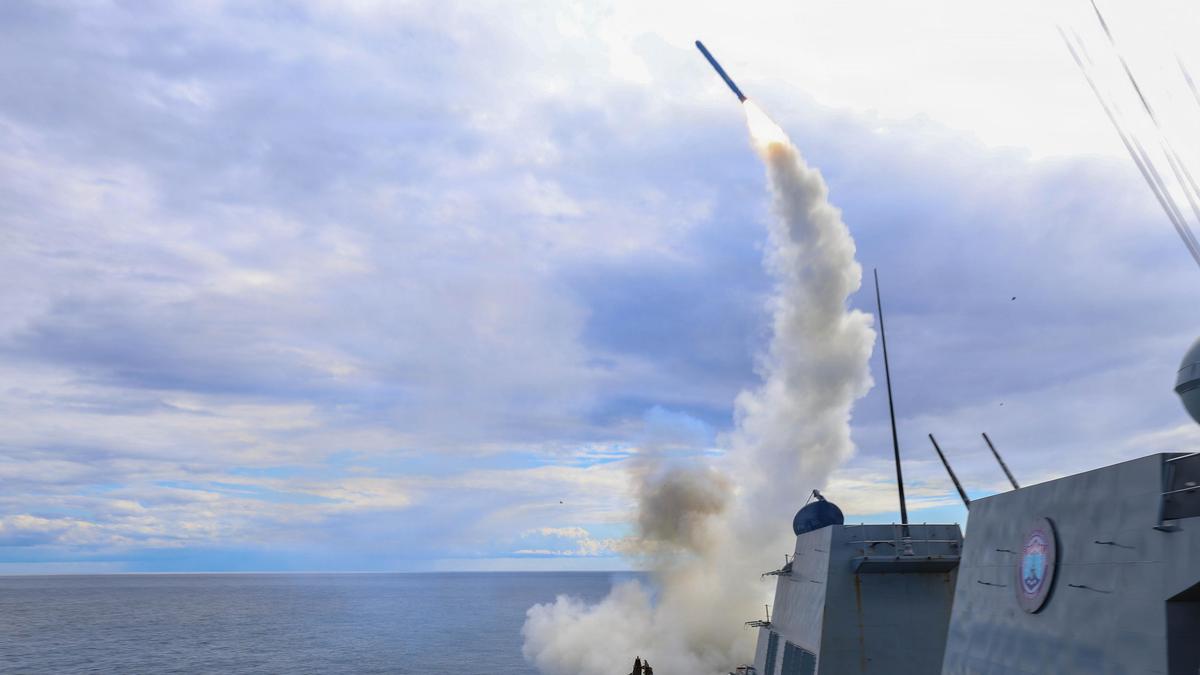
The Middle East has crossed a threshold from which there is no quiet return. While state media across the region scramble to tally missile counts and intercept rates, the true story isn’t found in the flash of explosions over Amman or Kuwait City. It is found in the total collapse of the "shadow war" era. For decades, Iran and Israel operated within a violent but predictable set of rules. They used proxies, cyberattacks, and targeted assassinations to hurt each other without triggering a regional conflagration. Those rules are now dead.
The reported firing of ballistic missiles toward Israel—tracking across the sovereign airspace of Jordan, Kuwait, and Bahrain—marks a fundamental shift in Tehran’s risk calculus. This is no longer about symbolic retaliation. It is a calculated gamble to test the limits of the American-led regional defense architecture. When missiles fly over Gulf cooperation partners like Kuwait and Bahrain, the message isn't just for Jerusalem. It is a warning to every Arab capital that hosts a U.S. base or maintains a quiet intelligence channel with the Mossad.
The Geography of a Widening Fire
Military analysts often focus on the technical specs of the Fattah or Shahab missiles, but the geography of this specific strike tells a more damning story. By utilizing flight paths that transit through Kuwaiti and Jordanian airspace, Iran is forcing these nations into an impossible choice. They must either intercept the projectiles and risk being labeled "Zionist defenders" by their internal populations, or allow their sovereignty to be ignored, effectively turning their skies into a highway for Iranian ordnance.
Jordan, in particular, finds itself in a vice. The monarchy depends on U.S. security guarantees but governs a population deeply sympathetic to the Palestinian cause. Every Iranian drone shot down by a Jordanian F-16 is a political liability for Amman. Tehran knows this. By saturating the skies over multiple neighbors simultaneously, the Islamic Revolutionary Guard Corps (IRGC) is attempting to shatter the "Middle East Air Defense" (MEAD) alliance before it can fully mature.
In Kuwait and Bahrain, the stakes are different but equally high. These are small states with massive U.S. military footprints. If a missile intended for an Israeli airbase falls short or is intercepted over a residential district in Kuwait City, the resulting chaos serves Iran’s narrative: that U.S. protection brings only danger, not security. This is psychological warfare disguised as a kinetic strike.
The Logistics of the Long Range Strike
Launching missiles at this scale requires a logistical feat that goes beyond pushing a button. We are seeing the culmination of years of decentralized launch site construction. Iran has moved away from large, vulnerable missile silos in favor of "missile cities" buried deep in the Zagros Mountains and mobile transporter-erector-launchers (TELs) that are nearly impossible to track via satellite in real-time.
The technical reality is that no missile defense system is perfect. Even the most advanced multi-tiered arrays—Arrow 3 for long-range, David’s Sling for medium, and the Iron Dome for short-range—can be overwhelmed by sheer volume. If you fire 200 projectiles, and only 10% get through, the mission is often considered a success by the aggressor if those 10% hit high-value targets like the Nevatim Airbase or intelligence hubs in the Galilee.
The "how" of this attack also involves a sophisticated coordination with the "Axis of Resistance." While the IRGC fires from Iranian soil, synchronized launches from militias in Iraq and Yemen force the Israeli radar systems to track threats from 360 degrees. This "circular threat" forces the defense systems to prioritize targets, creating tiny windows of vulnerability that a supersonic missile can exploit.
Why the Deterrence Model Failed
For years, the West believed that economic sanctions and the threat of massive Israeli retaliation would keep Iran in its box. That theory has been proven wrong. The Iranian leadership appears to have reached a conclusion that the status quo—where their commanders are picked off in Damascus and their nuclear facilities are sabotaged from within—is more dangerous than an open war.
They are betting that the United States has no appetite for another Middle Eastern ground war in an election cycle. By striking directly, Iran is calling a bluff. They are banking on the idea that Israel’s allies will eventually pressure Jerusalem to "take the win" of successful interceptions and refrain from a counter-strike that could ignite the oil fields of the Persian Gulf.
However, this ignores the internal pressure within Israel. No sovereign nation can allow a rain of ballistic missiles to become a routine occurrence. The "war between wars" has ended because the friction has become too high to contain. We are now in a period of "open-front" conflict where the distance between Tehran and Tel Aviv has effectively shrunk to zero.
The Economic Aftershocks
The immediate reaction to the reports from Kuwaiti and Jordanian state TV was felt in the global markets, but the long-term implications are grimmer. If the Strait of Hormuz becomes a combat zone, the global energy supply chain doesn't just bend; it breaks. Unlike previous skirmishes, this escalation involves the very territories that serve as the world's gas station.
Investors have long priced in "regional instability," but they haven't priced in a total war between the region's two most capable militaries. The insurance premiums for tankers in the Gulf have already begun to skyrocket. This serves Iran's goal of making the cost of supporting Israel too high for the international community to bear. It is a strategy of maximum pain, applied through both explosives and economics.
The Intelligence Failure of De-escalation
Western diplomats have spent the last eighteen months chasing the ghost of a "grand bargain" or a renewed nuclear understanding. This pursuit was based on the flawed premise that the Iranian regime prioritizes economic reintegration over its ideological commitment to regional hegemony. The smoke over the Levant today is proof that the IRGC, not the diplomats in Tehran, is holding the steering wheel.
By ignoring the warning signs—the increasing sophistication of drone transfers to Russia, the hardening of the Lebanese front, and the brazenness of Houthi attacks in the Red Sea—the international community allowed a vacuum to form. Iran filled it. They didn't just build better missiles; they built a better geopolitical shield by embedding their assets so deeply into the fabric of neighboring states that removing them requires a surgical precision that few believe is possible.
The reported involvement of Bahrain and Jordan as transit points for these missiles also highlights the fragility of the Abraham Accords. If these peace treaties cannot provide a security umbrella during a hot war, their value as a long-term stabilizing force is called into question. The Arab street is watching, and the Iranian leadership knows that every explosion is a televised event designed to radicalize the next generation.
The Technical Reality of Interception
Interdicting a ballistic missile is not like shooting a bird with a shotgun. It is like hitting a bullet with another bullet while both are traveling at several times the speed of sound. The data coming out of Jordan and Kuwait suggests a high volume of debris, which indicates successful mid-air kills but also poses a massive risk to civilians on the ground. A falling booster or a neutralized warhead still carries enough kinetic energy to level a city block.
Israel’s reliance on the United States for interceptor replenishment is the hidden clock in this conflict. The Iron Dome and Arrow systems use specialized, expensive missiles that cannot be manufactured overnight. If Iran can sustain a high-volume launch cadence for weeks rather than days, the "shield" begins to thin. This is a war of attrition played out in the stratosphere.
The reports of missiles over Kuwait are particularly jarring because they suggest a flight path intended to bypass the dense radar clusters in the northern Saudi desert. It shows an Iranian command that is studying the holes in the regional net and adjusting their telemetry in real-time. This is a learning adversary, not a desperate one.
The End of Ambiguity
We are now entering a phase where the "unattributed" strike is a thing of the past. When Iran fires from its own territory, it is claiming its status as a regional superpower. It is telling the world that it no longer fears the consequences of direct confrontation. This is a psychological shift that cannot be undone with a ceasefire or a new round of sanctions.
The reality on the ground is that the map of the Middle East has been redrawn by the arc of these missiles. The borders of Jordan, Kuwait, and Bahrain have been treated as mere waypoints in a larger struggle. This disregard for national boundaries by a major power is a signal that the Westphalian order in the region is essentially extinct.
Israel now faces a choice between a retaliatory strike that satisfies the need for deterrence and a strategic patience that keeps its alliances intact. But patience is a hard sell when the sirens are wailing in every major city. The era of the shadow war is over, and what follows will be dictated not by the words of diplomats, but by the readiness of the batteries and the resolve of the men who command them.
The next seventy-two hours will determine if this is a singular event or the opening salvo of a decade-long conflict that will reshape the global order. The missiles have been fired, the red lines have been erased, and the world is now watching the trajectory of a fire that no one seems able to put out.