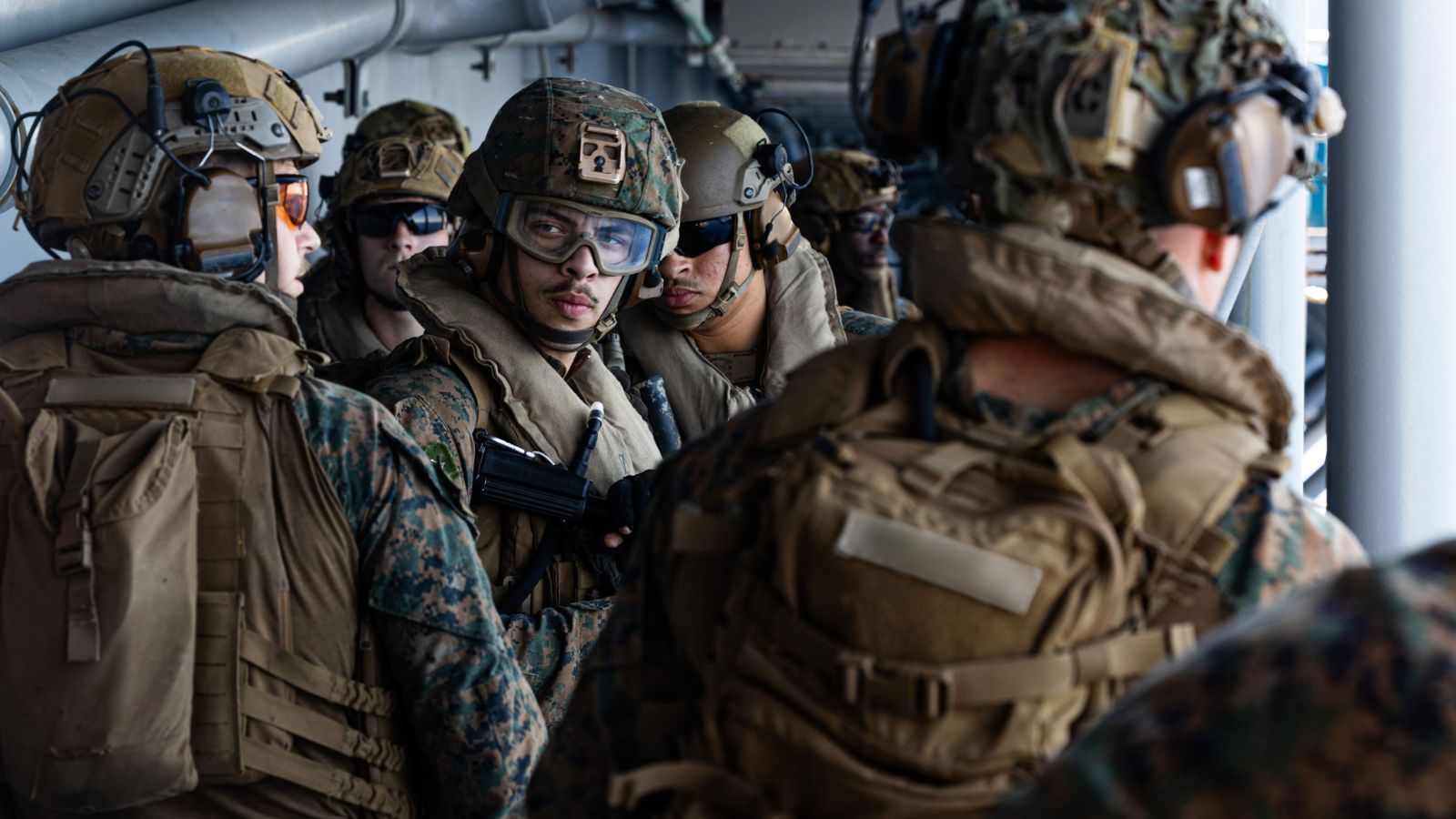
The metal floor of a C-17 Globemaster III has a specific temperature. It is never quite warm, even in the blistering humidity of a staging base, and it is never truly silent. It hums with the vibration of four Pratt & Whitney engines, a low-frequency growl that settles into the marrow of your bones and stays there long after you’ve unbuckled. For the 3,500 Marines currently moving toward the jagged coastlines and high deserts of West Asia, that hum is the soundtrack to a life put on indefinite hold.
We often talk about military deployments in the language of chess. We use words like "assets," "posture," and "deterrence." But the Pentagon’s recent decision to move a Marine Expeditionary Unit into striking distance of Iran isn't a game of wooden pieces on a board. It is a massive, logistical heave of human lives, specialized steel, and the terrifying precision of modern kinetic warfare.
When 3,500 people move, the world tilts.
Each one of those individuals carries a sea bag stuffed with Kevlar, extra socks, and the heavy, invisible weight of a family's anxiety. They are heading into a region where the air is thick with the scent of diesel and ancient dust, tasked with preparing for "weeks of ground operations." That phrase, tucked neatly into a Department of Defense press release, is a polite way of saying the world is holding its breath.
The Anatomy of an Arrival
To understand what is happening right now, you have to look past the maps. Look instead at the deck of an amphibious assault ship. These vessels are floating cities, jagged and gray, designed to project power where there is no runway. They are currently carrying the tools of a very specific, very modern brand of chaos.
There are the F-35B Lightning II jets, capable of hovering like ghosts before screaming into supersonic flight. There are the MV-22 Ospreys, those strange, tilt-rotor hybrids that look like something out of a fever dream, designed to drop squads of infantry into places where the doors don't have locks. This isn't a peacekeeping mission. This is a "forcible entry" capability. It exists to kick down doors that have been bolted shut by decades of geopolitical friction.
The Pentagon doesn't move this many boots unless the math has already been done. The calculations are cold. They involve fuel consumption rates, casualty projections, and the harrowing speed of Iranian drone swarms. For the planners in Arlington, this is a matter of "scaling response." For a young corporal from Ohio staring at the sunset over the Gulf of Oman, it’s a matter of wondering if the letters he wrote will be the last ones his mother reads.
The Invisible Stakes
Why now? The standard answer involves regional stability and the protection of shipping lanes. But the real story is written in the silence of the diplomatic backchannels that have finally gone cold.
Imagine a hypothetical scenario: a single miscalculation in the Strait of Hormuz. A fast-attack boat gets too close to a destroyer. A drone operator, tired after a twenty-hour shift, misidentifies a signal. In the span of twelve minutes, the global economy could shudder. Oil prices would spike, not by cents, but by dollars, overnight. The "weeks of ground operations" the Pentagon is preparing for are the contingency plan for that twelve-minute window.
We live in an era where war is often fought through screens—cyberattacks on infrastructure, disinformation campaigns on social media, the sterile hum of a predator drone three miles up. But ground operations are different. Ground operations are visceral. They are about holding territory. They are about the grit in a rifle's chamber and the agonizingly slow process of moving through a landscape that doesn't want you there.
The Iranian terrain is not the flat sand of popular imagination. It is a fortress of mountains and urban density. To prepare for operations there is to prepare for a type of conflict that the West hasn't truly seen in decades. It is a high-stakes gamble that the mere presence of these 3,500 Marines will be enough to keep the guns silent.
The Human Cost of Deterrence
There is a psychological toll to being the "deterrent." It is the exhaustion of being a tripwire.
Consider a hypothetical sergeant, let's call him Elias. Elias has two kids and a mortgage in North Carolina. He is currently sitting on a cot, cleaning a weapon he hopes he never has to fire. He knows the statistics. He knows that Iran possesses one of the largest missile reservoirs in the Middle East. He knows that his presence is a message, but he also knows that if the message fails, he is the one who pays the bill.
The tension in West Asia isn't just about borders or nuclear enrichment. It is about the friction between an old world of territorial dominance and a new world of asymmetric technological threats. Iran has mastered the art of the "grey zone"—actions that fall just short of open war but keep the nerves of the international community frayed. By deploying these Marines, the United States is attempting to draw a hard line in that grey fog.
But lines drawn in the sand are easily blurred.
The Engineering of a Conflict
The technical prowess on display during this deployment is staggering. We are seeing the integration of "net-centric" warfare, where every Marine is a sensor, feeding data back to a command structure that sees the battlefield in real-time infrared. It’s a marvel of human ingenuity. We have built machines that can see through walls and hit a target the size of a dinner plate from a hundred miles away.
Yet, all that technology still relies on the 3,500. It relies on their discipline, their restraint, and their ability to endure the crushing heat of a desert summer while wearing sixty pounds of gear.
The Pentagon is currently stockpiling more than just munitions. They are moving medical supplies, water purification systems, and the vast, clanking machinery of sustainment. You don't prepare for "weeks" of operations if you expect a quick resolution. You prepare for a grind. You prepare for the reality that once the first foot touches the shore, the narrative is no longer in your control.
The Echoes of History
We have been here before, or somewhere very much like it. The history of the 21st century is a series of "temporary" deployments that turned into permanent scars. The anxiety felt by the international community isn't just about the potential for a new war; it’s about the exhaustion of the old ones.
The 3,500 Marines are now part of a long lineage of men and women sent to the edges of the map to hold a flame against the dark. They are the physical manifestation of a foreign policy that has run out of words. When the talking stops, the transport planes start landing.
There is a terrifying beauty in the precision of a military deployment of this scale. The way the ships align, the way the logistics chains snap into place, the way the chain of command hums with singular purpose. It is the pinnacle of human organization. And yet, it serves a purpose that is fundamentally destructive.
As the sun sets over the Persian Gulf, the 3,500 are waiting. They are watching the horizon for the flicker of a missile or the silhouette of a drone. They are the living barrier between a fragile peace and a catastrophic escalation.
They are there because we haven't found a better way to talk to each other.
In the belly of the ships, the Marines check their gear one more time. They tighten straps. They check the seals on their masks. They wait for a signal that may never come, or may come before dawn. In the silence of the waiting, the only thing they can hear is the steady, rhythmic beat of their own hearts, 3,500 individual pulses, all beating in the shadow of a mountain they are being asked to climb.
The hum of the engines continues, a low, constant vibration that reminds everyone involved that once the machinery of war is set in motion, stopping it requires a miracle of will that history rarely provides.