The Sound of a Dying Radio
The static isn’t the scary part. It’s the rhythm. When you are 250 miles above the crust of the Earth, hurtling through a vacuum at 17,500 miles per hour, your life is a series of choreographed sounds. The hum of the carbon dioxide scrubbers. The mechanical whine of the cooling pumps. The constant, crackling reassurance of Mission Control in your ear.
But for NASA astronaut Mark Vande Hei, the sounds started to fail. Not the station’s systems. His own.
We often imagine space as a frontier of physical endurance—G-force crushing your chest, radiation invisible and piercing, the sheer athletic grit required to move a pressurized suit. We rarely talk about the fragility of the human operating system. We don't talk about what happens when the bravest among us, the peak of human biological engineering, simply breaks.
Vande Hei was supposed to be the marathon man of the stars. In 2021, he embarked on what would become a record-breaking 355-day mission. Yet, the story that eventually leaked out wasn't one of triumph, but of a terrifying, internal collapse. A medical emergency in the most isolated ICU in the universe.
The Body’s Rebellion
Imagine your brain as a high-performance computer. Now imagine someone starts unplugging the wires while the processor is still running.
Halfway through his mission, Vande Hei began to experience a neurological "brownout." It wasn't a sudden stroke or a dramatic injury. It was a creeping, insidious fog. He describes a moment where the connection between thought and speech simply severed. He knew the words. He could see them in his mind. But his mouth refused to form them.
Silence.
In a cockpit where communication is the difference between life and a cold, orbital death, losing your voice is the ultimate nightmare. This wasn't just "space sickness." This was a systemic failure of the human machine under the stress of prolonged microgravity and isolation.
The medical community calls it "neuro-ocular syndrome" or simply "space adaptation," but those are sterile terms for a visceral horror. When you are in orbit, your fluids shift. They pool in your head. Your brain sits in a different position in your skull. Your eyes change shape. For Vande Hei, the pressure wasn't just physical; it was cognitive.
The mission was cut short. Not because a bolt sheared off the hull, but because the man inside was fading.
The Myth of the Iron Man
We have spent decades culturing a specific image of the astronaut: the steely-eyed missile man. From the Mercury 7 to the Artemis generation, the branding is the same. They are unflappable. They are perfect.
This mythology is dangerous.
When Vande Hei returned to Earth and eventually spoke about his inability to communicate, he cracked the visor on a truth NASA rarely likes to broadcast. Space is fundamentally toxic to the human spirit and the human nervous system. We are creatures of gravity, of dirt, and of social feedback loops. Remove those, and the "Iron Man" starts to rust.
Consider the psychological tax of knowing that a single mistake in a checklist—a checklist you can no longer read because your vision is blurring and your brain is stuttering—could kill your entire crew. That is a weight no gym can prepare you for.
The competitor reports on this as a "mission update." A dry recount of a medical evacuation. But the real story is the vulnerability. It is the image of a man who conquered the stars only to be trapped inside a mind that wouldn't speak back to him.
The Invisible Stakes of the Red Planet
Why does a single astronaut’s struggle with speech matter to the rest of us? Because we are currently building the ships for Mars.
If a trip to the International Space Station—a mere stone’s throw in cosmic terms—can cause a seasoned veteran to lose his facility for language, what does a three-year round trip to the Red Planet do? There is no "abort mission" on the way to Mars. There is no quick descent to a Kazakhstan landing strip and a waiting medical team.
Vande Hei’s silence is a warning light on the dashboard of human ambition. It tells us that our technology has outpaced our biology. We can build engines that run for years, but we haven't yet figured out how to keep a human brain from misfiring under the pressure of the infinite.
The facts are stark:
- Over 70% of astronauts experience some form of visual or neurological impairment.
- Microgravity causes the brain to "rewire" itself, often in ways we don't fully understand until they return to Earth.
- Communication delays on deep-space missions mean that if an astronaut "glitches" like Vande Hei did, help is twenty minutes away at the speed of light.
We are sending delicate instruments of flesh and bone into a furnace of radiation and emptiness.
The Loneliness of the Return
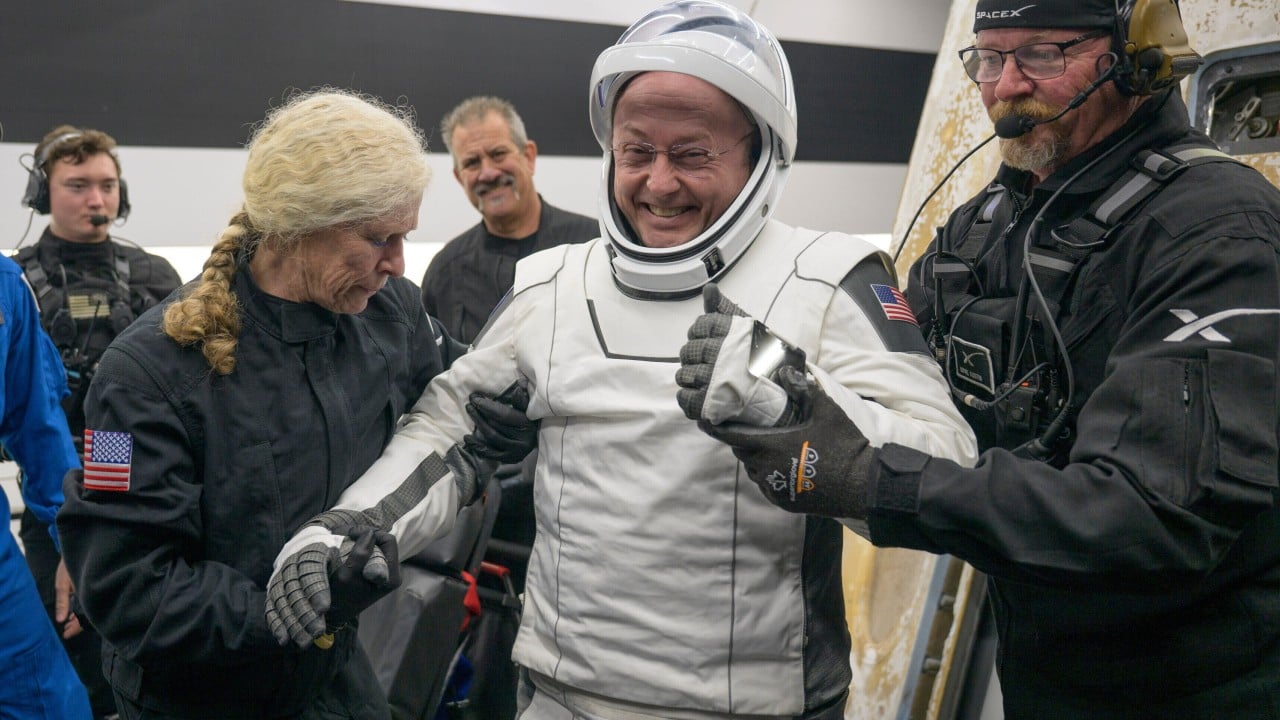
When Vande Hei finally touched down, the world saw the photos of the capsule charred by reentry. They saw the thumbs-up. They saw the record-breaker.
They didn't see the months of speech therapy. They didn't see the frustration of a genius-level pilot struggling to narrate his own day. They didn't see the man grappling with the fact that he had been "broken" by the dream he spent his life chasing.
There is a specific kind of grief in losing a part of yourself to your ambition. Vande Hei’s recovery is a testament to human resilience, but the scars are a reminder that the stars demand a tithe. We pay in bone density. We pay in vision. We pay in the very neurons that allow us to say, "I'm okay."
The real miracle isn't that we go to space. It's that we come back and try to find the words to describe it, even when the words have been shaken loose.
He sits in a room now, breathing thick, heavy Earth air. He speaks clearly. He tells his story. But every time he pauses to find a word, there is a ghost of that orbital silence lurking in the gap. He knows how thin the thread is. He knows that up there, in the black, the most complex machine in the universe is the one we understand the least.
The hatch closes. The countdown begins. We look at the fire and the steel, but we should be looking at the eyes behind the glass. They are the only part of the ship that can’t be replaced.