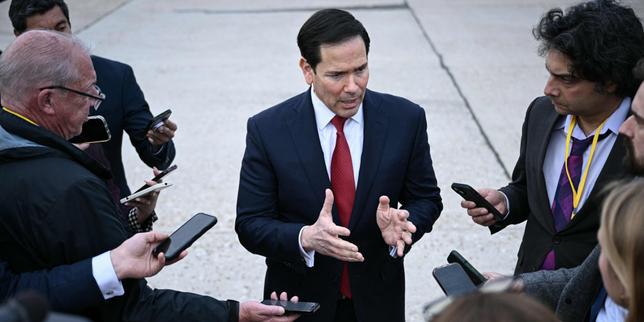
The tension between the Trump administration’s State Department, led by Marco Rubio, and the Ukrainian presidency represents a fundamental breakdown in the "Security Credibility Function." When a guarantor state—in this case, the United States—publicly accuses its client state of misrepresenting the nature of security assurances, the resulting friction increases the cost of any future peace settlement. This is not merely a diplomatic spat; it is a structural realignment of how security guarantees are priced in the international system.
The Triad of Deterrence Failure
To understand why the Rubio-Zelensky friction is occurring, one must decompose security guarantees into three operational pillars: Capability, Intent, and Communication.
- Capability: The physical ability of the United States to project power or supply materiel.
- Intent: The political will of the administration to trigger those capabilities in the event of a breach.
- Communication: The shared understanding between the guarantor and the recipient regarding what specifically triggers a response.
The current conflict stems from a total divergence in the Communication pillar. Zelensky’s administration has consistently messaged that anything short of NATO Article 5—or a bilateral equivalent with "automaticity"—is insufficient. Rubio’s accusation that Zelensky is "lying" suggests the U.S. is moving toward a model of "Conditional Support," where the guarantor retains the right to opt-out based on real-time national interests.
The Misalignment of Security Definitions
The fundamental disagreement revolves around the definition of a "guarantee." In high-stakes geopolitics, there is a binary distinction between Negative Security Assurances and Positive Security Guarantees.
- Negative Assurances: A promise not to use certain weapons (e.g., the Budapest Memorandum).
- Positive Guarantees: A commitment to actively intervene on behalf of the partner.
Zelensky’s "Victory Plan" assumes the necessity of Positive Guarantees. Rubio’s critique indicates a strategic pivot back toward a "Heavyweight Neutrality" model. This model provides the client state with the tools for self-defense (The Porcupine Strategy) but refuses to commit American "blood and treasure" to the defense of Ukrainian borders. By accusing Zelensky of dishonesty regarding Washington's offer, Rubio is signaling to the Kremlin—and the American electorate—that the U.S. will not be bound by Ukrainian interpretations of American promises.
The Mechanism of Diplomatic Devaluation
When the Chief of Diplomacy for the world’s primary superpower uses the word "lying" in reference to a strategic partner, it creates a Risk Premium on all future negotiations.
The mechanism works as follows:
- Trust Degradation: If the guarantor does not trust the recipient to accurately convey the terms of an agreement, the guarantor will implement more "Escrow Clauses"—strict conditions that must be met before aid is released.
- Information Asymmetry: Zelensky likely uses maximalist rhetoric to maintain internal Ukrainian morale and pressure Western parliaments. Rubio is attempting to collapse this asymmetry by forcing a "Market Correction" on what the Ukrainian public expects from the U.S.
- Incentivizing the Aggressor: When Russia observes a public fracture in the guarantor-recipient relationship, the perceived cost of continued aggression drops. If the U.S. is publicly distancing itself from Ukrainian claims, Moscow interprets this as a lack of Intent (the second pillar of deterrence).
The Cost Function of Security Ambiguity
Security ambiguity is often used as a tool to keep adversaries guessing. However, when applied to a partner, it creates a "Security Trap." Ukraine cannot plan its defense industrial base or its 2026-2030 military posture without knowing if the U.S. guarantees are "Hard" (Article 5 style) or "Soft" (Consultation-only).
The U.S. perspective, under Rubio’s articulated framework, prioritizes the Economic Rationality of Intervention. The "Cost-Benefit Delta" for the U.S. changes if the conflict is viewed as a regional border dispute rather than a systemic threat to the liberal order. By calling out Zelensky’s rhetoric, Rubio is re-indexing the value of American support to align with a "Transactional Realism" framework.
Strategic Divergence in Exit Metrics
The two leaders are working toward different "Exit Metrics" for the conflict.
- The Zelensky Metric: Restoration of 1991 borders plus a "Hard" security guarantee. Anything less is framed as a defeat that invites a third invasion.
- The Rubio/Trump Metric: Ceasefire on the current Line of Contact (LoC) with a "frozen" conflict status. In this framework, security guarantees are replaced by "Security Assistance"—a perpetual flow of arms that makes the cost of a Russian reinvasion prohibitively high without requiring U.S. troop involvement.
The friction is a direct result of the U.S. trying to downgrade the product (Security) while the customer (Ukraine) insists they were promised the premium version.
The Bottleneck of Multilateral Credibility
This dispute has secondary effects on European allies. If Rubio establishes a precedent where U.S. security promises are subject to "Fact-Checking" and public walk-backs, the "Credibility of the Umbrella" shrinks for the entire NATO Eastern Flank. Poland, the Baltic States, and Finland must now calculate a "Political Volatility Variable" into their own defense budgets.
The "Security Dilemma" is intensified. If Ukraine is forced to accept a "Soft" guarantee because the U.S. refuses to validate Zelensky’s "Hard" guarantee claims, Ukraine may be incentivized to seek non-conventional deterrents or form sub-regional alliances (e.g., a UK-Poland-Ukraine axis) that bypass Washington.
Operational Reality of the Rubio Doctrine
The Rubio critique suggests three tactical shifts in U.S. foreign policy toward Ukraine:
- Direct Communication Channels: Bypassing Zelensky’s public narratives to speak directly to Ukrainian military leadership or the public about the "actual" limits of U.S. support.
- Resource Linkage: Tying every shipment of ATACMS or Patriot missiles to specific diplomatic concessions or "honesty milestones."
- The End of "As Long As It Takes": Replacing the open-ended commitment with a "Performance-Based Timeline" that forces a negotiated settlement by a hard deadline.
The Final Strategic Play
The U.S. is currently executing a Controlled Devaluation of its security commitments to Ukraine. By framing Zelensky’s expectations as "lies," Rubio is preparing the diplomatic space for a settlement that will fall significantly short of Ukraine’s stated goals.
For Ukraine, the strategic move is to pivot from "Guarantees" to "Interdependence." Kiev must make the security of its territory an essential component of the Western European energy and defense supply chain. Only when the "Cost of Ukrainian Loss" exceeds the "Cost of American Intervention" will the friction between Rubio and Zelensky become irrelevant. Until that economic reality is established, the U.S. will continue to use rhetorical "Course Corrections" to lower the price of its eventual exit from the conflict's primary funding role.
The immediate requirement for the Ukrainian administration is a recalibration of their communication strategy to focus on Technical Interoperability and Joint Ventures rather than high-level "Security Assurances." Moving the conversation from "Do you promise to defend us?" to "How do we integrate our defense-industrial bases?" removes the political volatility that Rubio is currently exploiting.