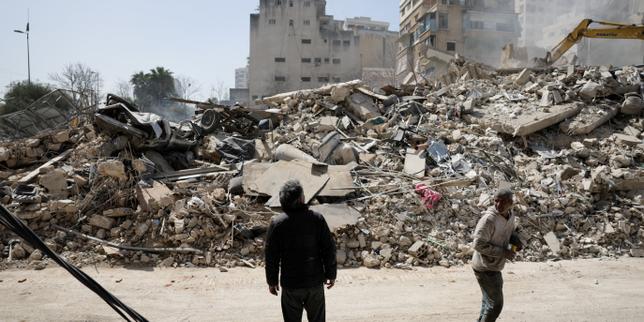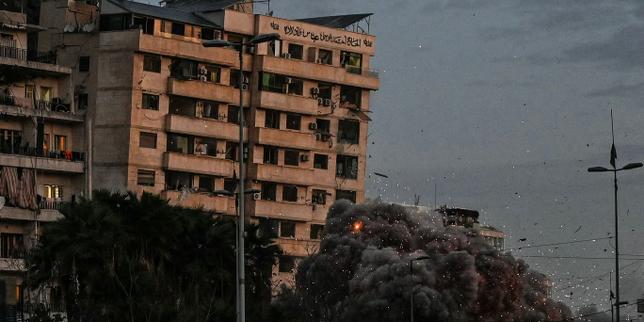
The camera stays remarkably still while the world in front of it dissolves. You've likely seen the footage by now. It’s a high-definition, slow-motion nightmare where a multi-story residential building in Beirut stands one second and becomes a mountain of pulverized concrete the next. This isn't a grainy, distant shot from a drone. It’s the kind of clarity that makes the war in Lebanon feel uncomfortably close, stripping away the abstraction of "military objectives" and replacing it with the terrifying physics of a precision strike.
The video capturing the exact moment an Israeli missile hits a building in the Ghobeiry district of Beirut’s southern suburbs isn't just another piece of war reportage. It represents a shift in how we consume the destruction of a modern city. We aren't just reading about the aftermath or seeing the smoke from a hillside anymore. We’re watching the structural failure of a home in real-time. It’s brutal. It’s clinical. It’s happening faster than the human brain can really process the loss involved.
The Physics of a Targeted Strike
When you watch that specific clip, the most jarring part isn't the explosion itself. It’s the split second before. You can actually see the projectile—a 2,000-pound class bomb, likely equipped with a JDAM (Joint Direct Attack Munition) guidance kit—streaking toward the lower floors. The intent is clear to anyone who understands demolition. You don't hit the roof if you want the whole thing gone. You hit the "knees" of the building.
Israeli military officials often claim these targets house Hezbollah infrastructure, command centers, or weapon caches. But for the people living in the surrounding streets, those labels don't change the reality of the shockwave. The building doesn't just fall over. It pancaks. This specific type of collapse is a nightmare for search and rescue teams because it leaves almost no survivable "void spaces."
The precision is horrifyingly high. In the footage, the neighboring structures remain standing, covered in dust but structurally intact, while the target is simply erased. This isn't carpet bombing. This is surgery with a sledgehammer.
Life Under the Warning System
There’s a pattern to these strikes that the media often glosses over. Before the cameras start rolling, there’s usually a frantic scramble. The Israel Defense Forces (IDF) frequently issue evacuation orders via social media, posting maps with red-highlighted buildings.
Imagine that for a second. You’re sitting in your living room, and a notification pops up on your phone telling you your specific block is about to be deleted. You have minutes. Maybe an hour if you're lucky. You grab your passport, your kids, and maybe a charger. You leave. Then you stand a few blocks away and watch your life's work vanish on a stranger's livestream.
Critics of this "warning" system argue it doesn't make the strikes legal or moral. Organizations like Amnesty International have pointed out that many people—the elderly, the disabled, or those without transport—can't just "evacuate" on command. Even if the building is empty of people, it’s full of history. When that missile hits, it’s destroying the economic and social fabric of a neighborhood that may never recover.
Why Beirut is Different This Time
The 2006 war was devastating, but the 2024-2026 conflict feels different because of the sheer density of the surveillance and the speed of the information loop. In 2006, we waited for the evening news. Now, we see the strike from five different angles on Telegram before the dust has even settled.
Beirut is a city of layers. It’s a place that has been rebuilt so many times it’s practically a miracle it still stands. But the current campaign is hollowing out the southern suburbs, known as Dahiyeh. This isn't just a Hezbollah stronghold; it’s a massive residential and commercial hub. When a building falls there, it’s not just a military target. It’s a pharmacy, a grocery store, and three floors of apartments where families lived for decades.
The psychological impact of these "exact moment" videos can't be overstated. They serve as a form of digital warfare. For the Israeli public, they’re proof of military efficacy. For the Lebanese, they’re a constant reminder of their vulnerability. For the rest of the world, they’re a viral spectacle that risks desensitizing us to the actual human cost.
The Reality Behind the Frame
Don't let the high-quality glass and the stable tripod fool you. Behind every one of these "cinematic" strikes is a massive failure of diplomacy. The war in Lebanon is escalating because the underlying issues—border security, the role of Hezbollah, and the sovereignty of the Lebanese state—remain unsolved by anything other than explosives.
The video of the Beirut strike is a technical marvel and a human tragedy. It shows us exactly what happens when modern technology is used to settle ancient grievances. The building is gone. The dust will settle. But the anger generated by these images stays in the soil, ready to fuel the next round of violence.
If you’re following this story, stop looking at the fireball and start looking at the maps of the displacement. Over a million people in Lebanon have been forced from their homes. That’s the real story. The missile is just the punctuation mark at the end of a very long, very grim sentence.
Stay informed by checking updates from ground-level journalists in Beirut who aren't just filming the strikes, but visiting the shelters where the survivors are gathered. Look for reports from the Lebanese Red Cross or Médecins Sans Frontières to understand the medical crisis following these urban collapses.