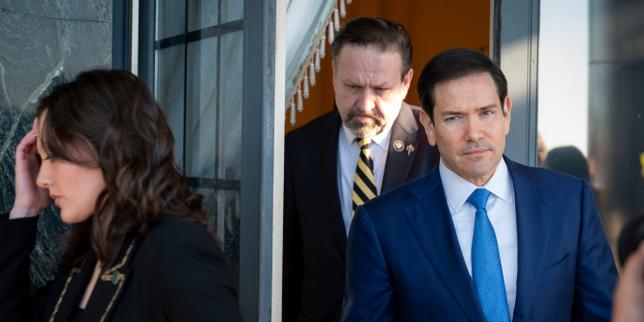
Marco Rubio is playing a classic game of smoke and mirrors, and the media is falling for it. When he denies that the Trump administration is pushing for the ousting of Miguel Díaz-Canel, he isn't just "clarifying" a policy. He’s protecting a status quo that serves Washington far better than any sudden democratic collapse ever would.
The lazy consensus suggests that the U.S. wants a free Cuba tomorrow morning. The reality? A controlled, slow-motion implosion is significantly more profitable and politically stable for American interests than the chaotic power vacuum that would follow a coup. If Díaz-Canel fell tonight, the ensuing migration crisis and security black hole would be a nightmare for the White House. Rubio knows this. The State Department knows this. They don't want him gone; they want him exactly where he is: paralyzed, broke, and predictable.
The Stability Trap Why Empires Love Weak Dictators
The common narrative is that sanctions are designed to topple the regime. That is a fundamental misunderstanding of geopolitical leverage. Sanctions are not a hammer; they are a leash. By keeping the Cuban economy in a state of perpetual asphyxiation, the U.S. ensures that Havana is too busy hunting for its next shipment of fuel to ever become a genuine regional threat again.
If you actually look at the mechanics of regime change, you’ll see it’s a messy, expensive business. I have seen foreign policy "experts" pitch the idea of a democratic transition as if it’s a simple software update. It isn't. It's a hardware crash.
When a centralized power structure like the Cuban Communist Party (PCC) dissolves, you don't get a Jeffersonian democracy. You get a failed state. You get warlords, cartel influence, and a mass exodus across the Florida Straits that would make the Mariel boatlift look like a weekend cruise. Washington talks a big game about "liberty," but they fear that specific brand of chaos more than they dislike Díaz-Canel’s bureaucracy.
The Rubio Denial Is a Strategic Pivot
Rubio’s statement that the U.S. isn't "pushing" for ousting is a masterclass in plausible deniability. It shifts the burden of failure onto the Cuban people while keeping U.S. hands clean. It’s the "strategic patience" of the 1990s rebranded for a new decade.
- The Internal Pressure Valve: By denying an active push for ousting, the U.S. avoids galvanizing the PCC around a "national defense" narrative.
- The Economic Chokepoint: The goal isn't to replace the leader; it's to force the leader to privatize the economy on terms favorable to future American investment.
- The Migration Shield: A sudden collapse triggers a refugee crisis that would bury any incumbent U.S. administration. Rubio isn't being soft; he’s being pragmatic.
The Myth of the "Incompetent" Successor
Pundits love to paint Díaz-Canel as an inept bureaucrat who can't hold the flame of the Castro brothers. This is a misunderstanding of his role. He isn't there to be a charismatic revolutionary. He is there to be the fall guy for the inevitable transition to state-managed capitalism—the "Vietnam Model."
The U.S. doesn't want to destroy the Cuban state apparatus; they want to buy it. If you dismantle the military’s hold on the tourism industry (GAESA), you destroy the only organized entity capable of maintaining order. Smart money doesn't bet on a revolution; it bets on the eventual fire sale of state assets. Rubio’s denial keeps that door open. It signals to the Cuban military elite that the U.S. isn't looking to lynch them—just to negotiate with them.
Stop Asking if the Regime Will Fall
You are asking the wrong question. The question isn't "When will the regime fall?" but "Who will own the remains?"
People also ask if sanctions actually work. They work perfectly, but not for the reasons you think. They don't inspire the hungry to revolt; they make the elite desperate enough to sell out. When the Cuban government finally breaks, it won't be because of a popular uprising in the streets of Havana. It will be because the colonels in charge of the hotels and the ports realized they could make more money as CEOs in a post-embargo world than as officers in a dying socialist experiment.
Imagine a scenario where the U.S. actually removed all sanctions tomorrow. The regime would claim a massive victory, solidify their power with a sudden influx of cash, and the "freedom" Rubio claims to want would be delayed by another fifty years. The current policy of "not pushing for ousting" while maintaining a stranglehold is the only way to ensure the eventual surrender is unconditional.
The Counter-Intuitive Truth of Modern Diplomacy
Authentic diplomacy isn't about winning; it's about managing the terms of the other guy's defeat. Rubio’s rhetoric is designed to keep the Cuban leadership looking over their shoulders without ever giving them a reason to jump.
If you want to understand the future of Cuba, stop reading the official press releases about human rights. Start looking at the debt cycles and the private "pyme" (small business) registrations. The U.S. is waiting for the fruit to rot so thoroughly that it falls into their lap without them having to shake the tree.
Shaking the tree is dangerous. Shaking the tree is what led to the Bay of Pigs. Rubio is many things, but he isn't a fool. He knows that the most effective way to end the Cuban Revolution is to let it starve in the dark, and his latest comments are just the sound of him turning off the lights.
The obsession with "regime change" is a 20th-century relic. We are in the era of "regime conversion." If you can't see the difference, you aren't paying attention.
Stop waiting for a "Caba Libre" moment and start watching the ledger. The revolution didn't end with a bang or a whimper; it ended when it became a bad business model. Rubio is just making sure nobody tries to fix the balance sheet before the liquidation sale begins.
Go look at the trade data between the U.S. and Cuba's "private" sector over the last eighteen months. Then tell me again that Washington wants to topple the government. They don't want to topple it. They want to invoice it.
You don't need to overthrow a president when you can simply wait for his credit to run out.