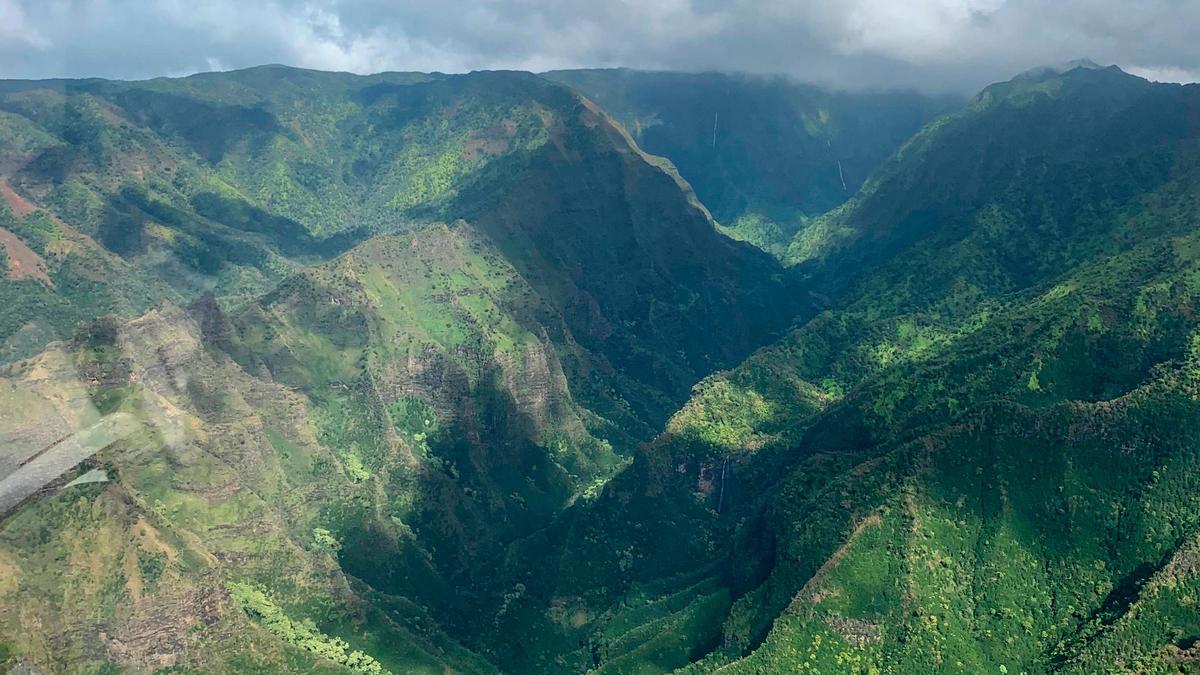
The air above Kauai doesn’t just move; it breathes. Anyone who has stood on the jagged emerald cliffs of the Na Pali Coast knows the sensation. It is a humid, salt-slicked weight that pushes against your chest, carrying the scent of crushed hibiscus and ancient volcanic dust. Travelers come from across the globe to hover in that air, suspended in glass-and-steel bubbles, seeking a glimpse of the "Manawaiopuna" falls—the Jurassic Park waterfall—where the water plunges 400 feet into a canyon that looks like it was carved by the gods.
They go up for the perspective. They come down with a story. But on a Tuesday that began like any other tropical morning, five people found themselves in a story they never asked to inhabit.
The helicopter, a workhorse of the sky, isn't supposed to fail. We trust the physics of the rotor. We trust the steady hands of pilots who navigate the "Cathedral Cliffs" daily. Yet, at approximately 9:40 a.m., the mechanical rhythm of a tour over the Garden Isle was replaced by the terrifying, discordant scream of a machine losing its fight with gravity.
The Anatomy of a Descent
Imagine you are sitting in the rear seat. You paid for the "doors-off" experience because you wanted to feel the wind. To your left, the Pacific Ocean is a shimmering sheet of sapphire. To your right, the fluted ridges of the Kalalau Valley rise like the spine of a sleeping dragon. Then, the pitch changes. It isn’t a bang. It’s a shudder. A vibration that starts in your molars and ends in the pit of your stomach.
The pilot’s hands move with a practiced, desperate fluidity. This is the moment where training meets the raw, unyielding reality of the terrain. Kauai is beautiful precisely because it is hostile. Most of the island is inaccessible by road; it is a fortress of rainforest and sheer rock. When a helicopter goes down here, it doesn't land in a field. It fights for a clearing amidst the canopy.
This specific craft, an Airbus EC130, was carrying one pilot and four passengers. They were hovering near the remote area of Honopu Valley when the world tilted. The impact was not the cinematic explosion we see in movies. It was a crushing, metallic crunch—the sound of high-strength alloys meeting the uncompromising basalt of the Hawaiian earth.
The Golden Hour in the Wilderness
In the immediate aftermath of a crash, time doesn't flow. It pools.
For the five people inside that wreckage, the silence that followed the engine's death must have been deafening. One moment, you are a tourist with a camera and a cocktail reservation; the next, you are a survivor in a landscape that suddenly feels very indifferent to your existence.
First responders in Kauai are a specific breed of heroes. They don't just drive to a scene; they rappell into it. The Kauai Fire Department and the U.S. Coast Guard shifted into a gear that the rest of us rarely have to witness. While the world scrolled through news feeds, rescuers were navigating the "wettest spot on earth" near Mount Waialeale, battling the same unpredictable winds that likely played a role in the crash.
The casualty count was grim but, miraculously, not final. One person was critically injured. Four others were stable but broken—shattered bones, internal trauma, and the kind of psychological scarring that no amount of island sun can bleach away. They were airlifted, one by one, plucked from the green abyss and flown toward the sterile lights of Wilcox Health in Lihue.
The Invisible Stakes of Paradise
We often treat travel as a series of postcards. We consume beauty as if it is a commodity, forgetting that the most breathtaking places on Earth are often the most dangerous. The helicopter industry in Hawaii is a vital artery of the local economy, but it operates on the edge of the envelope.
Since the early 2000s, the Federal Aviation Administration (FAA) has wrestled with the unique challenges of Hawaiian airspace. The microclimates are deceptive. A pilot can fly through a sun-drenched valley and, three minutes later, find themselves blinded by a "white-out" of sudden, torrential rain. The winds off the Napali Coast can create "mountain waves"—invisible currents of air that can drop a light aircraft hundreds of feet in seconds.
Consider the hypothetical case of a passenger named "Sarah." Sarah saved for three years to bring her family to Kauai. To her, the helicopter flight was the crown jewel of the trip. She didn't think about torque, or tail rotors, or the "dead man's curve"—the altitude-velocity diagram that pilots use to determine if they can safely autorotate to the ground if an engine fails. She thought about the photos.
When we look at the wreckage of this latest crash, we aren't just looking at a broken machine. We are looking at the collision between human wonder and physical limits. We are forced to ask: What is the price of the view?
The Burden of the Pilot
There is a tendency to look for a villain in the wake of a tragedy. We want to point to a maintenance log or a pilot’s error because it gives us the illusion of control. If it was "his fault," then it won't happen to "us."
But aviation in the islands is a complex dance. The pilots are often the best in the business, many with thousands of hours of flight time. They are the ones who know the names of every ridge and the temperament of every cloud. For a pilot, a crash isn't just a professional failure; it is a soul-crushing weight. They carry the lives of four strangers in a headset, tethered by nothing but air and skill.
The investigation into this crash will take months. The National Transportation Safety Board (NTSB) will pick through the bones of the EC130. They will analyze the fuel, the weather data, and the maintenance records. They will look for "the why." But for the five people who felt the ground rush up to meet them, the "why" matters far less than the "what now."
The Long Walk Back
Recovery from a helicopter crash is a slow, agonizing process of reassembling a life. For the critically injured survivor, the journey didn't end at the hospital helipad. It began there. It is a journey of surgeries, physical therapy, and the sudden, sharp panic that comes when you hear a ceiling fan whirring too loudly in a quiet room.
The island of Kauai continues to turn. The waterfalls still flow. The helicopters still take off from Lihue, their rotors thumping a steady rhythm against the sky. The beauty remains, but for those five people, the landscape has been permanently altered. They no longer see the Na Pali Coast as a backdrop for a vacation. They see it as the place where the world stopped, and where, against all odds, they were allowed to keep breathing.
We fly because we want to see the world as birds see it—limitless and grand. We forget that birds have wings, and we only have machines. The fragility of that arrangement is something we usually choose to ignore. But sometimes, the air reminds us. It reminds us that every flight is a leap of faith, and every landing is a gift.
The five survivors of the Honopu Valley crash are currently navigating the hardest terrain of their lives. They are proof that even when the rotors stop, the human spirit has its own way of staying aloft. The helicopter is gone, left to be reclaimed by the rust and the vines of the valley, a small, twisted monument to a Tuesday morning when the sky decided to let go.
The sun sets over the Pacific, casting long, golden shadows across the cliffs. The island is quiet again. But if you listen closely, past the sound of the waves and the rustle of the palms, you can almost hear the echo of that moment—the sharp, piercing reminder that life is as thin as a pane of cockpit glass, and just as clear.