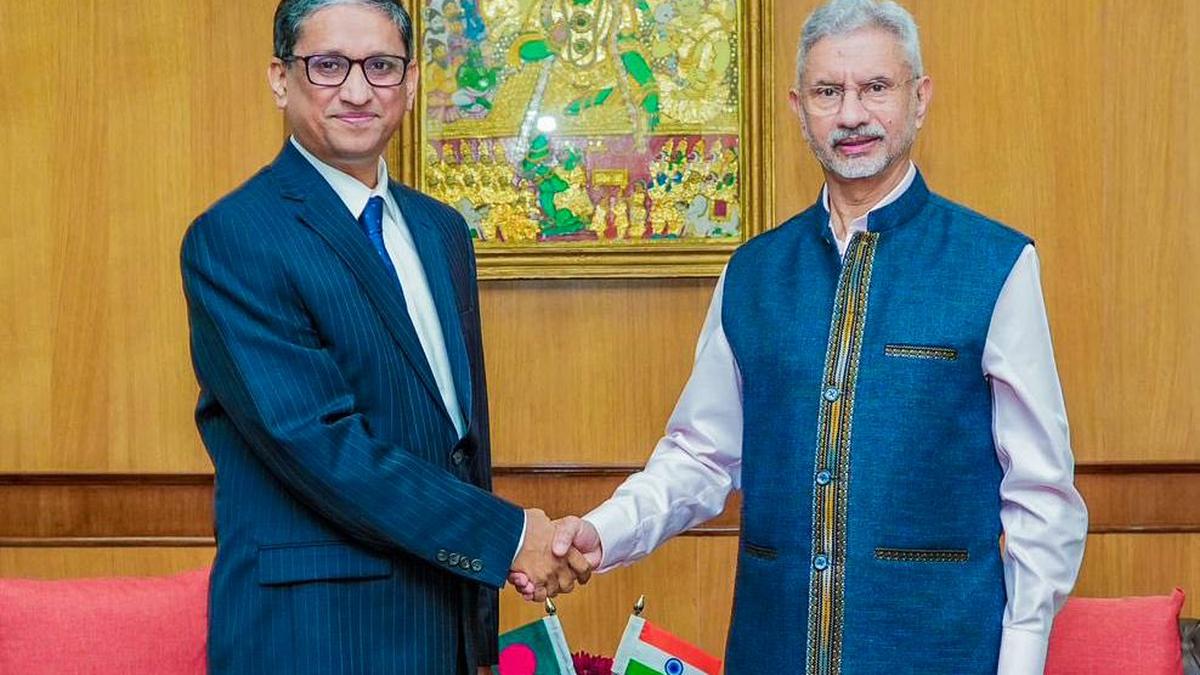
The stability of the Indo-Bangladesh corridor is currently constrained by a zero-sum resource allocation problem that transcends simple diplomatic "amicability." While official rhetoric from the Bangladesh High Commission emphasizes the need for a resolution to "sensitive issues," the underlying reality is a complex interplay of hydropolitics, internal security externalities, and a shifting trade deficit that requires a structural overhaul rather than incremental concessions. The bilateral relationship functions as a precarious equilibrium where the cost of inaction on water sharing is beginning to outweigh the benefits of security cooperation.
The Teesta Hydrological Bottleneck
The Teesta River serves as the primary flashpoint for bilateral friction. To understand the stalemate, one must look at the Teesta Flow Dynamics Model. The river originates in the Himalayas, flows through West Bengal, and enters Bangladesh, supporting approximately 14% of Bangladesh's total cropped area.
The core of the dispute is a seasonal scarcity problem. During the monsoon, the Teesta provides an excess of water, leading to destructive flooding and bank erosion in Bangladesh's northern districts. Conversely, during the dry season (December to March), the flow drops significantly. West Bengal’s Gazoldoba Barrage diverts a substantial volume of this water for the Teesta Barrage Project, leaving Bangladesh with a flow that often falls below the critical threshold required for its irrigation systems.
The failure to sign the 2011 interim treaty—which proposed a 37.5% share for India and 42.5% for Bangladesh—was not a failure of federal diplomacy but a collision of local constitutional mandates. In the Indian federal structure, water is a State subject. The West Bengal government’s veto persists because any reduction in upstream flow directly impacts the agricultural output of five North Bengal districts. This creates a Political Compensation Gap: New Delhi cannot offer Dhaka a water guarantee without simultaneously offering West Bengal a massive infrastructural or fiscal offset, such as alternative irrigation from the Sankosh-Torsa river link.
The Border Security Externalities
Security remains the strongest pillar of the relationship, yet it is plagued by the "Shoot-to-Kill" paradox. Bangladesh frequently highlights the killing of its nationals by the Indian Border Security Force (BSF) as a primary source of public resentment.
From a strategic perspective, the BSF operates under a mandate to curb cattle smuggling, human trafficking, and the movement of insurgents. The Border-Kill Function can be defined as:
$$K = f(S, V, P)$$
Where:
- $K$ is the frequency of lethal incidents.
- $S$ is the volume of illicit cross-border smuggling activity.
- $V$ is the visibility and density of border fencing.
- $P$ is the operational protocol regarding non-lethal weapon usage.
The move toward non-lethal weapons has reduced fatalities, but the fundamental issue is the economic disparity at the border. As long as the price of cattle and commodities in Bangladesh remains significantly higher than in India, the economic incentive for "illegal" crossing will exist. Amicable resolution requires moving beyond "restraint" to creating Joint Economic Zones at the border that formalize these trade flows, thereby reducing the tactical pressure on border patrols.
Mapping the Trade Imbalance and Logistics Friction
Bangladesh is India's largest trading partner in South Asia, but the trade deficit remains heavily skewed in India's favor. While Bangladesh’s exports to India surpassed $2 billion recently, Indian exports exceed $12 billion.
The bottleneck is not tariff-based; it is non-tariff and infrastructural. The Logistics Performance Index (LPI) at the Petrapole-Benapole land port—the busiest gateway—reveals systemic inefficiencies. Trucks often wait 15 to 20 days to cross, adding a "congestion tax" to every shipment.
Structural Constraints in Trade
- Testing and Certification: Bangladesh exporters face rigorous standards from the Bureau of Indian Standards (BIS) and the Food Safety and Standards Authority of India (FSSAI). Without a mutual recognition agreement (MRA) for laboratory testing, goods are often held at the border for weeks.
- Multimodal Gaps: Over-reliance on land routes prevents scale. The shift toward the Coastal Shipping Agreement and the use of Chittagong and Mongla ports by India is a move toward efficiency, but the "last-mile" rail connectivity from these ports into the Indian Northeast remains underdeveloped.
- The Adani Power Precedent: Energy cooperation has become a double-edged sword. While the import of 1,600 MW from the Godda plant in Jharkhand provides critical load-shedding relief for Bangladesh, the high cost of power and the dollar-denominated payment structure create a foreign exchange strain on Dhaka.
The Trans-Regional Connectivity Calculus
The relationship is increasingly defined by India’s "Act East" policy and Bangladesh’s "Indo-Pacific Outlook." Bangladesh acts as the bridge between South Asia and Southeast Asia.
The restoration of pre-1965 rail links and the operationalization of the BBIN (Bangladesh, Bhutan, India, Nepal) Motor Vehicles Agreement are designed to integrate the sub-region. However, India’s primary objective is transit and transshipment to its landlocked Northeast. For Bangladesh, the ROI (Return on Investment) for granting this transit is contingent on getting reciprocal access to Nepal and Bhutan via Indian territory.
Currently, the "Chicken’s Neck" (Siliguri Corridor) is a strategic vulnerability for India. By securing transit through Bangladesh, India effectively mitigates this geographical risk. The strategic value to India is immense, yet the economic rent paid to Bangladesh for this transit remains a point of contention. A standardized Transit Fee Framework that accounts for road wear-and-tear and carbon offsets would move the discussion from political "gestures" to a commercial contract.
Managing the China-India Hedge
Dhaka’s foreign policy is a masterclass in hedging. China is Bangladesh's largest trading partner and a major infrastructure financier, having committed over $24 billion to various projects.
India cannot compete with China on raw capital expenditure. Instead, India’s leverage lies in Geographic Proximity and Cultural Synchronicity. The "Security-Development Nexus" means that any instability in Bangladesh (whether from radicalization or economic collapse) has an immediate spillover effect on India’s eastern states.
India’s $8 billion Line of Credit (LoC) to Bangladesh has been slow to mobilize due to bureaucratic hurdles on both sides. To outcompete Chinese influence, India must shift from a "project-based" approach to a "systemic integration" approach, focusing on digital infrastructure (UPI integration) and the regional power grid.
The Risk of Internal Political Volatility
The "amicability" of the relationship is currently heavily dependent on the continuity of the Awami League government. This creates a Concentration Risk. If the bilateral relationship is viewed as a deal between two specific political elites rather than a treaty between two states, it remains vulnerable to domestic regime change.
A data-driven strategy would suggest that India needs to diversify its engagement within Bangladesh’s civil society and institutional frameworks. Relying on a single point of failure is a strategic error. The sensitivity of issues like the National Register of Citizens (NRC) and the Citizenship Amendment Act (CAA) in India provides ammunition for anti-India sentiment in Bangladesh, regardless of official diplomatic warmth. These are not just "domestic Indian issues"; they are externalities that lower the "Trust Coefficient" in Dhaka.
Strategic Optimization Pathway
To move beyond the cycle of "calling for resolution" toward an actualized partnership, the following technical shifts are required:
- Hydrological Data Transparency: Establish a real-time, shared digital dashboard for water levels across all 54 transboundary rivers. This removes the "information asymmetry" that fuels political blame games during floods or droughts.
- The Rupee-Taka Trade Mechanism: Accelerate the de-dollarization of bilateral trade to mitigate the impact of Bangladesh’s declining foreign exchange reserves. This provides a direct hedge against global currency volatility.
- Joint River Basin Management: Move away from "sharing water" to "managing the basin." This involves joint dredging projects and the construction of reservoirs that can store monsoon excess for dry-season release.
- Northeast-Bangladesh Special Economic Zones (SEZs): Incentivize Indian manufacturers to set up units in Bangladesh’s SEZs, specifically targeting the Indian Northeast market. This transforms the trade deficit into a regional manufacturing ecosystem.
The current diplomatic impasse is not a lack of "will" but a failure to align local political incentives with national strategic goals. India must internalize the cost of West Bengal’s water veto as a national security expense, while Bangladesh must institutionalize its relationship with India to survive political cycles.
Would you like me to analyze the specific impact of the Matarbari Deep Sea Port on this regional trade architecture?