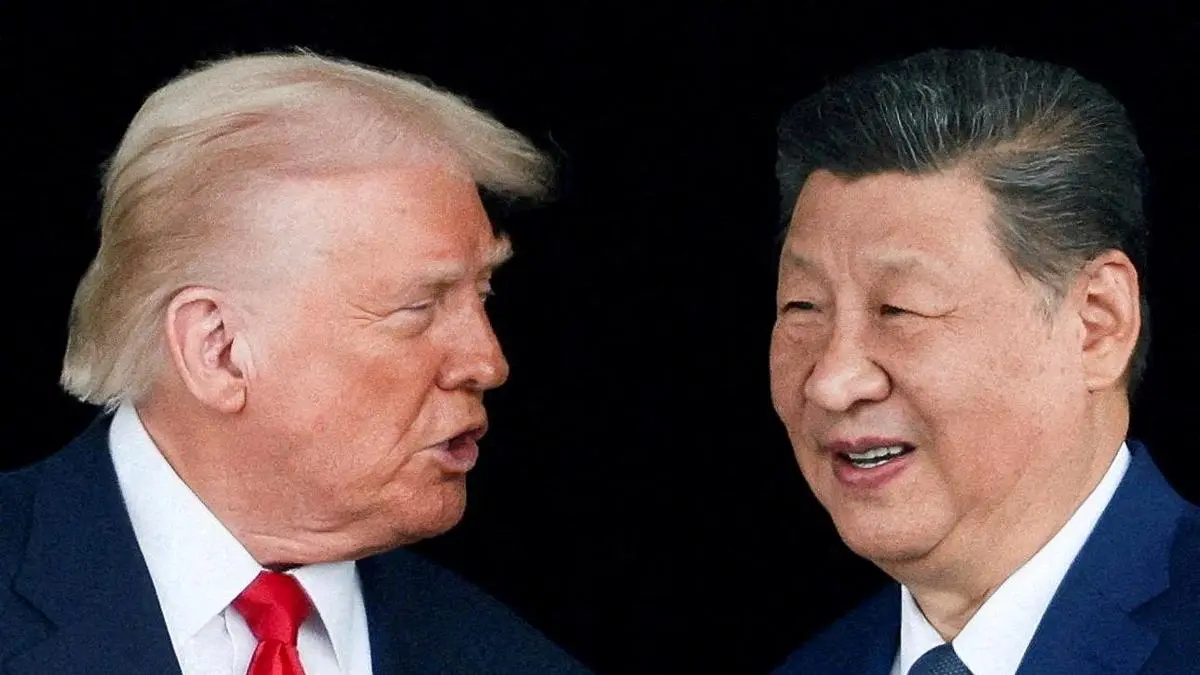
The upcoming diplomatic engagement between Donald Trump and Xi Jinping on May 14–15 represents a recalibration of the global trade equilibrium rather than a mere bilateral meeting. While the headline focuses on the physical presence of two heads of state in Beijing, the underlying structural reality is a high-stakes negotiation over the decoupling of supply chains and the re-indexation of the U.S. dollar against the Yuan. This summit functions as a clearinghouse for unresolved friction points in semiconductor lithography, agricultural export quotas, and the maritime sovereignty of the South China Sea. Success for either party will not be measured in joint press statements, but in the specific adjustment of tariff schedules and the lifting of entity list restrictions.
The Triad of Strategic Friction
The negotiation table is defined by three distinct vertical pressures that dictate the boundaries of any possible agreement. Each vertical operates with its own internal logic and carries a specific cost of failure. If you liked this post, you might want to check out: this related article.
- The Technology Enclosure: The United States has pursued a policy of "small yard, high fence" regarding critical dual-use technologies. The summit serves as a pressure test for the durability of the CHIPS and Science Act and subsequent export controls. China’s objective remains the restoration of access to high-end GPU clusters and Extreme Ultraviolet (EUV) lithography equipment. From a strategic consulting perspective, this is a zero-sum game; any concession by Washington on tech transfer directly degrades its long-term defensive posture in autonomous systems and cryptographic security.
- The Agrarian-Industrial Exchange: Beijing utilizes agricultural purchases as a tactical lever to influence domestic U.S. political sentiment. By shifting soybean and corn procurement from Brazil back to the American Midwest, Xi Jinping can offer Trump a "win" that translates directly into political capital. However, the mechanism is fragile. This is not a market-driven exchange but a state-directed procurement strategy used to offset the pain of U.S. manufacturing reshoring initiatives.
- Currency and Capital Flow Liquidity: The divergence between Federal Reserve interest rate projections and the People's Bank of China’s (PBOC) easing cycle creates a widening yield gap. This gap drives capital flight from the mainland and puts downward pressure on the Yuan. The May 14 summit will likely include "closed-door" discussions regarding currency stability. A managed depreciation of the Yuan would negate the impact of U.S. tariffs, essentially turning the trade war into a currency war where the primary casualty is global price stability.
The Mechanics of the Tariff Elasticity
The efficacy of trade barriers is often misunderstood as a static tax. In reality, the tariffs currently in place—and those threatened for the post-summit period—function as a dynamic cost function. For U.S. importers, the "China plus one" strategy has increased the complexity of logistics networks by roughly 15% to 22%.
When Trump arrives in Beijing, the negotiation will center on the "Section 301" investigations. The logic of the U.S. delegation is to use these tariffs as a perpetual enforcement mechanism. If China fails to meet specific IP protection benchmarks, the tariffs automatically escalate. This creates a "ratchet effect" where trade barriers only move in one direction unless substantial, verifiable structural changes are made to the Chinese economic model—specifically regarding state-owned enterprise (SOE) subsidies. For another look on this story, see the latest coverage from USA Today.
Analyzing the "Face" vs. "Function" Paradox
Diplomacy in the Asia-Pacific region requires an understanding of "mianzi" (face), but the data-driven analyst must look at "shizhi" (substance). The May 14 date is strategically chosen. It falls after the initial Q1 economic data releases for both nations, allowing both leaders to negotiate from a position of "interpreted strength."
- The U.S. Position: Focused on the reduction of the trade deficit. However, the trade deficit is a lagging indicator and a poor metric for national competitiveness. The real metric of success for the U.S. is the "reshoring rate" of critical manufacturing.
- The Chinese Position: Focused on "Stability above all." Xi Jinping needs a period of relative calm to address domestic property market stagnation and local government debt. A successful summit provides the psychological "floor" needed to prevent further foreign direct investment (FDI) withdrawal.
Strategic Bottlenecks in the South China Sea
While the economic theater is primary, the military-geographic bottleneck in the South China Sea serves as the ultimate "veto" over trade relations. The May 14 summit occurs against a backdrop of increased "gray zone" activities. The analytical error made by most commentators is treating trade and security as separate silos. In reality, they are linked via the "Maritime Insurance Premium."
Increased tension in the Taiwan Strait or the Second Thomas Shoal directly correlates with higher shipping insurance rates and a subsequent "risk tax" on all goods transiting the region. If Trump and Xi cannot establish a credible de-escalation protocol, the economic benefits of any trade deal will be cannibalized by the increased cost of maritime security and logistics hedging.
The Semiconductor Deadlock
The most significant hurdle to a "grand bargain" is the fundamental incompatibility of national goals regarding silicon. China views semiconductor self-sufficiency as a matter of regime survival. The U.S. views Chinese semiconductor parity as an existential threat to its military edge.
There is no middle ground here. Any "agreement" reached in Beijing regarding tech will likely be superficial—perhaps a temporary pause on new entity list additions in exchange for a temporary increase in Boeing aircraft orders. This is a tactical pause, not a strategic resolution. The underlying trend of "bifurcation"—the creation of two separate, incompatible tech ecosystems—remains the dominant trajectory.
Quantifying the Impact on Global Markets
Market volatility leading up to May 14 is a certainty. Institutional investors are currently pricing in a "Neutral-Positive" outcome, meaning a return to the status quo with no new escalations. However, the risk of a "Negative-Divergent" outcome is underpriced. This would occur if the summit ends early or if the joint statement fails to mention specific progress on the "Phase One" trade deal remnants.
The impact on specific sectors:
- Consumer Electronics: High sensitivity to tariff rhetoric. A failure to reach a consensus on assembly-line components will accelerate the migration of production to Vietnam and India.
- Energy: China’s demand for U.S. Liquefied Natural Gas (LNG) is a potential "sweetener" for the deal. Increased LNG exports provide the U.S. with a trade surplus in energy, offsetting the deficit in manufactured goods.
- Financial Services: Access to the Chinese domestic market for U.S. banks remains a key demand. However, the "Data Security Law" in China makes it increasingly difficult for U.S. firms to operate without localizing their servers, creating a massive operational hurdle.
The Limits of Individual Agency
While the personalities of Trump and Xi are forceful, they are both constrained by deep structural forces. Trump is constrained by a Congress that is increasingly hawkish on China across both party lines. Xi is constrained by a slowing economy that cannot afford a full-scale trade war while simultaneously managing a demographic collapse.
The "Great Power Competition" is not a choice made by these men; it is the inevitable result of a shift in the global distribution of power. The summit is an attempt to manage the speed of this shift, not to reverse it.
Strategic Play for the Q3 Window
The most probable outcome of the May 14–15 summit is a "Strategic Freeze." Both sides are likely to agree on a framework for "continuous communication" to prevent accidental kinetic conflict, accompanied by a symbolic purchase of American commodities.
For corporate entities and investors, the play is not to wait for a "normalization" of relations. Normalization is dead. The play is to utilize the temporary stability provided by this summit to accelerate the diversification of supply chains. The "May 14 Window" provides a 6-to-12 month period of reduced volatility. This window should be used to de-risk assets located in high-friction zones and to re-tool logistics for a world of permanent trade friction. The summit will not solve the competition; it will merely provide the rules of engagement for the next phase of the conflict.