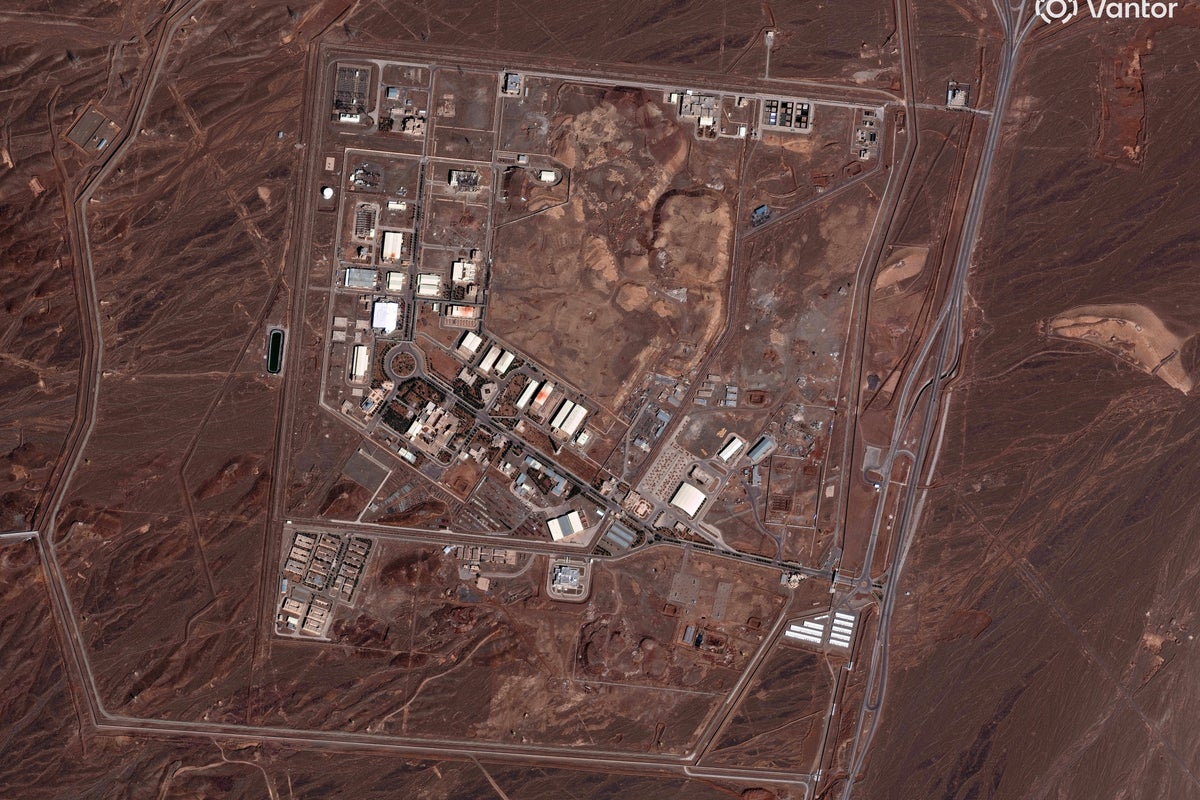
The prevailing narrative regarding Iran’s nuclear program is a cocktail of 1990s action-movie tropes and fundamental misunderstandings of nuclear physics. Every mainstream analyst is currently obsessed with "seizing" or "destroying" a hidden uranium stockpile. They talk about it like it’s a pirate’s chest of gold buried in the desert. They argue that the risk of a military strike is high, but the risk of inaction is higher.
They are wrong on both counts.
The obsession with the physical stockpile is a tactical distraction from the actual problem: the irreversible migration of intellectual capital. You can’t "seize" a centrifuge design that exists in the minds of a thousand engineers. You can't bomb a mathematical formula. The world is staring at a pile of dirt while the mountain is moving.
The Physicality Fallacy
Security "experts" love to count kilograms. They tell you that 60% enriched Uranium-235 is a "hair’s breadth" away from weapons-grade 90%. This leads to the frantic conclusion that we must physically remove the material.
Here is the reality check: The material is the easiest part to replace.
If a kinetic operation—whether a Mossad-style heist or a US-led surgical strike—successfully neutralized 1,000kg of enriched hexafluoride, it would buy the West exactly twelve to eighteen months. That is it. In exchange for a year of breathing room, you validate every hardline argument within the Iranian regime, collapse the remaining oversight from the International Atomic Energy Agency (IAEA), and trigger a regional firestorm.
We have seen this play out. Look at the Stuxnet worm. It was brilliant engineering, but it was a strategic failure. It slowed down the centrifuges at Natanz for a moment, but it taught the Iranian cyber-corps exactly how to defend their systems and, more importantly, how to build their own offensive digital tools. Seizing the stockpile is just Stuxnet with boots on the ground. It treats a symptom while making the virus stronger.
The Underground Myth
The competitor's piece frets over "hidden" sites like Fordow, buried deep under mountains. They suggest that the depth makes the risk of seizure "extreme."
The risk isn't that we can't get to the uranium; the risk is that the uranium doesn't actually matter as much as the latent capability.
Nuclear latency is the state of being a "screw’s turn" away from a bomb without actually having one. Japan is a latent nuclear power. They have the tech, the material, and the delivery systems, but no warhead. Iran has already achieved latency. Once a nation masters the enrichment cycle—specifically the gaseous diffusion or centrifuge cascades required to separate isotopes—the physical stockpile becomes a secondary accounting metric.
If you seize the current 121.5kg of highly enriched uranium (as reported by the IAEA in late 2023/early 2024), you are essentially trying to stop a baker by stealing a bag of flour. The baker still has the oven, the recipe, and the staff. He will just buy more flour, and this time, he’ll lock the door.
The Cost of the "Surgical" Strike
I have sat in rooms where military planners talk about "minimal collateral damage." In the context of a nuclear facility, that phrase is an oxymoron.
- Environmental Reality: You aren't just blowing up a building. You are breaching containment on UF6 (uranium hexafluoride). When UF6 hits the air, it reacts with moisture to form hydrofluoric acid and uranyl fluoride. It’s a toxic, corrosive plume.
- The Martyrdom Effect: A physical seizure or strike provides the Iranian Revolutionary Guard Corps (IRGC) with the ultimate "rally 'round the flag" moment. Currently, the Iranian public is deeply divided, with significant internal pressure on the regime. Nothing heals a domestic rift faster than a foreign power violating national sovereignty to steal "scientific progress."
A Superior Strategy: Controlled Integration
Instead of the fool’s errand of seizing material, we should be leaning into the one thing the regime fears more than a bomb: economic transparency.
The "lazy consensus" says we need more sanctions and more Special Ops. I argue we need a radical pivot toward monitored industrialization.
Imagine a scenario where the West stops trying to empty the silos and starts demanding "Golden Sentry" style monitoring in exchange for high-end medical and energy technology. We don't need to take their uranium if we own the sensors that watch it 24/7.
By focusing on a physical heist, we are playing into a 20th-century warfare mindset. We are trying to win a game of Capture the Flag when we should be playing a game of Financial and Technological Enmeshment.
Why the "Seizure" Plan Fails Logic 101:
- Intelligence Gaps: You cannot seize what you cannot find. If Iran has a "hidden" stockpile, by definition, your intel is incomplete. If your intel is incomplete, your seizure mission is a suicide pact.
- The Second-Strike Capability: Iran has spent decades diversifying its storage. There is no single "X" on the map.
- The Escalation Ladder: The moment a foreign team enters Iranian soil to take physical assets, the Strait of Hormuz closes. 12% of the world's oil supply vanishes overnight. Is a 12-month delay in enrichment worth a global depression?
The Counter-Intuitive Truth
The most dangerous thing for the Iranian nuclear program isn't an American SEAL team. It’s a bored, well-paid Iranian scientist who wants to publish papers in international journals and send his kids to Stanford.
Brain drain has done more to slow down Tehran’s nuclear ambitions than every sabotage mission combined. When we treat the nuclear program as a military target, we turn those scientists into national heroes. When we treat the nuclear program as a failing, isolated industrial project, we turn those scientists into disgruntled employees looking for an exit.
Stop asking how we can steal the uranium. It’s heavy, it’s toxic, and it’s replaceable. Start asking how we can make the possession of that uranium so costly, so isolating, and so technologically redundant that the regime itself decides to trade it for a seat at the global table.
The "high risk" isn't in failing to seize the stockpile. The high risk is in succeeding, only to realize you’ve captured a pawn while losing the king.
The stockpile is a ghost. Stop chasing it.