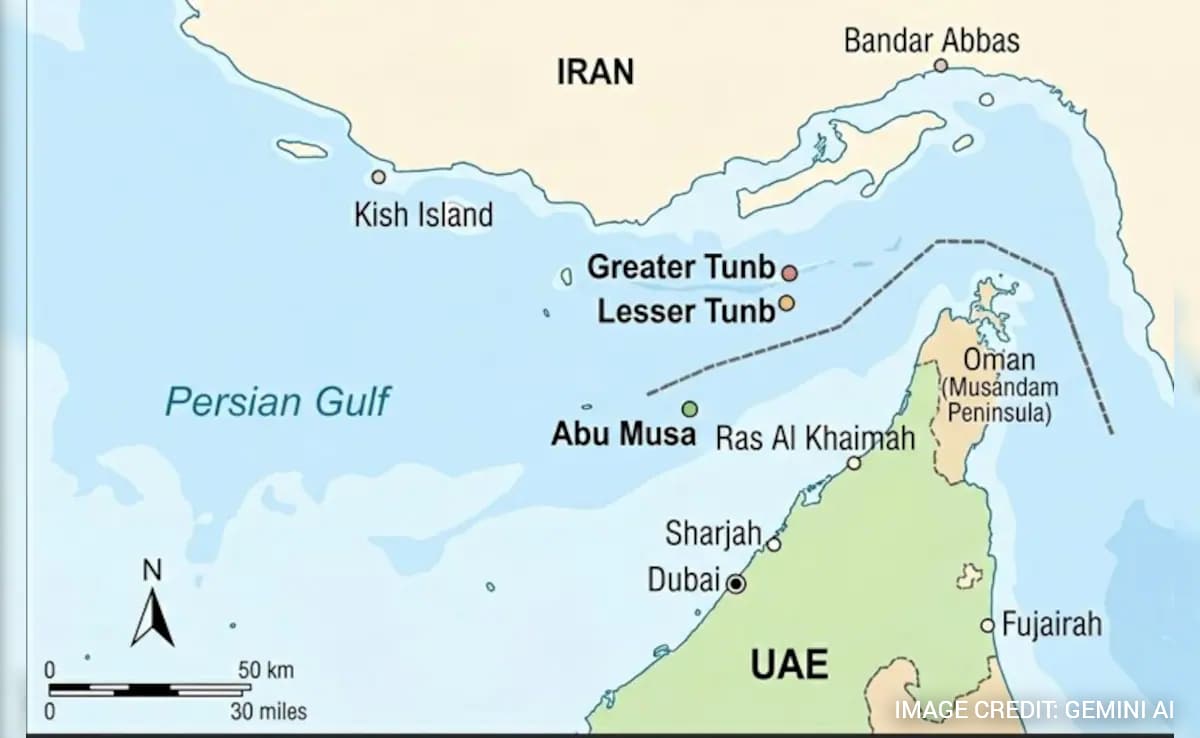
A few chunks of rock in the Persian Gulf might seem like an odd reason to risk a global war. But if you look at a map of the Strait of Hormuz, you'll see why Abu Musa, Greater Tunb, and Lesser Tunb are the most expensive pieces of real estate you've never heard of. These three islands sit directly alongside the world’s most vital shipping lanes. If they move from one hand to another, the cost of your gasoline, the stability of your bank account, and the security of the entire Western world change overnight.
The dispute over these islands isn't some dusty historical footnote. It’s a live wire. Iran has occupied them since 1971, just as the British were packing their bags to leave the Gulf. The United Arab Emirates (UAE) claims them as their own, backed by most of the Arab world and, increasingly, by heavyweights like Russia and China who are playing both sides. We’re talking about a choke point where 20% of the world’s petroleum passes daily. If you control the islands, you don't just control the land. You control the tap.
The strategic nightmare of the Strait
The Strait of Hormuz is narrow. At its tightest point, the shipping lanes are only about two miles wide in either direction. Most people think of the ocean as a vast, open space where ships can go anywhere. It’s not. Massive tankers drawing 60 feet of water are stuck in narrow corridors. This makes them sitting ducks.
The three islands—Abu Musa, Greater Tunb, and Lesser Tunb—are positioned perfectly to monitor, harass, or block these lanes. Iran understands this better than anyone. They’ve turned these islands into unsinkable aircraft carriers. We’ve seen the reports of fast attack boats, anti-ship missiles, and advanced radar systems stationed there. It’s a classic "bastion" strategy. By holding these points, Tehran ensures that any naval intervention by the U.S. or its allies starts at a massive disadvantage.
You can’t just sail past. You have to deal with the battery of missiles tucked into the limestone cliffs. This isn’t theoretical. During the "Tanker War" of the 1980s, these waters turned into a graveyard for merchant vessels. Today, the technology is much deadlier.
Why the UAE won't let it go
From the perspective of the UAE, this is about more than just national pride. It's about sovereignty and the long game. Before the British left in 1971, the islands were part of the emirates of Sharjah and Ras al-Khaimah. The day before the UAE officially became a country, Iranian troops landed.
The UAE has been remarkably patient. They haven’t started a shooting war. Instead, they’ve used every diplomatic tool in the kit. They’ve brought it up at the UN. They’ve lobbied the GCC. Recently, they’ve even managed to get China and Russia to sign statements supporting a "peaceful solution" to the dispute. This infuriated Tehran. Why? Because Iran views the islands as non-negotiable territory.
If the UAE ever regained control, or even just achieved a joint-administration deal, the power balance would flip. Suddenly, the "choke" in the choke point wouldn't belong to a single, often hostile power. It would be shared with a globalized, trade-heavy nation that has every incentive to keep the oil flowing.
The China and Russia factor
This is where the plot thickens. For years, Iran felt it had a "blank check" from its allies in Moscow and Beijing. But trade talks change things. In late 2022 and again in 2024, China signed joint statements with Arab leaders that touched on the island issue. Moscow did the same.
It's a cold business calculation. China is the world's largest oil importer. They hate instability. While they need Iran’s energy and cooperation, they can't afford a total blockade of the Strait. They're playing a double game. They want Iran to feel secure enough to stay in their orbit, but they want the UAE to know that China recognizes their concerns.
Russia is in a similar boat. They need Iran’s drones and military cooperation for the conflict in Ukraine, but they also want Gulf investment. This diplomatic friction shows that the islands are no longer just a local squabble. They're a bargaining chip in the new multipolar world.
Military reality on the ground
Let’s be real about the "defensive" nature of these islands. Iran’s Islamic Revolutionary Guard Corps (IRGC) runs the show there. They aren’t just building lighthouses.
- Abu Musa: The largest of the three. It has a civilian population, a runway, and a significant military garrison. It’s the nerve center for monitoring the lower Gulf.
- The Tunbs: These are smaller, rugged, and almost entirely militarized. They’re perfectly placed to launch "swarming" drone attacks or sea mines.
If a conflict breaks out, these islands allow Iran to "layer" its defenses. They can strike at ships from multiple angles, making it nearly impossible for minesweepers or destroyers to clear a path quickly. A delay of even one week in the Strait of Hormuz would send global oil prices into a vertical climb. We're talking $150 or $200 a barrel. Your local gas station would feel the effects within 48 hours.
The legal mess nobody can solve
International law is supposed to settle these things. The UAE wants to take the case to the International Court of Justice (ICJ). Iran refuses. Under international law, if you’ve occupied a territory for 50+ years and the other side hasn't managed to kick you out, "effective occupation" starts to weigh heavy.
Iran points to historical maps from the 18th century. The UAE points to colonial-era treaties and the Sharjah-Iran memorandum of understanding from 1971. Honestly, the legal arguments are a wash because there’s no way to enforce them. No one is going to march into Abu Musa and hand out eviction notices to the IRGC.
The only way this shifts is through a massive geopolitical realignment. If Iran ever seeks a "Grand Bargain" with the West or its neighbors to end sanctions, the islands will be on the table. Until then, they remain a ticking time bomb.
What this means for you
It’s easy to ignore a few dots on a map when you’re worried about inflation or your own job. But these dots cause the inflation you're worried about. The Strait of Hormuz is the jugular vein of the global economy. As long as the ownership of these islands is contested, the risk of a "black swan" event remains high.
One stray missile, one misunderstood naval maneuver, or one over-eager commander on Greater Tunb could trigger a chain reaction. We saw a glimpse of this with the seizure of tankers like the Stena Impero or the attacks on the Fujairah anchorage. Each time, the islands played a role as a staging ground or a monitoring post.
You should watch the diplomatic language coming out of the BRICS summits and the GCC meetings. When you see "territorial integrity" or "peaceful resolution of island disputes" mentioned, know that it's code for a struggle over the world's most important waterway.
If you want to track the actual risk level, don't look at the fiery speeches in Tehran or Washington. Look at the insurance premiums for oil tankers. When those start to spike, it means the people with the most money on the line think something is about to happen near those three small islands.
Stay informed by following maritime tracking data from sources like MarineTraffic or tankertrackers.com. They show the literal flow of wealth past these islands in real-time. Understanding the geography of the Strait is the first step in understanding why the Middle East remains the center of the geopolitical universe. Keep an eye on the UAE’s "soft power" moves—every trade deal they sign with an Iranian ally is a slow-motion attack on Iran's hold over those rocks.