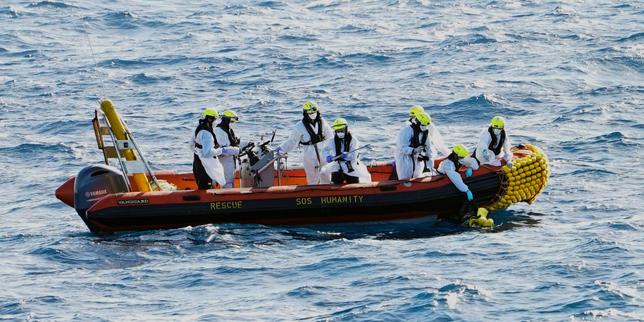
The death of twenty-two individuals following six days of drift in the Mediterranean is not an isolated maritime accident; it is the predictable output of a degraded search-and-rescue (SAR) architecture. When an inflatable vessel loses propulsion in the Central Mediterranean, it enters a terminal decay phase where survival is dictated by three intersecting variables: the rate of physiological depletion, the density of commercial shipping lanes, and the response latency of state-authorized rescue assets. The failure of these variables to align reveals a systemic "safety gap" where the cost of non-intervention is borne entirely by the occupants of the vessel.
The Physics of Inflatable Transit Failure
The vessels typically used in these crossings—often reinforced rubber or low-grade PVC inflatables—are engineered for single-use buoyancy rather than navigational durability. Once the outboard motor fails or fuel is exhausted, the craft ceases to be a transport vehicle and becomes a passive drifter.
The Buoyancy Decay Model
Standard migrant inflatables face immediate structural risks that compound over time:
- Puncture Vulnerability: Low-grade materials are susceptible to degradation from UV exposure and saltwater saturation, leading to slow-leak scenarios.
- Overloading and Freeboard Reduction: Excessive passenger weight lowers the freeboard (the distance from the waterline to the top of the hull), making the vessel prone to "swamping" even in moderate Sea State 2 or 3 conditions.
- Structural Flex: Without a rigid hull, wave action causes the floorboards to shift, often rupturing the fuel bladders and creating a caustic mix of gasoline and seawater that causes chemical burns on passengers.
The Six-Day Depletion Timeline
The human cost of "errance" (aimless drifting) follows a steep curve of biological and psychological attrition.
- Hours 0–24 (The Exposure Phase): Initial panic gives way to acute seasickness. The loss of electrolytes via vomiting accelerates dehydration.
- Hours 24–72 (The Resource Exhaustion Phase): Supplies of potable water are typically exhausted or contaminated. Heat stroke (hyperthermia) during the day and mild hypothermia at night begin to compromise cognitive function.
- Hours 72–144 (The Critical Failure Phase): Organ failure begins among the most vulnerable—children and the elderly. The psychological "will to survive" is undermined by hallucinations and the physical inability to bail water out of the vessel.
The SAR Latency Framework
The survival of the remaining passengers after six days suggests a massive failure in the maritime "Chain of Custody." Under the International Convention for the Safety of Life at Sea (SOLAS), any vessel—commercial or governmental—is legally obligated to assist a craft in distress. The six-day delay indicates a breakdown in three specific operational areas.
Detection and Reporting Gaps
Modern maritime surveillance utilizes a mix of aerial assets (Frontex drones and aircraft), satellite imagery, and the Automated Identification System (AIS). A vessel drifting for nearly a week without interception suggests either a "surveillance blind spot" or a failure to categorize the vessel as "in distress" during initial sightings. In many cases, a vessel is monitored but not intercepted if it is deemed to be making "slow progress," a distinction that ignores the high probability of imminent engine failure.
Coordination Friction
The Central Mediterranean is partitioned into Search and Rescue Regions (SRRs). When a vessel drifts across these invisible boundaries—moving from Libyan to Maltese or Italian zones—the responsibility for coordination often becomes a point of diplomatic friction. This "jurisdictional handoff" creates a period of inaction where no single Maritime Rescue Coordination Center (MRCC) takes command, leaving the drifting vessel in a state of operational limbo.
The Commercial Disincentive
Merchant vessels are the primary responders in high-traffic lanes. However, the commercial cost of a rescue—fuel consumption, port delays, and the legal complexity of disembarking rescued persons—creates a "silent bypass" effect. While the legal obligation to rescue remains, the lack of clear disembarkation protocols in European ports creates an economic and logistical penalty for commercial ships that fulfill their SOLAS obligations.
The Three Pillars of Mediterranean Attrition
To understand why twenty-two people died while others survived on the same craft, we must analyze the specific mechanics of mortality in these corridors.
1. The Proximity-to-Hazard Variable
Survival is often a matter of seating geometry. Those positioned on the perimeter of the inflatable are more likely to be swept overboard during high-sea events. Those in the center often succumb to "fuel-wash" burns—a mixture of leaked gasoline and salt water that strips skin and causes systemic infection.
2. The Information Asymmetry
Passengers often lack the means to communicate their precise GPS coordinates to rescue centers. Even when satellite phones are available, battery life is a finite resource. Once the phone dies, the vessel becomes a "dark target," visible only by visual scanning or radar, which is notoriously unreliable for low-profile rubber boats.
3. The Deterrence-Effect Bottleneck
Current European migration policy emphasizes "pull factor" reduction, which manifests as a withdrawal of proactive naval patrols. By shifting the burden of rescue to the Libyan Coast Guard or private NGO vessels, the state creates a fragmented response network. When NGOs are impounded and the Libyan Coast Guard fails to deploy, the response capacity drops to near zero, ensuring that drifting vessels will remain at sea until they either reach land by luck or sink.
Economic and Geopolitical Feedbacks
The loss of life in the Mediterranean is frequently framed as a humanitarian tragedy, but it is more accurately described as a failure of a high-risk logistics chain. The smugglers operate on a "zero-liability" business model. Once the vessel departs the shore, the smugglers have extracted the full lifetime value of the customer. They have no economic incentive to ensure the vessel reaches its destination.
This creates an inverted insurance market. In traditional shipping, the carrier insures the cargo and the vessel. In Mediterranean migration, the "cargo" (the migrants) bears the entire risk of total loss. The "carrier" (the smuggler) incurs no penalty for the destruction of the vessel or the death of the passengers.
Furthermore, the externalization of border controls to third-party nations creates a "moral hazard." By funding and training external coast guards without rigorous oversight or synchronized disembarkation agreements, European states create a system where the primary goal is interception rather than rescue. This distinction is critical: interception is a security function; rescue is a life-safety function. When the two are conflated, the speed of the life-saving response is compromised by the protocols of border security.
The Strategy of Managed Friction
The persistence of these tragedies suggests that the current state of "attrition by delay" is a functional, if unstated, component of regional migration management. The "six-day drift" is the logical result of a system that has successfully:
- Decentralized the responsibility for maritime surveillance.
- Criminalized or obstructed non-governmental rescue assets.
- Disincentivized commercial shipping intervention through port-of-entry restrictions.
The mortality rate is not a bug in the system; it is a metric of the system's current calibration. To reduce these deaths, the operational focus must shift from "interception at the border" to "stabilization at the point of detection."
Stabilization requires a decentralized network of emergency "buoyancy and life-support" drops. Rather than waiting for a large-scale rescue ship to arrive—which can take 12 to 24 hours—aerial assets must be equipped to deploy automated life rafts and desalination kits immediately upon sighting. This decouples the "act of saving a life" from the "act of crossing a border," forcing a shift in the maritime cost function. Until the response latency is reduced below the 24-hour mark, the Mediterranean will continue to function as a high-attrition zone where the probability of death is a variable of time rather than intent.