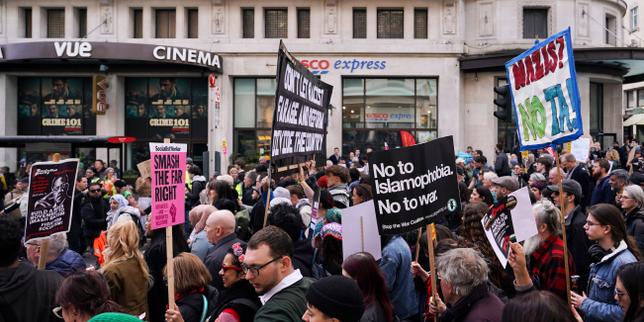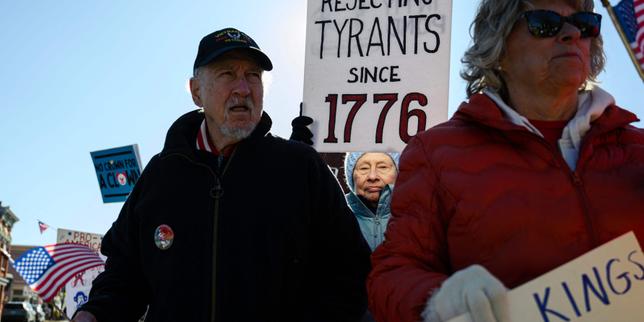
The "No Kings" movement has transitioned from a digital hashtag into a physical blockade of American commerce and governance. Millions of citizens are currently mobilizing across major metropolitan hubs to protest what they characterize as the transition of the executive branch into a de facto monarchy under Donald Trump. While the surface-level narrative focuses on partisan anger, the underlying machinery of this mobilization reveals a sophisticated, decentralized network that is bypassing traditional political structures to challenge the very definition of presidential immunity. This is not a standard protest cycle; it is a systemic rejection of the legal frameworks recently bolstered by the highest courts in the land.
The Infrastructure of Discontent
The scale of these demonstrations suggests a level of planning that extends far beyond spontaneous outrage. For decades, American protest culture relied on established NGOs and labor unions to provide the logistical backbone for mass gatherings. "No Kings" has discarded that model. Instead, we are witnessing the deployment of encrypted, localized "cells" that coordinate via peer-to-peer mesh networks, making the movement nearly impossible to decapitate through legal or law enforcement pressure on leadership.
They are targeting specific nodes of economic power. By focusing on transit corridors and financial districts rather than just the symbolic lawn of the White House, the movement is attempting to make the "business as usual" of a perceived autocracy impossible to sustain. The strategy is clear. If the law no longer restrains the executive, the people will restrain the economy that the executive claims to have perfected.
The Immunity Paradox
At the heart of the "No Kings" banner lies a profound legal grievance. The movement gained its name as a direct rebuttal to recent judicial interpretations regarding presidential immunity. Protesters argue that the current administration is utilizing these legal shields to bypass Congressional oversight and civil service protections.
To understand the stakes, one must look at the specific executive orders currently being challenged. These aren't just cultural flashpoints; they are fundamental rewritings of how federal agencies operate. By stripping protections from non-partisan civil servants—often referred to as the "Schedule F" reclassification—the administration is effectively creating a loyalist bureaucracy. This is the "tyranny" the streets are reacting to.
The legal experts I've tracked for decades note that this is a unique moment in the American experiment. Usually, power shifts through the ballot or the bench. Today, the street has become the third chamber of the legislature.
Why the Traditional Media is Missing the Story
Most cable news outlets are obsessed with the optics of the crowd size or the occasional skirmish with police. This misses the strategic depth of the "No Kings" organizers. They are not looking for a "vibe" or a viral moment. They are building a shadow administration.
By creating decentralized support systems for those arrested or fired for political reasons, the movement is insulating itself against the usual pressures that cause mass protests to fizzle out after a few weeks. This is a battle of endurance. The administration’s playbook—waiting for the media cycle to turn—is failing because the movement is the media cycle.
The Economic Impact of Permanent Protest
No one is talking about the cost. Not the cost of policing, but the cost of the paralysis. When millions of people stop contributing to the status quo, the market reacts. We are seeing a slow-motion decoupling of the retail economy from the political heartland.
In major cities, the disruptions to logistics and transportation are already being felt. This is by design. The "No Kings" leadership—to the extent that it exists—is banking on the fact that corporate donors will eventually find the administration’s "stability" too expensive to maintain. If the president cannot guarantee a functional commerce environment because of his own actions, his support among the donor class will begin to erode.
Beyond the No Kings Hashtag
The movement's longevity depends on its ability to transcend Donald Trump as a person. While his specific actions triggered the mobilization, the grievances are structural. The "No Kings" sentiment is a reaction to a century of executive overreach that has finally reached a breaking point.
Even if this administration were to vanish tomorrow, the infrastructure built by these protesters would remain. They have created a template for how a modern, technologically literate populace can challenge the executive. This isn't just about a single president. It is about the future of the American presidency itself and whether it will remain an office or become a throne.
The Role of Counter-Protests and Civil Friction
We cannot ignore the reaction from the other side. As "No Kings" occupies the streets, pro-administration groups are mobilizing in a mirror-image strategy. This creates a volatile environment where the police are no longer just maintaining order; they are referees in a low-intensity civil conflict.
The danger lies in the lack of a neutral ground. When every public space becomes a battleground for the definition of the republic, the risk of a misstep leading to sustained violence increases exponentially. The administration's response—invoking the Insurrection Act or similar measures—could be the very spark that turns a mass protest into something far more permanent and institutional.
A System Under Pressure
The reality is that the American system of checks and balances was never designed for this level of digital-age mobilization. The Founding Fathers didn't account for encrypted messaging or a president who could command a movement directly through a screen while bypassing every traditional gatekeeper.
The "No Kings" movement is essentially a stress test of the Constitution in real-time. If the executive power remains unchecked by the courts and the legislature, the street becomes the only remaining check. This is not a sustainable model for a stable republic. It is a sign of a system that is failing to provide the basic function of conflict resolution through its established institutions.
The Definitive Action Step
For those watching from the sidelines, the goal isn't just to observe the chaos but to understand the shift. This is a reorganization of American political power. The era of the passive voter is ending, replaced by the era of the active disruptor. The "No Kings" movement is simply the most visible manifestation of this new reality.
Those who expect this to end with a few arrests or a presidential tweet are fundamentally misunderstanding the gravity of the current mobilization. The streets are full because the halls of power are perceived as empty of justice. Until that perception changes, the "No Kings" banner will continue to fly over every major city in the country, and the economy will continue to pay the price of a presidency that refuses to be governed.
Watch the logistics, not the signs. The real story is in how they are staying fed, staying connected, and staying in the streets despite every effort to clear them. That is where the power has shifted.