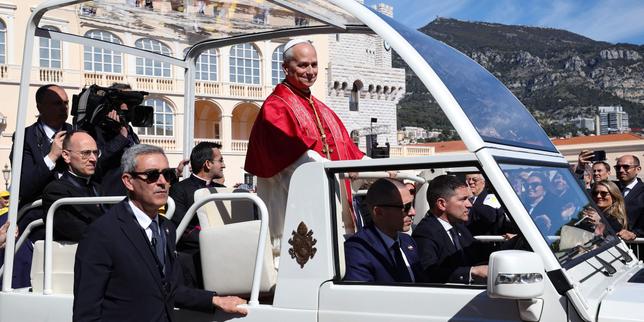
Pope Leo XIV stood on the sun-drenched terrace of the Prince’s Palace in Monaco and did what every institutional leader does when they lack a seat at the real table: he moralized. By attacking the "logic of omnipotence" and claiming it "wounds the world," the first American Pope isn’t just playing the role of a spiritual shepherd. He is engaging in a desperate, last-ditch effort to keep the Vatican relevant in a multipolar world that has long since stopped looking to Rome for its marching orders.
The mainstream press ate it up. They called it "prophetic." They called it "courageous."
They are wrong.
The Pope’s critique of power isn't a radical intervention. It is a fundamental misunderstanding of how the modern world maintains the very peace he claims to protect. If you want to understand why the Vatican’s current diplomatic strategy is failing, you have to look past the velvet robes and address the hard reality of power dynamics that the Church is too afraid to name.
The Myth of the "Logic of Omnipotence"
Leo XIV’s central thesis is that the pursuit of absolute power—the "all-powerful" stance of nation-states—is the root of global instability. This is a classic category error.
In the real world, instability doesn't come from "omnipotence." It comes from power vacuums.
When a dominant power recedes, or when the "logic of power" is abandoned in favor of vague moral platitudes, you don't get peace. You get Syria. You get the South China Sea. You get the Sahel. Peace is not a natural state of being that emerges when everyone decides to be nice; peace is an expensive, high-maintenance byproduct of credible deterrence.
By framing power as inherently "wounding," Leo XIV is effectively asking for a world without a sheriff. History shows us exactly what that looks like: a chaotic scramble where the most ruthless actors—not the most moral ones—set the terms.
Monaco: The Ultimate Irony
There is a staggering lack of self-awareness in choosing Monaco as the stage for a lecture on the dangers of wealth and power.
Monaco is a sovereign entity that exists solely because of the very "logic of power" the Pope decries. It is a protectorate of France, shielded by the military might of a secular state. It thrives as a tax haven for the global elite, the very people whose "toute-puissance" (all-powerfulness) Leo XIV supposedly finds so distasteful.
If the Pope wanted to speak truth to power, he would have delivered this speech in a shipping container in Mariupol or a dusty camp in Tigray. Instead, he chose a principality where the per capita GDP is roughly $234,000.
This isn't "speaking truth to power." This is "speaking truth at power" while drinking their vintage champagne. It’s a branding exercise. The Vatican knows that its influence in the West is hemorrhaging. In the U.S., the "Nones"—those with no religious affiliation—are the fastest-growing demographic. In Europe, the pews are museum-bound. Leo XIV is attempting to pivot to the Global South, but he’s doing it through the lens of a Western liberal intellectual. He’s lecturing the very power structures that his own Church helped build over 1,500 years.
The Papacy’s Real Geopolitical Role
The Pope isn't just a religious leader. He is a sovereign head of state.
Historically, the Vatican was a power broker. They weren't just "blessing" treaties; they were negotiating them. When Alexander VI drew the Line of Demarcation in 1493, he wasn't just talking about "logic." He was partitioning the globe.
Leo XIV’s current approach is a retreat into sentimentality. He’s trading realpolitik for "Fratelli tutti" vibes. By de-emphasizing the Church’s role as a mediator between states and instead becoming a lifestyle brand for "social justice," the Vatican is losing its ability to actually stop a bullet.
When you devalue the "logic of power," you devalue your own seat at the table. If the Pope wants to "compromise peace," he should continue to ignore the reality of how peace is actually brokered—through high-stakes, often amoral compromise between superpowers.
The Unseen Benefit of "All-Powerfulness"
Let’s look at the data the Pope ignores. The most peaceful era in human history—the Pax Americana—was defined by the "logic of omnipotence."
Between 1945 and today, despite the Cold War, despite the localized conflicts Leo XIV decries, the world saw an unprecedented decline in state-on-state violence. This wasn't because of a sudden global conversion to the beatitudes. It was because the cost of challenging the "omnipotent" power was too high.
- Trade Stability: Global commerce requires a dominant naval power to keep the lanes open.
- Nuclear Deterrence: The "logic" of mutually assured destruction is the only reason we haven't seen a direct conflict between major powers since 1945.
- Technological Advancement: Most of the green energy and medical tech the Pope wants to share with the poor was funded by the defense and expansionist budgets of "all-powerful" nations.
When Leo XIV calls this "logic" a wound, he is calling the very mechanism of modern stability a disease. This isn't just contrarian; it’s dangerous. It creates a moral justification for the dismantling of the systems that actually keep the lights on and the food moving.
The Strategy for True Peacemaking
If the Vatican wants to be a player in 2026, it needs to stop the "monologue in Monaco" and start doing the dirty work of diplomacy.
- Stop the Moral Equivalence: You cannot talk about the "logic of power" in the abstract while one side is the aggressor and the other is the victim. Peace requires a winner.
- Acknowledge Hard Power: Instead of decrying military spending, the Church should be advocating for its just use. The "Just War" theory of Augustine and Aquinas has been buried under a pile of vague pacifism. It’s time to exhume it.
- The Monaco Test: If you’re going to critique the global financial system, do it where it hurts. Don't just talk about "wounds." Talk about the specific tax laws, the shell companies, and the money laundering that happens within earshot of your podium.
The Pope’s speech was a masterpiece of "lazy consensus." It told the world exactly what it wanted to hear: that power is bad, peace is good, and we should all just try a little harder to be nice. It was the geopolitical equivalent of a "Live, Laugh, Love" sign in a billionaire’s penthouse.
True peace isn't the absence of power. It is the presence of a power so overwhelming that conflict becomes a suicide note. Leo XIV can decry that logic all he wants from his gilded balcony. But until he’s ready to offer a replacement that doesn't involve a total collapse into anarchy, he’s just a tourist in a world he no longer understands.
Stop listening to the moralists. Start watching the map.
Power isn't the problem. The lack of it is.
If you want peace, don’t pray for the end of "omnipotence." Pray for the competence of those who hold it.
The speech was a distraction. The reality is much louder.