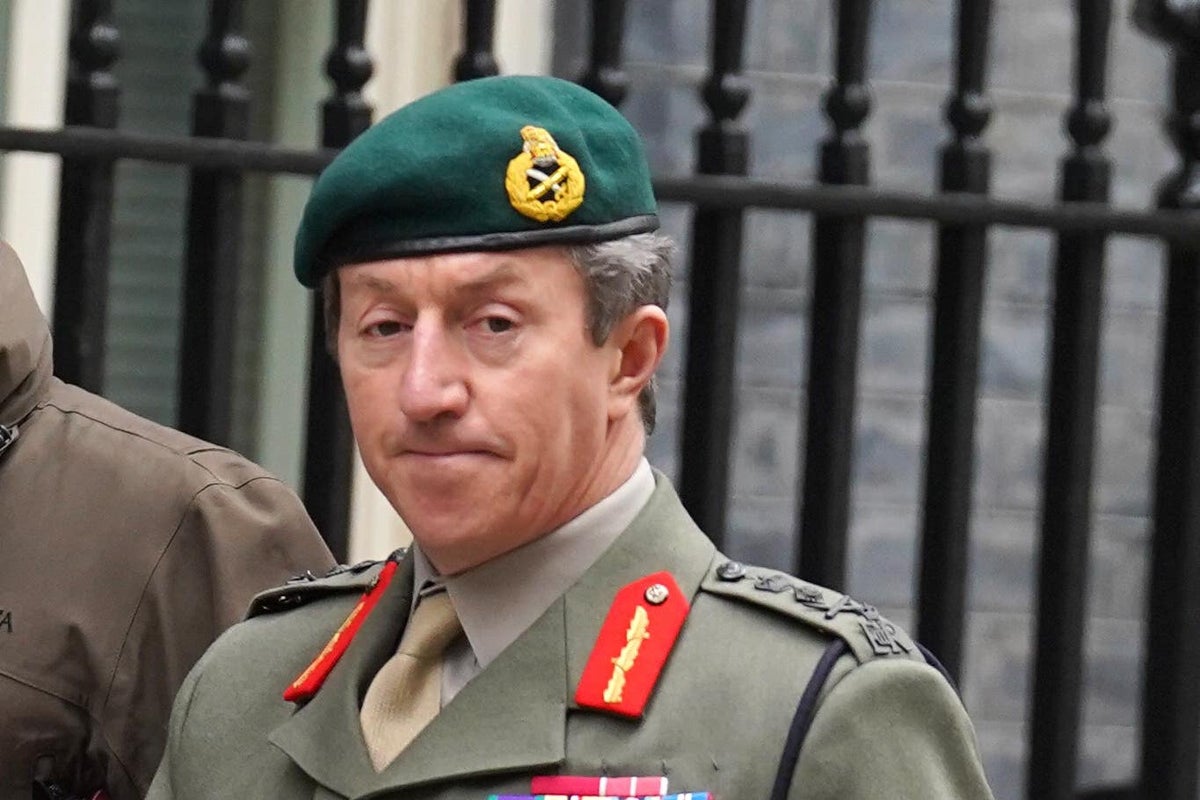
The Royal Navy currently operates within a paradox of high-spec technological procurement and critical operational insolvency. While the public discourse often focuses on the admission by the First Sea Lord regarding a lack of war-readiness, the underlying crisis is not one of intent, but of systemic friction across three specific vectors: hull availability, lethality density, and the recruitment-retention feedback loop. The inability to deploy a credible carrier strike group without significant allied supplementation indicates that the United Kingdom has transitioned from a blue-water power to a "tiered" maritime force, capable of policing but incapable of high-intensity peer-to-peer conflict.
The Triad of Maritime Operational Failure
To understand the current deficit, one must analyze the Royal Navy through a structural framework rather than a political one. Combat readiness is a function of three interdependent variables:
- Platform Availability (The Hull Function): The percentage of the fleet that is not in deep maintenance or undergoing unplanned repairs.
- Lethality Density (The Capability Coefficient): The ratio of offensive and defensive armament relative to the displacement of the vessel.
- Human Capital Endurance (The Manning Ratio): The ability to sustain double-watch or combat-tempo operations without catastrophic burnout or safety failures.
The First Sea Lord’s admission stems from the reality that all three variables are currently trending downward simultaneously.
The Hull Function: Maintenance Debt and the Frigate Gap
The Royal Navy is currently suffering from a "Maintenance Debt Trap." Because the fleet has been reduced to a historically small number of hulls—specifically within the Type 23 frigate and Type 45 destroyer classes—each individual vessel is required to spend more days at sea to meet global standing commitments. This increased "tempo" accelerates mechanical wear and tear, leading to longer-than-projected periods in dry dock.
When a Type 45 destroyer remains in dock for power-propulsion remediation (the "PIP" program), the remaining five destroyers must cover the same geographic area. This creates a feedback loop where the active fleet is run to the point of failure, further increasing the maintenance backlog. The "Frigate Gap"—the period between the decommissioning of aging Type 23s and the commissioning of Type 26 and Type 31 vessels—represents a strategic valley where the UK lacks the mass to absorb losses in a contested environment.
Lethality Density: The "Fitted For But Not With" Fallacy
A recurring critique of British naval procurement is the philosophy of "Fitted For But Not With" (FFBNW). This strategy involves building ships with the physical space and wiring for advanced missile systems or sensors but failing to purchase or install the hardware at the time of commissioning to save immediate costs.
The result is a fleet of technologically advanced "targets." For instance, the Batch 2 River-class offshore patrol vessels (OPVs) are sophisticated maritime platforms that lack any meaningful organic air defense or anti-ship missile capability. In a high-intensity conflict, these vessels cannot contribute to the battle force and instead require protection from the few overstretched destroyers available. The lethality density of the Royal Navy is currently too low to survive a saturated missile environment, such as that seen in the Red Sea or the South China Sea.
The Economics of Attrition and Human Capital
The most significant bottleneck to war-readiness is not the steel, but the sailors. The Royal Navy is currently experiencing a "negative retention delta," where the rate of trained personnel leaving the service exceeds the rate of new recruits entering the system.
The Recruitment-Retention Feedback Loop
Modern naval warfare requires highly specialized technicians to maintain complex Aegis-equivalent radars, nuclear propulsion systems, and digital fire-control networks. These individuals are in high demand in the civilian sector, where pay is higher and the lifestyle is decoupled from six-month deployments.
The "Operational Tempo" (OP_TEMPO) creates a compounding interest effect on exhaustion. When a ship is short-staffed, the remaining crew works longer hours. This leads to decreased job satisfaction, which triggers more resignations, further increasing the workload on those who stay. This cycle has reached a critical threshold where certain vessels cannot deploy not because they are broken, but because they lack the legally mandated minimum safe manning levels.
The Carrier Strike Group (CSG) Illusion
The Queen Elizabeth-class carriers were designed to be the centerpiece of British power projection. However, a carrier is a liability without its "ring of steel"—the protective screen of frigates, destroyers, and submarines.
To deploy a full CSG, the Royal Navy must commit:
- At least two Type 45 destroyers for Area Air Defense.
- Two Type 23 or Type 26 frigates for Anti-Submarine Warfare (ASW).
- An Astute-class nuclear attack submarine (SSN).
- A Solid Support Ship for logistics.
Currently, the Royal Navy struggles to generate this force independently without stripping every other global commitment bare. Relying on Dutch or American frigates to fill the gaps in a British carrier group is a tactical workaround, but it is not a sovereign capability. If a peer adversary were to strike during a transition period between deployments, the UK would lack the "surge capacity" to respond.
Technology as a Force Multiplier or a Critical Vulnerability
The shift toward autonomous systems and Uncrewed Surface Vessels (USVs) is often cited as the solution to the Navy’s mass problem. While USVs can provide persistent surveillance and mine-hunting capabilities, they do not yet solve the problem of high-end sea control.
The Limits of Automation
Automation reduces the headcount required to sail a ship, but it increases the technical burden on the shore-side maintenance infrastructure. A "lean-manned" ship is highly efficient in peacetime but lacks the "damage control" depth required to survive a hit in wartime. In naval history, ships are saved from sinking by large numbers of people moving water and shoring up bulkheads. By reducing the crew to the absolute minimum, the Royal Navy has traded combat survivability for operational efficiency.
Digital Fragility
The integration of the fleet into a Joint Data Environment makes it susceptible to Electronic Warfare (EW) and cyber-attacks. If the "Link 16" or successor data links are jammed or spoofed, a fleet that relies on networked sensor-fusion becomes a collection of isolated platforms. The Royal Navy’s reliance on high-end, networked assets assumes a permissive electromagnetic environment that is unlikely to exist in a conflict with a Tier-1 adversary.
The Strategic Path Forward: Hard Choices in Force Structure
The admission of unreadiness must be met with a fundamental reallocation of resources. Continuing to prioritize the "prestige" of two large carriers at the expense of the "workhorse" frigate and destroyer fleet is a strategic error.
A viable maritime strategy requires the following shifts:
- Pivoting to Mass over Complexity: The Royal Navy must consider "high-low" mixes where cheaper, more numerous, missile-heavy vessels supplement the few high-end platforms.
- Ammunition Stockpiling: "Readiness" is often a euphemism for "magazines." A destroyer with 48 VLS cells is useless if there are only enough missiles in the national stockpile to fill them once. Transitioning from "just-in-time" to "just-in-case" logistics is mandatory for war-readiness.
- The Sovereign Subsidy for Personnel: If the Navy cannot compete with civilian wages, it must compete on radical lifestyle flexibility for shore-based technical roles and aggressive retention bonuses for sea-going engineers.
The gap between the Royal Navy’s stated ambitions and its actual capacity is widening. Without a contraction in global "presence" missions to allow the fleet to undergo deep maintenance and crew recovery, the force risks a structural collapse. The objective should not be to "do more with less," which has historically failed, but to "do what is necessary with what is available." This requires the UK to accept a reduced global footprint in the short term to ensure the survival of the fleet in the long term.
The final strategic move is a move toward "Fortress UK" maritime security—pulling back from peripheral deployments in the Indo-Pacific to secure the North Atlantic and the High North. By concentrating limited assets in a core theater, the Royal Navy can restore the density of its force and regain the readiness it currently lacks.

.png?width=1200&auto=webp&crop=3%3A2)