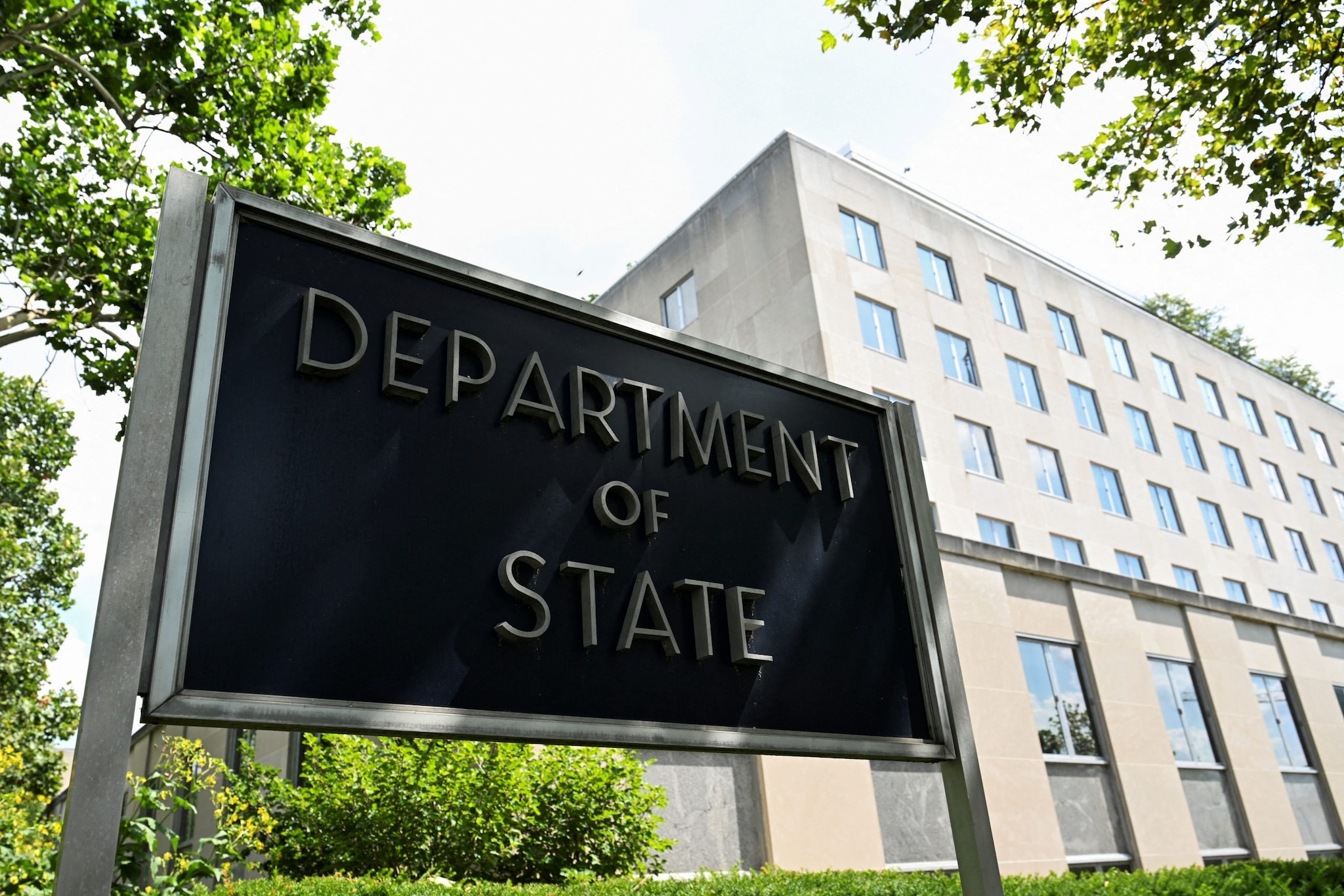
The decision by the United States Department of State to order the departure of non-emergency personnel from the U.S. Embassy in Beirut is not merely a reactive safety measure; it is a calculated reduction of the diplomatic "attack surface" in a theater defined by asymmetric escalation. This maneuver signals that the risk-to-utility ratio for mid-level diplomatic engagement has breached an acceptable threshold. When a superpower thins its presence, it is prioritizing operational mobility and minimizing the potential for "hostage-logic" scenarios—where the presence of non-essential staff becomes a strategic liability that limits military or political response options.
The Triad of Risk Escalation
The drawdown in Beirut functions through three distinct pressure points that force the hand of the State Department's Bureau of Diplomatic Security.
1. Kinetic Spillover and Proximity Risks
The geography of the Lebanese-Israeli border ensures that any escalation between the Israel Defense Forces (IDF) and Hezbollah creates a geographic contagion. Unlike traditional state-on-state warfare, the presence of long-range precision-guided munitions (PGMs) in the hands of non-state actors means that "safe zones" within Beirut are theoretical rather than functional. The departure order acknowledges that the Lebanese state lacks the sovereign capacity to guarantee the "inviolability of diplomatic missions" as mandated by the Vienna Convention on Diplomatic Relations.
2. The Iranian Influence Vector
Tensions between Washington and Tehran do not move in a straight line; they manifest through proxy nodes. Lebanon serves as the primary node for Iranian power projection via the "Unity of Fronts" strategy. When the U.S. perceives an imminent threat from Iran, the embassy in Beirut becomes a convenient target for deniable retaliation. By removing non-essential staff, the U.S. reduces the "density of targets," effectively signaling to Tehran that the remaining personnel are purely high-value, protected assets whose harm would trigger a disproportionate kinetic response.
3. Logistical Gridlock and Evacuation Constraints
Evacuating a full embassy staff during an active conflict is a logistical failure point. Beirut-Rafic Hariri International Airport is highly vulnerable to blockades or kinetic strikes, as seen in historical precedents. The "Ordered Departure" phase precedes the "Non-combatant Evacuation Operation" (NEO). By initiating a voluntary or ordered departure of non-essential personnel now, the military simplifies the math for a potential future NEO, which would involve the U.S. Sixth Fleet and complex amphibious or aerial extraction under fire.
The Cost Function of Diplomatic Presence
Maintaining a full diplomatic mission during a period of high regional friction involves a massive hidden cost in security resources. Every non-essential staff member requires a specific allocation of "Life Support" and "Security Detail" assets.
- Security Overhead: In high-threat environments, the ratio of security personnel to civilian staff can reach $1:2$ or higher. Reducing the civilian footprint allows the remaining security assets to focus on the protection of the Ambassador and key intelligence officers.
- Intelligence Focus: A smaller staff allows the mission to pivot from "broad-spectrum engagement" (cultural exchange, trade, general visas) to "crisis-critical intelligence." This shift ensures that the embassy functions less as a bureaucratic outpost and more as a forward-deployed sensing station.
- Political Messaging: A drawdown is a form of non-verbal communication. It tells the host government—in this case, the fragile Lebanese administration—that the U.S. views the security environment as unmanageable. This exerts pressure on Lebanese political actors to restrain Hezbollah, as a full U.S. withdrawal often precedes a total loss of Western economic and diplomatic support.
Deconstructing the Hezbollah Factor
Hezbollah is not a monolithic actor, but it operates under a rational-actor framework within the context of its own survival and Iranian interests. The U.S. strategic calculus must account for Hezbollah's internal "escalation ladder."
The first rung is symbolic: rhetorical denunciations and low-level border skirmishes. The second involves targeted strikes on military infrastructure. The third, and most dangerous for diplomatic staff, is the targeting of U.S. assets to force a total regional retreat. The current staff reduction is a defensive posture designed to skip the third rung. If there are fewer targets to hit, the "cost" for Hezbollah to initiate a major strike on the embassy becomes higher relative to the "gain," as any strike would now likely hit high-ranking officials, triggering an immediate and devastating U.S. counter-strike.
Structural Vulnerabilities in Lebanon’s Security Architecture
The U.S. decision is also a vote of no confidence in the Lebanese Armed Forces (LAF). While the U.S. has historically funded the LAF as a counterweight to non-state militias, the LAF’s inability to control the southern border or secure the capital’s perimeter during a major conflict is a known quantity.
- Institutional Fragmentation: The LAF is subject to the same sectarian divisions that paralyze the Lebanese parliament. In a conflict involving Hezbollah, the LAF’s chain of command is likely to fracture, rendering them useless as a protective force for foreign embassies.
- Infrastructure Fragility: Lebanon’s power grid and telecommunications are on the verge of collapse. A diplomatic mission cannot operate "non-essential" services when it must generate its own electricity and secure its own water and fuel supply in a collapsing economy. The drawdown reduces the mission's "resource burn rate."
The Logic of Preemptive Attrition
This is not an isolated event but part of a broader doctrine of "Preemptive Attrition." In the modern era, the optics of a chaotic embassy evacuation (reminiscent of Saigon or, more recently, Kabul) carry a high political cost domestically in the United States.
The State Department’s "Emergency Action Plan" (EAP) dictates that the transition from "Authorized Departure" (where staff can choose to leave) to "Ordered Departure" (where they must leave) is a signal that the internal intelligence suggests a closing window of safety. The "Authorized" phase acts as a pressure valve, allowing families and non-critical workers to exit before the commercial transport infrastructure fails.
Strategic Forecast and Contingency Requirements
The drawdown should be viewed as the definitive end of "normalization" in the Levant for the current cycle. The remaining core team in Beirut will now operate under a "fortress embassy" mandate. This involves:
- Suspension of Public-Facing Diplomacy: Consular services and public affairs move to a virtual or skeletal framework.
- Hardening of Communication Lines: Transitioning all mission-critical data to hardened satellite links as the local fiber-optic infrastructure is deemed compromised.
- Coordination with the "Quad": Increased reliance on regional partners (Cyprus, Jordan, and the UAE) to act as offshore processing hubs for Lebanese-related affairs.
The strategic play here is to decouple U.S. foreign policy from the vulnerability of its personnel. By thinning the ranks in Beirut, Washington regains the "freedom of maneuver." It can now take more aggressive stances against Iranian proxies or support Israeli defensive actions without the immediate fear that a mob or a militia will overrun a sprawling embassy complex filled with hundreds of defenseless administrators.
The move is a tactical retreat to enable a more flexible strategic offense. If tensions de-escalate, the staff returns. If they do not, the U.S. has already completed the most difficult part of a withdrawal: the early exit of those who cannot defend themselves. The mission in Beirut is now a lean, high-security node in a regional conflict matrix, prepared for the transition from diplomacy to crisis management.