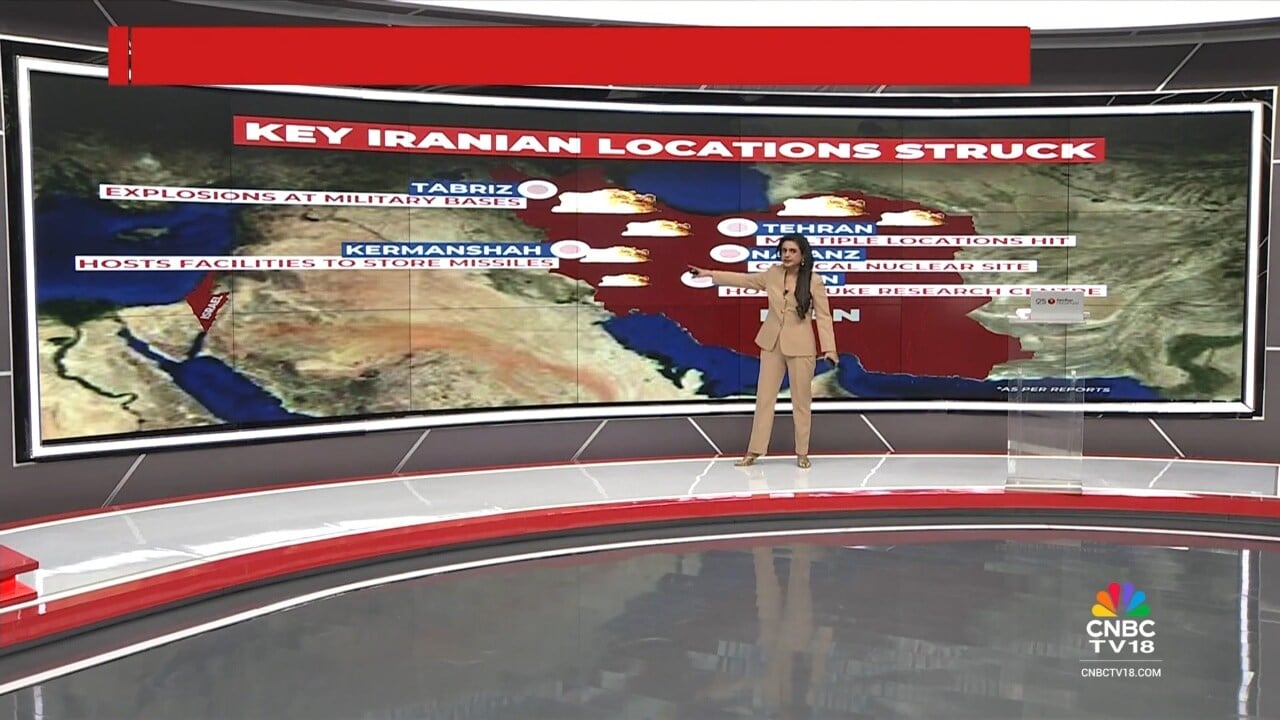
The shift from symbolic posturing to systemic degradation marks a fundamental transition in the kinetic exchange between the United States, Israel, and Iran. While surface-level reporting focuses on the visual spectacle of explosions, a structural analysis of the strikes reveals a calculated attempt to dismantle specific operational capacities. This is not a generalized "war"; it is a sequence of precision-engineered interventions designed to reset the regional balance of power through the targeted removal of critical infrastructure.
The Triad of Strategic Objectives
To understand the internal logic of these strikes, one must categorize the targets not by location, but by their functional role in the Iranian defense architecture. The operation follows a three-pillared strategy:
- Suppression of Enemy Air Defenses (SEAD): Before any long-term objectives can be met, the immediate tactical environment must be cleared. This involves the neutralization of early-warning radar systems and surface-to-air missile (SAM) batteries. By blinding the defender, the attacker secures "freedom of maneuver," allowing subsequent waves of aircraft or munitions to operate with minimal risk.
- Disruption of Logistics and Assembly: The strike packages focus on facilities involved in the production and storage of ballistic missiles and unmanned aerial vehicles (UAVs). These are the primary vectors for Iranian power projection. Destroying a launch site offers temporary relief; destroying a manufacturing hub creates a multi-year deficit in the adversary's inventory.
- Command and Control (C2) Decapitation: The third pillar involves hitting the communication nodes that allow centralized leadership to direct decentralized militia proxies. Severing these links forces the adversary to rely on slower, more vulnerable communication channels, introducing latency into their decision-making cycles.
The Physics of Precision and the Limit of Kinetic Force
The effectiveness of these strikes is governed by the Circular Error Probable (CEP)—a measure of a weapon system's precision. When dealing with hardened underground facilities, such as those housing centrifuges or missile silos, the math of destruction changes.
Standard high-explosive yields are often insufficient for "bunker-busting" operations. Instead, the strategy relies on kinetic energy penetrators. The formula for kinetic energy, $E_k = \frac{1}{2}mv^2$, dictates that velocity is far more critical than mass. By increasing the impact speed, munitions can penetrate tens of meters of reinforced concrete or rock before detonating. However, there is a physical limit to what can be achieved through conventional strikes. Deeply buried assets require sustained "boring" strikes—where multiple munitions hit the exact same coordinate in rapid succession—to eventually reach the target.
This creates a bottleneck in mission planning. Each hardened target requires a disproportionate amount of the strike package's total payload. Consequently, military planners must choose between broad-spectrum damage across many soft targets (logistics hubs, fuel depots) or deep-penetration strikes against a few high-value hardened sites.
Strategic Signaling vs. Operational Necessity
A recurring error in conflict analysis is the failure to distinguish between a strike meant to communicate intent and a strike meant to eliminate a capability.
- Communication Strikes: These often target peripheral assets or empty facilities during off-hours. The goal is to demonstrate that "we can reach you" without triggering an all-out escalatory response.
- Capability Strikes: These occur without warning and target the most sophisticated components of the enemy's military, such as high-end S-300 or S-400 radar arrays.
The current trajectory indicates a move toward the latter. When an attacker targets radar systems, they are not just "sending a message." They are preparing the environment for a much larger, more sustained campaign. Removing a radar site is a prerequisite for a follow-on strike. If the radar is not replaced within a specific window, the defender remains blind, creating a "vulnerability gap" that the attacker can exploit at will.
The Cost Function of Regional Proxies
Iran’s primary defensive strategy is not based on its domestic borders but on its "Forward Defense" doctrine. This utilizes a network of non-state actors (Hezbollah, Houthis, various militias) to create a multi-front dilemma for Israel and the United States.
The economic cost of this strategy is asymmetric. A drone costing $20,000 can force a defender to launch an interceptor missile costing $2,000,000. Over a long enough timeline, the defender faces "interceptor depletion," where they run out of high-end munitions faster than the attacker runs out of low-end drones.
The strikes in Iran attempt to invert this cost function. By hitting the source of the technology—the engineers, the specialized tooling, and the assembly lines—the United States and Israel aim to make the "export" of these low-cost weapons prohibitively expensive. If the manufacturing base is compromised, the cost of each remaining drone in the inventory effectively sky-writes, as it becomes an unreplaceable asset rather than a mass-produced commodity.
Intelligence Integration and the Kill Chain
The "Kill Chain" is the process of finding, fixing, tracking, targeting, engaging, and assessing a target. In the context of the Iran strikes, the most difficult phase is not the "engage" part (the actual explosion), but the "find" and "assess" phases.
- Finding: This requires "all-source" intelligence, including signals intelligence (SIGINT) to intercept communications and human intelligence (HUMINT) on the ground to confirm the contents of a warehouse.
- Assessing: Battle Damage Assessment (BDA) is the most overlooked part of the cycle. After the smoke clears, satellite imagery must determine if the target was actually neutralized. If a building is still standing but the internal machinery is destroyed by overpressure, the BDA might incorrectly record a miss. Conversely, hitting a decoy—a common Iranian tactic—results in a "wasted" sortie.
The sophistication of these strikes suggests a high level of "penetrative intelligence." This means the attackers likely have real-time data on the movement of mobile missile launchers (TELs). These launchers are notoriously difficult to hit because they can deploy, fire, and relocate within a 15-minute window. Success against TELs indicates a persistent overhead presence, likely via stealth UAVs or high-revisit satellite constellations.
Escalation Dominance and the Risk of Miscalculation
The concept of "Escalation Dominance" refers to a state's ability to control the intensity of a conflict at every possible level. If one side raises the stakes (e.g., by launching a larger missile barrage), the other side must be able to respond with even greater force to force a de-escalation.
The danger in the current US-Israel-Iran triangle is the "Blind Spot of Rationality." Both sides assume the other is a rational actor who wants to avoid total war. However, if the strikes hit a "red line" target—such as a site essential to the regime's internal survival or a high-ranking religious leader—the logic of escalation dominance breaks down. The defender may feel they have no choice but to respond with "irrational" force to maintain their internal legitimacy.
Furthermore, the involvement of third-party actors like Russia or China introduces a geopolitical variable. Russia, in particular, has become reliant on Iranian drone technology for its operations in Ukraine. Any significant degradation of Iranian manufacturing capacity directly impacts Russian frontline capabilities, potentially drawing Moscow into a more active role in the Middle East to protect its supply chain.
Economic Fallout and Energy Security
While the strikes are military in nature, their primary global impact is felt in the energy markets. The Strait of Hormuz remains the world's most critical chokepoint.
- Total throughput: Approximately 20-30% of the world's consumption of liquid petroleum.
- The Threat: Iran has the capability to mine the strait or use anti-ship missiles to disrupt tanker traffic.
The military strikes are specifically designed to neutralize the launch sites of these anti-ship missiles. By prioritizing coastal defense units, the US and Israel are attempting to "de-risk" the global economy from a potential energy blockade. If the naval assets and coastal batteries are removed early in the conflict, the threat of an oil price spike is significantly mitigated.
Structural Weaknesses in the Iranian Response
Iran’s response to these strikes has historically relied on "Strategic Patience"—the idea of absorbing hits while waiting for a more favorable political or diplomatic environment. However, this strategy has a shelf life. As the technical gap between Israeli/US capabilities and Iranian defenses widens, "patience" begins to look like "incapacity."
The second weakness is the "Technological Monoculture." Iran’s missile and drone programs rely on a specific set of imported components (often dual-use electronics) and domestic adaptations of older designs. Once the blueprints and the specific manufacturing nodes for these systems are identified, the entire network becomes vulnerable to a "systemic collapse" where the destruction of a few key components halts the entire production line.
Tactical Execution and Future Trajectories
The current operation is not a singular event but a phase in a larger multi-domain conflict. The immediate tactical focus will remain on:
- The "Grey Zone": Cyber-attacks aimed at the electrical grids of military bases to supplement kinetic strikes.
- Satellite Jamming: To prevent Iranian-aligned groups from using GPS-guided munitions.
- Electronic Warfare (EW): Flooding the airspace with false signatures to confuse remaining radar operators.
The shift from proxy-led skirmishes to direct-state-on-state strikes signifies that the "threshold of deterrence" has been crossed. The previous status quo, where Iran could hide behind its proxies to avoid direct consequences, is functionally extinct.
The strategic play now is to force a "compellence" scenario. The US and Israel are not trying to conquer territory; they are trying to compel the Iranian leadership to change its behavior by making the cost of its current foreign policy unsustainable. This requires a relentless focus on the "Centers of Gravity"—the specific military and economic assets that the regime values most.
For the observer, the metric of success is not the number of explosions recorded on social media, but the subsequent silence. If Iran fails to launch a significant retaliatory strike within the expected window, it indicates that the SEAD and C2 disruption phases were successful. The next strategic move is the systematic expansion of the target list to include the "Deep Reserve" assets, effectively stripping the adversary of its ability to project power for the next decade. Success in this theater depends entirely on maintaining the "Information Advantage"—the ability to see, decide, and strike before the defender can even identify that their sensors have been compromised.
Would you like me to analyze the specific electronic warfare signatures used in these recent strikes or the economic impact of a potential Strait of Hormuz blockade?