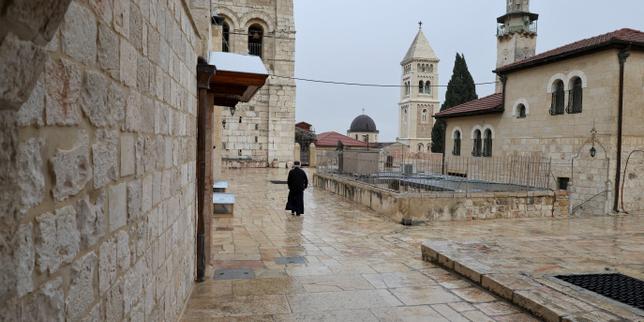
The restriction of Cardinal Pierbattista Pizzaballa, the Latin Patriarch of Jerusalem, from accessing the Church of the Holy Sepulchre for Palm Sunday services is not merely a bureaucratic oversight or a temporary security hiccup. It is a calculated escalation in the long-standing struggle for religious sovereignty in one of the most volatile square miles on earth. When the Vatican denounces an "offense to believers," it is signaling that the Status Quo—the delicate 19th-century legal framework governing holy sites—is currently being shredded.
For the first time in recent memory, the representative of the Pope was physically barred from the spiritual heart of Christendom at the precise moment the liturgical calendar demands his presence. This incident serves as a flashpoint for the broader tensions currently gripping the Old City, where the intersection of heightened security and religious nationalism has created an environment where even the most senior clergy are no longer exempt from the restrictive measures imposed on the local Palestinian Christian population.
The Invisible Walls of the Old City
To understand why a Cardinal cannot walk a few hundred yards through his own diocese, one must look at the hardening of the checkpoints and the selective application of "security necessity." Since late 2023, the movement of Christians from the West Bank into Jerusalem has been almost entirely halted. However, the move to block the Patriarch himself represents a shift from restricting the congregation to neutralizing the leadership.
The mechanics of the disruption are often mundane but effective. It starts with the denial of permits for the traditional procession. Then comes the "buffer zone" strategy, where iron barricades are placed strategically to choke the flow of people toward the Christian Quarter. By the time the Patriarch’s entourage reaches the Damascus Gate or the New Gate, they are met with a logistical wall that security forces claim is for "crowd control," despite the fact that the crowds have already been thinned by the permit bans.
This is a strategy of attrition. If you make it difficult enough to worship, the act of worship becomes a political statement rather than a spiritual one. The Vatican's sharp response reflects a growing realization that the neutrality of the Holy See is being ignored by local authorities who see the Christian presence as an inconvenient variable in the larger demographic struggle for Jerusalem.
The Collapse of the Status Quo
The Status Quo agreement of 1852 was designed to prevent exactly what we saw this Palm Sunday. It dictates who can enter which part of the Church of the Holy Sepulchre and when. It is the only thing keeping the peace between Greeks, Latins, Armenians, Copts, and Syrians. When an external state power intervenes to prevent a primary stakeholder like the Latin Patriarch from fulfilling his duties, the entire legal edifice begins to wobble.
Historically, the Israeli police and the various religious orders have maintained a professional, if frosty, coordination. That coordination has been replaced by a unilateral command structure that prioritizes security theater over religious freedom. The "offense to believers" mentioned by Rome refers to the psychological impact on a community that already feels its days in the city are numbered. When the Patriarch is stopped, the average parishioner feels completely unprotected.
We are seeing a transition from Jerusalem as a shared city of three faiths to Jerusalem as a city where one faith holds the keys and the others are merely tolerated guests. This shift is not accidental. It is reflected in the increased frequency of spitting incidents against clergy and the vandalism of cemeteries—actions that the Latin Patriarchate has repeatedly warned are being met with "impunity" by the state.
The Geopolitics of a Palm Sunday Procession
The international community often views these incidents as minor local disputes. They are wrong. The blocking of Cardinal Pizzaballa has immediate ripples in Paris, Washington, and Amman. Jordan, as the custodian of the holy sites, views any encroachment on Christian or Muslim access as a direct threat to its own legitimacy and the regional peace treaty.
Furthermore, the Vatican’s uncharacteristically blunt language suggests that the era of "quiet diplomacy" is failing. For decades, the Holy See preferred to handle these matters behind closed doors. Now, they are taking the fight to the public square because the "behind closed doors" options have been exhausted. The Patriarch is no longer just a religious figure; he has been forced into the role of a human rights advocate for a dwindling minority.
Critics of the Patriarchate suggest that the church is being overly political. This argument ignores the reality that in Jerusalem, the very act of walking through a gate is a political decision. If the Patriarch does not demand access, he effectively cedes the right to that access for all future generations. The church is not seeking a fight; it is trying to survive in a landscape where the rules of engagement are being rewritten by those who do not value the pluralistic history of the city.
The Security Pretext and the Reality of Control
Authorities often cite "intelligence warnings" or "safety concerns" regarding the structural integrity of the Old City's narrow streets to justify these blockades. While crowd surges are a legitimate concern in ancient cities, the selective nature of these restrictions tells a different story. During other national holidays, the same streets are often packed with thousands of marchers under state protection.
The difference lies in the perceived loyalty of the participants. The Christian Palm Sunday procession is seen as an expression of Palestinian identity as much as it is an expression of faith. By limiting the Patriarch’s movement, the authorities are attempting to decouple the religious identity from the national identity, effectively telling the world that the Christians of Jerusalem are a museum piece to be managed, rather than a living community with rights to the city.
The fallout from this incident will likely manifest in a further cooling of relations between the Holy See and the State of Israel. It also emboldens hardline elements on both sides who believe that coexistence is a relic of the past. The Patriarch’s inability to reach the tomb of Christ on the day marking his entry into the city is a chilling metaphor for the current state of the Holy Land: the gates are locked, and the key-holders are no longer interested in dialogue.
The Economic and Social Vacuum
Beyond the theological outrage, there is a practical devastation to these blockages. The Christian Quarter relies on these high-holy days for economic survival. When the Patriarch is barred and pilgrims are discouraged, the local shops, guest houses, and restaurants suffer. This economic pressure accelerates the "quiet exodus" of Christians from Jerusalem.
A city without its indigenous Christian population becomes a theme park. The Vatican is aware that if the Patriarch cannot lead his people, there will soon be no people left to lead. The demographic reality is that the Christian population in the Old City has dropped below 2%, a historic low. Every barred gate and every cancelled procession is a nudge toward the exit for families who have lived there for centuries.
The international response must move beyond "deep concern." Without a firm re-establishment of the Status Quo that includes guaranteed access for religious leaders, the precedent set this Palm Sunday will become the new baseline. The "offense to believers" isn't just a slight against a religion; it is an assault on the legal and social fabric that has kept Jerusalem from complete self-destruction for over a century.
The reality on the ground suggests that the authorities are testing the limits of international patience. By targeting a figure as prominent as Pizzaballa, they are measuring the level of pushback from Rome and the West. If the reaction is perceived as weak, we can expect the restrictions to become permanent fixtures of the liturgical year. The Patriarch standing before a line of police is the new icon of the Holy Land—a shepherd separated from his flock by the cold steel of a modern checkpoint.
Take a moment to examine the current diplomatic cables coming out of the Latin Patriarchate and compare them to the statements made five years ago; the shift from hopeful cooperation to defensive urgency is undeniable.