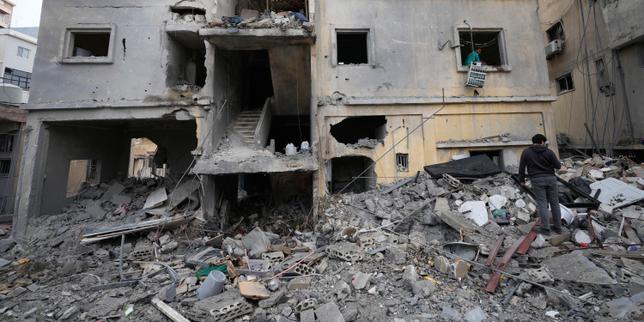
Lebanon currently operates as a state with negative fiscal equity, where the cost of maintaining its internal security and basic infrastructure exceeds its sovereign revenue generation by an order of magnitude. The escalation of kinetic conflict between Israel and Hezbollah does not merely create a humanitarian crisis; it acts as a terminal stress test on three specific structural pillars: the viability of the 2022 maritime border agreement, the solvency of the remaining banking reserves, and the delegation of legitimate force. By analyzing the current escalation through the lens of institutional degradation, we can quantify why this specific conflict serves as a catalyst for a permanent regional shift rather than a temporary disruption.
The Triad of Institutional Erosion
The collapse of a mid-tier Mediterranean economy usually follows a predictable sequence of currency devaluation followed by brain drain. Lebanon, however, is experiencing a non-linear breakdown driven by three competing vectors.
1. The Fiscal Asymmetry of Non-State Warfare
Hezbollah’s military infrastructure operates outside the Lebanese national budget, yet the costs of its engagement are socialized across the entire Lebanese population. This creates a "free-rider" problem in reverse: a sub-state actor initiates a high-cost conflict, while the state—which has no control over the decision-making process—is expected to manage the resulting destruction of physical capital.
The destruction of agricultural land in the south and the displacement of over 100,000 citizens represent a direct hit to the GDP that the central bank, currently operating under a restricted "cash economy" model, cannot mitigate. When a non-state actor dictates the external risk profile of a nation, the sovereign credit rating becomes irrelevant, replaced by a "conflict premium" that halts all foreign direct investment (FDI).
2. The Bankruptcy of Technical Reforms
Prior to the current escalation, the International Monetary Fund (IMF) and international coordinators like Pierre Duquesne focused on a roadmap involving the restructuring of the banking sector and the implementation of capital controls. These reforms required a baseline of political stability. The kinetic conflict has effectively killed the "reform-for-aid" logic.
International donors are now forced to pivot from developmental aid (aimed at fixing the electricity grid or water systems) to emergency humanitarian aid. This transition is a strategic setback. Humanitarian aid is ephemeral; it sustains life but does not build equity. By shifting the international community's focus back to survival, the window for structural financial stabilization has likely closed for the next decade.
3. The Fragmentation of Sovereign Authority
A state's primary product is the "monopoly on the legitimate use of physical force." In Lebanon, this monopoly has been fragmented for decades, but the current war reinforces this division. As the Lebanese Armed Forces (LAF) remain on the sidelines to avoid direct confrontation with Israel or internal friction with Hezbollah, their perceived value as a national guarantor diminishes. This creates a vacuum filled by local sectarian militias and "neighborhood watch" groups, leading to a "cantonization" of the country that is harder to reverse than a simple financial deficit.
The Maritime Boundary and Resource Extraction Paradox
In 2022, the US-mediated maritime deal between Israel and Lebanon was framed as a path toward Lebanese energy independence. The logic was that the Qana field would provide the fiscal runway needed to pay down debt. The current conflict invalidates the risk-assessment models used by TotalEnergies and other consortium partners.
No energy conglomerate will deploy multibillion-dollar extraction platforms in a zone where the threat of missile exchange is a daily reality. This creates a "stranded asset" scenario. Lebanon’s potential gas wealth is effectively locked behind a geopolitical firewall. Without the prospect of future energy revenues, the Lebanese government loses its only credible collateral for future international loans. The cost of insurance for maritime operations in the Levant has already spiked, making the break-even price of Lebanese gas uncompetitive compared to Qatari or American LNG.
The Hezbollah Dependency Loop
The conflict reinforces a dangerous feedback loop regarding social services. As the Lebanese state fails to provide food, healthcare, or housing to those displaced by Israeli strikes, Hezbollah’s civil wing steps in. This is a deliberate strategy of institutional displacement.
- Step 1: External conflict destroys state-managed infrastructure.
- Step 2: The state, bankrupt and paralyzed by political deadlock, fails to respond.
- Step 3: The non-state actor utilizes its independent funding streams (often via illicit finance or regional patrons) to provide relief.
- Step 4: The population’s loyalty shifts from the abstract concept of "the state" to the functional reality of "the sect."
This loop makes the disarmament of Hezbollah or its integration into the state military impossible. The war doesn't just "strengthen" Hezbollah; it makes the Lebanese state an unnecessary middleman in the eyes of a significant portion of the electorate.
Regional Contagion and the "Buffer State" Model
France and the European Union have historically viewed Lebanon as a buffer—a democratic, pluralistic outpost that prevents the complete destabilization of the Levant. This view is now obsolete. The "buffer" has become a "conduit."
The flow of weapons and intelligence through Lebanon, coupled with the potential for a massive new wave of migration toward Cyprus and onwards to Europe, changes the calculus for Brussels. If Lebanon becomes a failed state, it becomes a permanent source of regional instability rather than a barrier to it. The "cost of inaction" for Europe is now higher than the "cost of intervention," yet the tools for intervention (sanctions, diplomatic pressure) have proven ineffective against actors who operate outside the global financial system.
The Breakdown of the Taif Agreement
The 1989 Taif Agreement, which ended the Lebanese Civil War, was built on a foundation of elite power-sharing. This system—confessionalism—is designed for paralysis, not crisis management. In a period of total war, a government that requires consensus between eighteen different religious sects cannot make the rapid-fire decisions necessary to protect its borders or its currency.
The current environment exposes the fatal flaw of the Lebanese constitution: it was designed to prevent one group from dominating, but it also prevents the state from acting. As Israel targets Hezbollah’s financial arm (Al-Qard Al-Hassan), the entire parallel economy of Lebanon is being dismantled. Because the formal banking sector is already dead, the destruction of the parallel sector leaves the country in a state of primitive barter.
Strategic Forecast: The Emergence of the "Grey Zone" Protectorate
Lebanon is not heading toward a traditional "recovery" or a "total collapse." Instead, it is settling into a "Grey Zone" state of being.
The most probable outcome involves a fragmented territory where the central government in Beirut maintains a symbolic presence while the real power is exercised by local commanders and international actors. The "enemies" of the state mentioned in traditional diplomatic circles are not just external; they are the internal mechanisms of corruption and the parallel military structures that have now been battle-hardened and further integrated into the social fabric.
To stabilize this environment, the international community must move beyond the "Pierre Duquesne" model of polite diplomatic pressure. A new framework is required:
- Direct Funding of Neutral Institutions: International aid must bypass the central ministries entirely, flowing directly to the Lebanese Armed Forces and municipal-level NGOs to prevent the "dependency loop" mentioned above.
- Sanctions on the Financial Enablers: Targeting the political elites who provide legal cover for non-state actors is more effective than targeting the actors themselves. The "enablers" have assets in Paris, London, and New York that are vulnerable.
- A Redefined Maritime Security Mandate: UNIFIL’s mandate must be expanded to include the active protection of energy infrastructure if there is any hope of attracting energy investment back to the region.
The window for a "sovereign" Lebanon is narrowing. The current conflict is the final evidence that the 1920-era "Grand Liban" project has reached its structural limits. Future stability will not come from restoring the old system, but from a brutal, data-driven reorganization of how power and capital are distributed in the Levant.
Move the focus of diplomatic engagement away from the stalled Presidential election and toward the immediate creation of a "Special Economic Zone" for the Port of Beirut and the offshore gas blocks, managed by an international board with executive powers. This bypasses the confessional deadlock and creates a "state-within-a-state" for capital that can survive even if the political center remains in a state of permanent war.


