You probably haven't thought about the New World screwworm in decades. Most Americans haven't. That's because we technically won the war against this parasite back in the 1960s. But history has a nasty habit of repeating itself, and right now, this literal flesh-eater is scratching at the door. If it gets back into the United States permanently, the impact on our food supply and wildlife will be devastating. This isn't just a "gross bug story" for the evening news. It’s a biological crisis that demands immediate attention before your grocery bill doubles and our deer populations collapse.
The New World screwworm (Cochliomyia hominivorax) is a nightmare in larval form. Unlike most flies that feed on dead tissue, screwworm larvae prefer living flesh. They enter through the tiniest nicks—a tick bite, a scratch from a thorn, or the navel of a newborn calf—and begin eating the host alive from the inside out. They have these jagged, screw-like ridges on their bodies that anchor them into the wound. It’s as painful as it sounds. If left untreated, the host dies. It's that simple.
Why the Buffer Zone Is Breaking Down
For over half a century, the U.S. and its partners in Central America have maintained a "biological wall" at the Darien Gap between Panama and Colombia. This is known as the Screwworm Barrier Maintenance Commission (COPEG). They use a fascinating, albeit strange, tactic called the Sterile Insect Technique. They breed millions of screwworms, blast them with just enough radiation to make them sterile, and then drop them from planes. When these sterile males mate with wild females, no offspring are produced. The population crashes.
It worked brilliantly for years. We pushed the "front line" all the way down to the narrowest point of the Americas. But lately, things have gone sideways.
In late 2023 and throughout 2024, Panama declared a state of emergency. The screwworm didn't just stay in the jungle; it started moving north. Costa Rica and Nicaragua followed with their own emergencies shortly after. Climate change is playing a role here. Warmer winters and shifting rainfall patterns create the perfect humid breeding ground for these flies. They're moving faster than we can drop sterile flies to stop them.
Political instability and increased migration through the Darien Gap also complicate things. More people and animals moving through dense, unmonitored jungle means more opportunities for the parasite to hitch a ride. We're seeing a breakdown in the very systems designed to keep this thing contained.
The Economic Cost of Failure
If you think this is only a problem for ranchers, you're mistaken. The USDA estimated years ago that if the screwworm were to re-establish itself in the United States, it would cost the livestock industry over $1 billion annually. Adjusted for today's inflation and the current state of the global supply chain, that number is likely much higher.
Ranchers would have to inspect every single animal in their herd daily. That’s labor-intensive and expensive. Every time a cow is branded, dehorned, or gives birth, it becomes a target. In the mid-20th century, before the eradication program, screwworms killed millions of head of cattle. We’re talking about a direct hit to the price of beef, dairy, and leather.
Wildlife gets hit even harder. When the screwworm made a brief, terrifying appearance in the Florida Keys in 2016, it nearly wiped out the endangered Key deer. Over 130 deer—roughly 15% of the entire population—had to be euthanized because the infestations were so gruesome. They didn't have ranchers to treat their wounds. They just suffered. Imagine that happening to elk in the Rockies or white-tailed deer across the South. It would be an ecological massacre.
How the Parasite Actually Operates
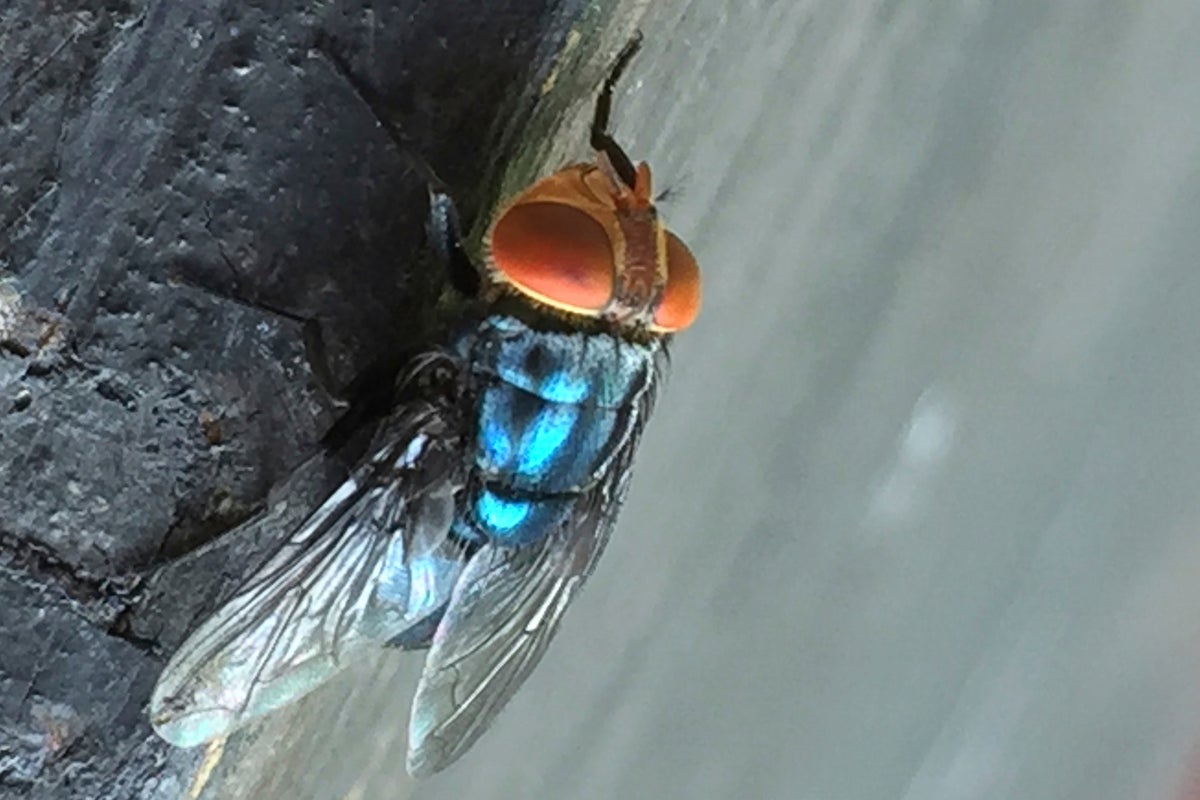
The fly itself looks like a common housefly but with a shiny, metallic blue-green body and three dark stripes on its back. You wouldn't think much of it if it landed on your soda can. But its life cycle is built for efficiency.
- The Entry: A female fly finds a warm-blooded animal with any kind of open wound.
- The Eggs: She lays up to 400 eggs at the edge of the wound.
- The Feast: Within 12 to 24 hours, the larvae hatch and burrow deep into the living tissue.
- The Growth: They feed for five to seven days, growing into "screws" about half an inch long.
- The Cycle Continues: They drop to the ground, pupate in the soil, and emerge as flies ready to do it all again.
What It Takes to Stop the Invasion
Stopping the screwworm isn't about better pesticides. We tried that, and it doesn't work on a continental scale. The only way forward is a massive, coordinated scale-up of the sterile fly program.
We need more fly "factories." Currently, the main production facility is in Panama. Relying on one single point of failure is a massive strategic mistake. If that facility goes down due to a natural disaster or political unrest, the "biological wall" disappears overnight. We should be looking at regional hubs for sterile insect production to provide redundancy.
Funding is another hurdle. The U.S. government often forgets about successful programs. Because we haven't seen a screwworm in Texas or Arizona in decades, the urgency to fund COPEG or similar initiatives often fades. That’s a "success paradox." We’re so good at keeping the threat away that we stop fearing it. We need to treat this as a permanent national security line item, not a temporary project.
Surveillance at the border needs a massive upgrade. It’s not just about cows crossing the Rio Grande. It’s about pets. In the 2016 Florida outbreak, the most likely culprit was a dog or another small animal brought into the country. Every pet traveling from an endemic area needs a rigorous veterinary check. Most people don't even know what to look for, which makes education the second-most important tool after sterile flies.
Your Role in the Defense
Don't assume the government has this under control. If you live in a southern state or travel with pets to Central or South America, you're on the front line.
Check your animals. If you have a dog with a persistent "sore" that doesn't seem to heal, or if you see larvae that look like they're burrowing into the skin rather than sitting on top, don't wait. Call a vet immediately. Take photos. Collect a sample in a jar of alcohol if you’re brave enough. Early detection is the only reason the 2016 Florida outbreak didn't spread to the mainland.
We’ve won this war once before. We know the tactics that work. But complacency is the screwworm's best friend. If we don't reinforce the Darien Gap barrier and increase our domestic surveillance now, we're going to spend the next decade watching our livestock and wildlife disappear one bite at a time. Support increased USDA funding for trans-border pest control. It’s a lot cheaper than the alternative.