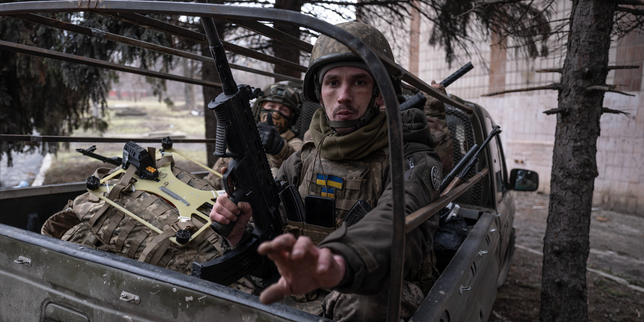
The Russian military failed to secure any measurable territorial gains throughout March 2024, marking a significant stagnation in their winter campaign. Despite consistent frontal assaults and a staggering expenditure of artillery shells, the front lines remained functionally frozen. This lack of progress, confirmed by data from the Institute for the Study of War (ISW), suggests that the momentum gathered after the fall of Avdiivka has dissipated. Moscow is currently trading lives for meters, and in March, even those meters proved elusive.
The High Cost of Minimal Ambition
Russia’s inability to move the needle in March is not for a lack of trying. The Kremlin has maintained a high tempo of operations across the eastern axis, specifically targeting areas like Bakhmut, Lyman, and Kupiansk. Yet, the maps don't lie. When you overlay the positions from March 1st against those of March 31st, the differences are microscopic.
The strategy has shifted toward a war of attrition that favors the defender in the short term. Russian commanders are relying on "meat assaults"—sending waves of infantry, often under-equipped and poorly trained, to reveal Ukrainian firing positions. It is a brutal, 19th-century approach to a 21st-century conflict. While this tactics can eventually wear down a defender's ammunition supplies, it has failed to create the operational breakthroughs necessary to seize significant hubs.
Ukraine is playing a disciplined game of "active defense." They are willing to yield small patches of gray-zone territory to preserve their most capable units, but in March, even those tactical withdrawals were unnecessary. The Russian offensive hit a wall of well-prepared trenches and sophisticated drone oversight that makes any concentrated armor movement a suicide mission.
Logistics and the Shell Gap Myth
There is a persistent narrative that Russia possesses an inexhaustible supply of artillery. While they certainly outgun Ukraine in terms of raw volume, the quality and distribution of that fire are degrading. Intelligence reports suggest that many of the shells currently reaching the front are North Korean imports with high failure rates or refurbished Soviet stock that lacks precision.
Quantity has a quality of its own, but only if you can hit the target. In March, Russian artillery struggled to suppress Ukrainian drone teams. This is the central friction of the current battlefield. Every time Russian forces attempt to mass for an attack, they are spotted by low-cost reconnaissance drones and engaged by First Person View (FPV) loitering munitions before they even reach the starting line.
Ukraine's "drone wall" has effectively neutralized the advantage Russia hoped to gain through its superior numbers. This isn't just about technology; it's about the democratization of precision. A $500 drone is destroying a $5 million tank, and in March, the math was heavily in Ukraine’s favor.
The Mud Factor and Tactical Exhaustion
We cannot ignore the geography. The "rasputitsa"—the season of mud—turned the Donbas into a quagmire throughout March. Off-road movement became impossible for heavy tracked vehicles, forcing Russian columns onto predictable paved roads. This created a shooting gallery for Ukrainian anti-tank teams.
Beyond the weather, there is the issue of tactical exhaustion. Units that have been in the field since the start of the year are depleted. Russia has avoided a second wave of formal mobilization, preferring to entice "volunteers" with high salaries. This provides a steady stream of bodies but fails to produce cohesive, high-functioning combat teams. You cannot build an elite armored division in three weeks.
The units currently failing to take ground are a patchwork of survivors and raw recruits. They lack the specialized training for complex combined arms maneuvers. Without the ability to coordinate tanks, infantry, and air support effectively, they are relegated to simple, frontal charges that are easily repelled by a modern, dug-in force.
Ukraine’s Strategic Breathing Room
The stalemate in March provided Kyiv with a vital window. After months of anxiety regarding Western aid, the European supply lines began to harden. Czech-led initiatives to source hundreds of thousands of shells from outside the EU started to materialize on the horizon.
Ukraine didn't just sit back and watch the Russians fail. They used this time to accelerate the construction of a multi-layered defensive line modeled after the very obstacles that stymied their own counter-offensive last year. Dragon’s teeth, deep anti-tank ditches, and vast minefields are now being laid at a feverish pace. Russia’s failure to break through in March means they will soon be facing an even more formidable fortress.
The psychological impact of a month with zero gains is also weighing on the Russian command structure. There are reports of increasing friction between the Ministry of Defense and various "Z-blogger" factions who are demanding faster results. The Kremlin's clock is ticking; they want to show progress before the ground dries and the next phase of the war begins.
The Black Sea Diversion
While the land war remained static, the maritime conflict continued to evolve. Russia’s inability to protect its Black Sea Fleet has forced its remaining ships to retreat further east, away from Sevastopol. This isn't just a naval sideshow. Every ship sunk or damaged is a blow to Russia's logistical capability to supply the southern front.
If Russia cannot dominate the sea, they cannot easily bypass the land-based bottlenecks in the south. The paralysis of the fleet mirrors the paralysis of the army. It is a systemic failure to adapt to a high-transparency battlefield where every move is tracked and countered in real-time.
The Intelligence Gap
One of the most overlooked factors in the March stalemate is the disparity in situational awareness. Ukraine is operating with a level of battlefield intelligence that is historically unprecedented. Through a combination of Western satellite data, domestic signals intelligence, and a massive network of civilian observers in occupied territories, Kyiv knows exactly where the Russian spikes are forming.
Russia, conversely, is fighting with a blindfold. Their command and control remain top-heavy and rigid. Decisions made in Moscow or Rostov-on-Don often fail to account for the immediate reality on the ground in a suburb of Donetsk. This lag in communication means that by the time a Russian unit receives an order to exploit a perceived weakness, the window of opportunity has already been slammed shut by Ukrainian reinforcements.
The Internal Strain
Sanctions might not have collapsed the Russian economy, but they are hollowing out the Russian military-industrial complex. The inability to source high-end chips and precision optics is resulting in "dumbed-down" versions of Russian hardware. T-90 tanks are being replaced by modernized T-62s. Advanced cruise missiles are being used sparingly, replaced by crude "glide bombs" that are powerful but lack the accuracy to hit specific military nodes reliably.
In March, this degradation became visible. The Russian offensive lacked the "snap" of a professional military operation. It felt sluggish, heavy, and predictable. If the goal was to capitalize on Ukrainian ammunition shortages before Western aid arrived, the window is closing fast. Russia spent its winter momentum and has nothing to show for it but a longer list of casualties and a fleet of burnt-out hulls.
The front line is a living entity, and right now, it is refusing to move. Every day that Russia fails to advance is a day that Ukraine strengthens its positions and integrates new technologies. The myth of the Russian steamroller has been replaced by the reality of a grinding, inefficient machine that is running out of gears.
The focus now shifts to whether Russia can reconstitute its forces for a late-spring push, or if the March stalemate is the new permanent reality of the war. Success in modern warfare requires more than just the will to sacrifice men; it requires a level of organizational flexibility that the current Russian command seems fundamentally unable to achieve. The mud will dry soon, but the structural rot in the Russian military remains.