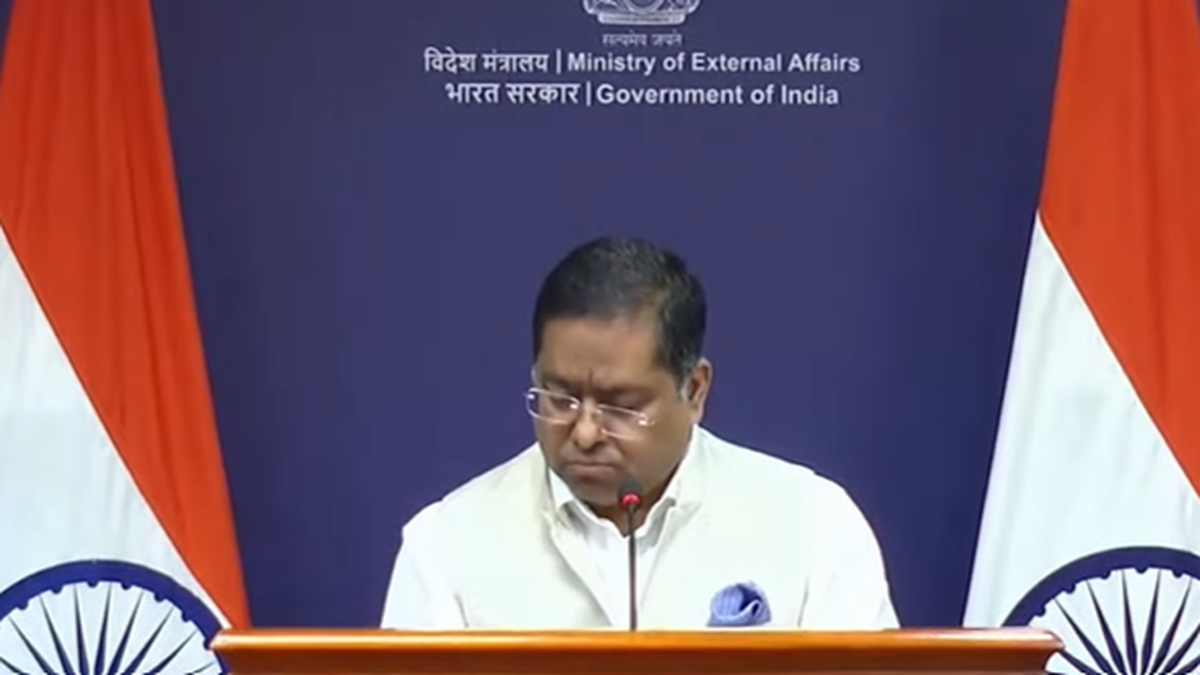
India’s refusal to explicitly name Israel in its condemnation of attacks on the United Nations Interim Force in Lebanon (UNIFIL) is not a diplomatic oversight but a calculated exercise in strategic multi-alignment. This response operates at the intersection of three distinct pressures: the preservation of international legal norms, the protection of non-combatant personnel in high-risk zones, and the maintenance of a high-value bilateral partnership with Israel. By analyzing the mechanics of New Delhi's "statement of concern," one can map the hierarchy of India’s foreign policy priorities in the Middle East.
The Tripartite Logic of New Delhi’s Rhetoric
The official reaction to the firing on UNIFIL positions—specifically the wounding of peacekeepers and the breaching of perimeter security—utilizes a specific linguistic framework. To understand why India chose a generalized condemnation over a targeted one, we must deconstruct the Three Pillars of Indian Diplomatic Neutrality.
- The Normative Pillar: India maintains a historical commitment to the sanctity of UN mandates. As one of the largest troop-contributing countries (TCCs) to UN missions, India views any attack on Blue Helmets as a systemic threat to the viability of collective security. If UNIFIL's immunity is compromised without a formal protest, the precedent endangers Indian personnel deployed in other volatile theaters, such as South Sudan (UNMISS) or the Democratic Republic of the Congo (MONUSCO).
- The Strategic Pillar: Israel is a primary defense and technology partner for India. The bilateral relationship has evolved from transactional arms sales to a deep-state integration involving intelligence sharing and co-development. Publicly censuring Israel would create friction in the "I2U2" (India, Israel, UAE, USA) grouping and complicate India's role as a balancing power in the region.
- The Tactical Pillar: By omitting a specific perpetrator, India leaves room for back-channel communication. In the lexicon of the Ministry of External Affairs (MEA), a "grave concern" directed at "the deteriorating security situation" allows for a stern message to be delivered to the Israeli leadership privately, without the domestic or international blowback associated with a public denunciation.
The Cost Function of Peacekeeping Vulnerability
The risk to UNIFIL personnel is a function of Operational Overlap. Unlike traditional peacekeeping where a clear buffer zone exists, the current conflict in Southern Lebanon involves a "non-contiguous battle space." The Israeli Defense Forces (IDF) are targeting Hezbollah infrastructure that is frequently situated in close proximity to UNIFIL outposts.
The technical cause of the current friction is the IDF’s Proximity Strategy. When Israeli forces operate near UN positions, they create a binary dilemma for the UN: evacuate and abandon the mandate, or remain and risk becoming collateral damage. India’s response focuses on the "inviolability of UN premises," a specific legal term under the Status of Forces Agreement (SOFA). The violation of this inviolability is treated by New Delhi as a technical breach of international law rather than a political provocation.
This distinction is critical. By framing the issue as a legal and safety concern rather than a political one, India avoids taking sides in the broader Israel-Hezbollah conflict while still signaling that the safety of its 900+ soldiers in the region is a non-negotiable priority.
Dissecting the MEA Statement: A Forensic Analysis
The phrasing "deteriorating security situation along the Blue Line" serves as a structural shield. The Blue Line is not a sovereign border but a withdrawal line established by the UN in 2000. By referencing this specific geography, India anchors its concerns in a UN-recognized framework rather than the shifting frontline of a ground invasion.
The omission of "Israel" reflects a broader Indian doctrine: Issue-Based Alignment. India does not view international relations as a series of zero-sum alliances. Instead, it treats each incident as a discrete data point.
- Incident: Fire on UNIFIL towers.
- Indian Goal: Ensure safety of Indian peacekeepers.
- Constraint: Maintain the "strategic partnership" with the actor responsible for the fire.
- Result: A statement that condemns the action but shields the actor.
This creates a "Strategic Buffer." If India names Israel, it aligns itself with the bloc of nations (such as Ireland or Spain) that have taken a more confrontational stance. This would diminish India's perceived utility as a "Vishwa Mitra" (Global Friend) that can talk to all sides.
The Troop Contributor Dilemma
India's position as a major TCC introduces a unique variable into the strategic equation. The TCC Risk Premium involves the political cost a government pays when its soldiers are harmed abroad. For the Indian government, the domestic optics of soldiers being injured by a "friendly" nation like Israel are highly sensitive.
The current crisis exposes a bottleneck in the UNIFIL mandate. Resolution 1701, which governs the mission, requires a cessation of hostilities that neither side is currently observing. Peacekeepers are essentially tasked with monitoring a peace that does not exist.
The mechanical failure here is the Lack of Enforcement Power. UNIFIL is a Chapter VI-plus mission; it has the right to self-defense but not the mandate to forcibly separate the combatants. India’s statement reflects the frustration of this structural limitation. By calling for "respect for the mandate," New Delhi is pointing out that the international community has placed its troops in a position of maximum exposure with minimum agency.
Mapping the Ripple Effects on Middle East Strategy
India’s nuanced stance is a prerequisite for its broader Connectivity Ambitions. Projects like the India-Middle East-Europe Economic Corridor (IMEC) rely on a stable, or at least predictable, Israel. If India were to pivot toward a hardline stance against Israeli military tactics, it would jeopardize the diplomatic capital required to revive these trans-continental trade routes.
The second limitation of a more aggressive stance is the Regional Balance. India has significant interests in Iran and the Arab world. While some Arab nations might prefer a stronger condemnation of Israel, they also value India’s role as a counterweight to Chinese influence in the region. A moderate Indian position provides these nations with a partner that is not beholden to the West but is also not reflexively anti-Israel.
The Strategic Play
The path forward for Indian diplomacy involves the transition from Passive Observation to Active Mediation Support. New Delhi must leverage its "silent condemnation" to extract specific safety guarantees from the Israeli defense establishment.
The strategic play is not a change in rhetoric, but a reinforcement of the Bilateral Military-to-Military Channel. India should utilize its high-level defense ties to establish "deconfliction protocols" specifically for Indian-held UNIFIL sectors. This moves the solution from the realm of public diplomacy—where it is subject to political theater—to the realm of operational security.
By maintaining this ambiguity, India preserves its seat at the table for any future post-conflict settlement. The objective is to remain the only major power that possesses the trust of the Israeli government, the Lebanese state, and the UN Secretariat. This positioning ensures that when the "reconstruction phase" of the Blue Line begins, India’s influence is not just requested, but required. The current "silence" on Israel’s name is the sound of a power preserving its options for the endgame.