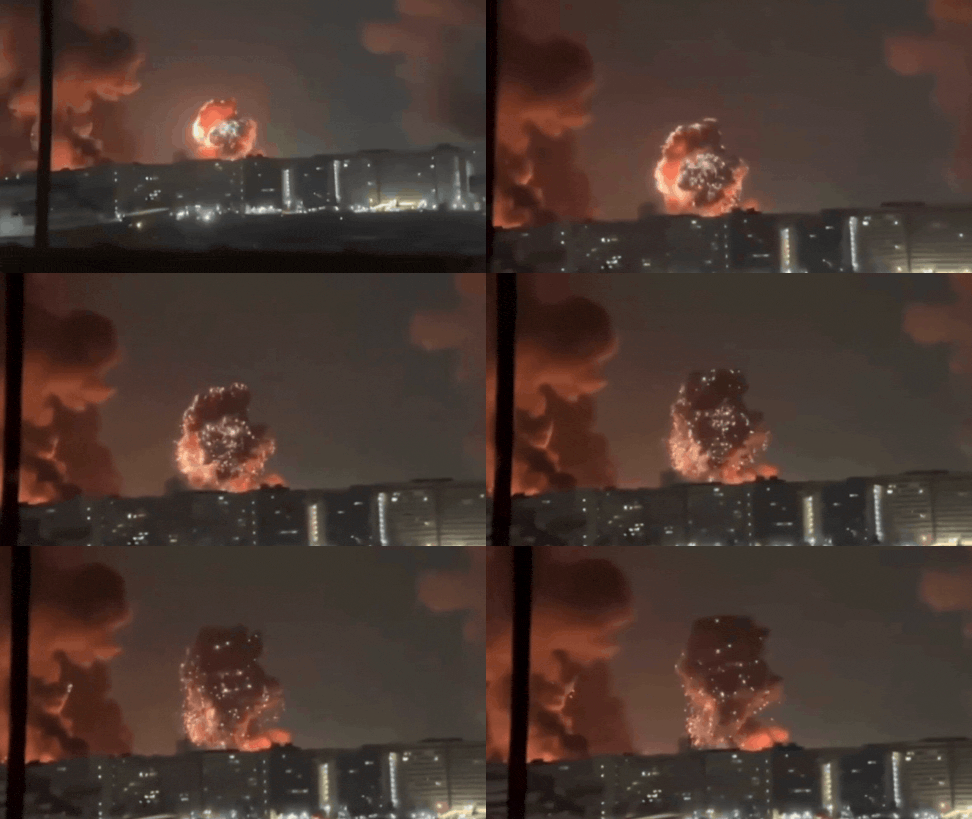
The images coming out of Tehran's Mehrabad and Imam Khomeini airports aren't just another headline in a long-standing regional conflict. When Israeli strikes hit the tarmac and hangar facilities in the heart of Iran's capital, they didn't just target military hardware. They struck the literal gateway of a sovereign nation. Reports confirm that several planes were ignited and massive explosions rocked the surrounding districts, yet miraculously, no casualties have been officially reported so far. This isn't just about tactical success or failure. It's about a fundamental shift in how "red lines" are drawn in 2026.
If you've been following the escalations between Israel and Iran, you know the dance. Usually, it's a proxy battle in Lebanon or a surgical strike in a remote desert. Not this time. By hitting the capital's aviation hubs, Israel is sending a message that no infrastructure is off-limits. The lack of casualties suggests a level of precision that is frankly terrifying, or perhaps a deliberate choice to avoid a total war scenario while still crippling the enemy's logistics.
The Strategy Behind Targeting Civilian Infrastructure
Military analysts often talk about "dual-use" facilities. An airport is the ultimate example. While these hubs move families and business travelers, they also serve as the primary conduits for IRGC (Islamic Revolutionary Guard Corps) transport. When you see a cargo plane engulfed in flames on a Tehran runway, it’s rarely just carrying mail. Israel has long claimed that these civilian channels are used to ferry drone components and missile guidance systems from North Korea or domestic factories to proxies like Hezbollah.
Hitting an airport in a capital city is a massive gamble. It disrupts the economy. It terrifies the populace. But from a strategic standpoint, it’s the most effective way to "ground" an opponent. By damaging runways and specialized maintenance hangars, Israel has effectively put a bottleneck on Iran's ability to project power quickly. You can't fly "ghost flights" if the tarmac is full of craters and the fueling stations are charred ruins.
What the Ground Reports Actually Tell Us
The initial chaos on social media showed secondary explosions. That's a huge detail. A standard missile hit causes a blast, but "secondary" pops and sustained fires usually mean the target was sitting on something combustible—like munitions or high-grade jet fuel. While the Iranian state media was quick to downplay the severity, satellite imagery and leaked cellphone footage from airport workers tell a different story.
We saw at least two large transport aircraft—likely Ilyushin Il-76s—completely gutted by fire. These aren't easy to replace. Because of international sanctions, Iran's aviation fleet is a patchwork of aging Boeings and Soviet-era workhorses kept alive by "cannibalizing" parts from other planes. Losing even two or three of these assets is a logistical nightmare that will take years to rectify.
Precision Over Destruction
The most striking aspect of this raid is the surgical nature of the hits. In a dense urban environment like Tehran, a missed coordinate means a high-rise apartment block or a school becomes "collateral damage." The fact that we are seeing zero reported deaths suggests the use of low-collateral warheads or perhaps cyber-kinetic integration that disabled defense systems before the kinetic strike.
It’s a display of dominance. Israel is saying, "We can put a hole in your plane while it’s parked in your house, and we won’t even wake up your neighbors." That kind of psychological warfare is arguably more potent than the physical damage itself. It forces the Iranian leadership to wonder what else is within reach. Their nuclear facilities? Their command bunkers? If an airport with high-security clearance can be hit this easily, nothing is safe.
The Global Ripple Effect on Air Travel
Don't think this is just a local problem. Tehran is a major waypoint for certain international corridors. When the smoke rises over Mehrabad, insurance premiums for every airline flying in the Middle East skyrocket. We are already seeing carriers like Emirates and Qatar Airways reroute flights to avoid Iranian airspace entirely.
This creates a "dead zone" in the sky. Longer flight times. Higher fuel costs. More carbon emissions. It’s a tax on global travel caused by a regional kinetic event. If you’re planning to fly through the region, expect delays and sudden cancellations. The "no-fly" maps are being redrawn in real-time by military commanders rather than civil aviation authorities.
Why the No Casualties Claim Matters
Whenever a state says "no casualties" after a massive explosion, you should be skeptical. However, in this case, it might actually be true. If the strikes happened in the early morning hours—around 3:00 AM—the ground crews would be at their lowest numbers.
By avoiding a body count, Israel leaves a small door open for de-escalation. It’s a "proportional" response in the twisted logic of Middle Eastern diplomacy. If they had killed 50 civilians, Iran would be forced to launch a massive retaliatory strike to save face. By "only" destroying expensive hardware, they’ve given the Iranian regime an out. They can complain about the "cowardly" attack and the loss of property without being backed into a corner where they have to start World War III.
Modern Air Defense Failures
One has to ask: where were the S-300s? Iran has spent billions on Russian-made air defense systems designed specifically to stop this kind of incursion. The fact that Israeli jets—or more likely, long-range stand-off missiles—penetrated the "ring of steel" around Tehran is an embarrassment for the Iranian military.
It suggests that electronic warfare (EW) played a massive role. Modern strikes aren't just about dropping bombs; they're about "blinding" the radars first. If the air defense crews saw a blank screen while the hangars were blowing up, it means the technological gap between the two nations is wider than previously thought. This failure will likely lead to a purge within the Iranian military ranks as they scramble to find out how their sovereign airspace was so easily breached.
The Impact on Regional Proxies
Tehran's airports are the heart of the "Land Bridge" and "Air Bridge" to Damascus and Beirut. When you clog the heart, the limbs go numb. Groups like Hezbollah rely on a steady heartbeat of supplies. If the airport is out of commission for even a week, the inventory of precision-guided munitions in Southern Lebanon starts to dwindle.
This strike was likely timed to coincide with movements on other fronts. It’s a synchronized effort to degrade the entire "Axis of Resistance" from the top down. By the time the smoke clears, the strategic balance of the Levant might look very different.
How to Track the Aftermath
If you want to understand the true scale of the damage, don't look at the news—look at the flight trackers. Watch for "NOTAMs" (Notices to Air Missions) issued by the Iranian Civil Aviation Organization. These technical documents will tell you exactly which runways are closed and for how long.
Keep an eye on the Iranian Rial too. Every time a bomb falls in Tehran, the local currency takes a hit, making life harder for the average person who has nothing to do with this war. The real story isn't just the fire on the runway; it's the slow-motion collapse of regional stability.
Move your travel dates if you have layovers in the Gulf. Update your emergency contact info if you have family in the region. Most importantly, stop looking for "official" statements and start watching the satellite data providers like Maxar or Planet Labs. They don't lie, and they don't have a political agenda. They just show the charred remains of what used to be a functional airport. The era of deniable shadow wars is over. We are now in the age of blatant, high-stakes strikes in the heart of the world's most volatile cities.