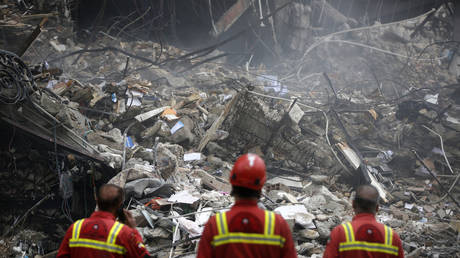
While President Donald Trump signals a five-day pause in airstrikes to court a "historic" diplomatic resolution with Tehran, Israeli Prime Minister Benjamin Netanyahu has made his position clear: the bombs will keep falling. On Monday, Netanyahu publicly split from the White House’s optimistic narrative, confirming that while Washington explores a "Venezuela-style" regime transition, the Israeli Air Force is still actively "crushing the missile and nuclear program to dust." This isn't just a tactical disagreement. It is a fundamental clash between a President looking for a fast exit and a Prime Minister who views the total eradication of the Iranian state apparatus as his only path to political and personal survival.
The divergence is now out in the open. Trump, buoyed by what he calls "very productive" back-channel conversations, has ordered the U.S. Department of War to postpone strikes on Iranian power plants and energy grids. He is gambling on a high-stakes leverage play, attempting to swap military pressure for a total Iranian nuclear surrender and the reopening of the Strait of Hormuz. Netanyahu, conversely, has just announced the assassination of two more Iranian nuclear scientists and authorized fresh waves of strikes on Tehran and Lebanon.
The Strategy of Mowing the Grass
To understand why Netanyahu is comfortable defying his closest ally, one must look at the "mowing the grass" doctrine that has defined his career. For decades, the Israeli security establishment has operated on the premise that threats cannot be permanently solved, only periodically reduced. However, the current "Operation Roaring Lion" has shifted that philosophy into something far more permanent.
Netanyahu is no longer interested in a managed threat. His rhetoric has shifted toward "regime change" and the "systematic plan to eradicate the Iranian regime." By continuing to strike while Trump pauses, Israel is effectively narrowing the window for diplomacy. If the Israeli military can dismantle enough of Iran's command-and-control infrastructure during this five-day U.S. window, any "deal" Trump reaches may be rendered moot by the collapse of the Iranian state's ability to enforce it.
Trump’s Venezuela Model vs. Israeli Reality
The White House appears to be chasing a specific ghost: the 2025-2026 "Venezuela Model." This strategy relies on identifying "pragmatic" insiders within a crippled regime to facilitate a transition that secures American interests—primarily oil flow and regional stability. Trump has even suggested that the U.S. could take physical control of Iran’s enriched uranium as part of a "complete and total resolution."
But Iran is not Venezuela. Tehran’s retaliation strategy has been horizontal and economic. By throttling the Strait of Hormuz, through which 20% of the world’s oil passes, the IRGC has already driven global petroleum prices above $100 a barrel. This economic pain is Trump’s primary motivator for a deal. He needs the oil flowing to protect the American economy, whereas Netanyahu views high oil prices as a secondary concern compared to the existential threat of a nuclear-capable Iran.
The Breakdown of Objectives
- The Trump Goal: A swift, televised "victory" that reopens the Strait, secures the uranium, and installs a "reasonable" leadership that can be managed like a corporate subsidiary.
- The Netanyahu Goal: The total degradation of Iran’s military-industrial complex to a point where it cannot be rebuilt for a generation, regardless of who is in charge.
- The Iranian Response: Tehran officially denies any talks exist, labeling Trump’s claims "psychological operations." Meanwhile, the IRGC continues to launch ballistic missile waves at Israeli cities like Dimona and Arad, proving that despite 24 days of heavy bombing, their "reach-back" capability remains functional.
The Personal Stakes of Perpetual War
There is a darker undercurrent to Netanyahu’s persistence. Domestically, the Prime Minister is a man with his back to the wall. He still faces unresolved corruption charges and a looming national inquiry into the security failures of October 7, 2023. In the history of the Levant, a leader at war is rarely a leader in the dock.
By framing this conflict as a "moment of truth" for the liberation of the Iranian people, Netanyahu is attempting to rehabilitate his image from a embattled politician into the architect of a New Middle East. If the war ends tomorrow with a Trump-brokered signature, the focus in Israel shifts back to the Prime Minister’s legal and political vulnerabilities. If the war continues until "total victory," the day of reckoning is pushed indefinitely into the future.
A Fragile Coalition under Pressure
The military reality on the ground is increasingly complex. While U.S. and Israeli pilots reportedly have "near-total control" over Iranian skies, the ground situation is a powderkeg. Thousands of U.S. Marines are currently moving toward the region, originally intended as a deterrent, but now potentially serving as a target for Iranian proxies if the "five-day pause" fails.
Netanyahu’s insistence on striking Lebanon simultaneously—targeting Hezbollah bridges over the Litani River—shows he is fighting a regional war of architecture, not just a border dispute. He is physically decoupling Iran from its "Ring of Fire" proxies. This is a task that cannot be accomplished via a diplomatic "deal" signed in Palm Beach.
The next 120 hours will determine the trajectory of the decade. If Netanyahu’s strikes trigger a major Iranian retaliation during Trump’s self-imposed pause, the President will be forced to choose between abandoning his peace initiative or publicly rebuking his most vital regional partner. For Netanyahu, that is a risk worth taking.
Watch the frequency of Israeli strikes on Tehran over the next 48 hours; if the tempo increases, it is a signal that Jerusalem is intentionally trying to burn the bridge to the negotiating table before Trump can cross it.