The strategic utility of naval mining in the Strait of Hormuz is not rooted in the total closure of the waterway, but in the permanent alteration of the risk-premium landscape for global energy markets. While conventional military analysis often focuses on the tactical exchange between the Islamic Republic of Iran Navy (IRIN) or the Islamic Revolutionary Guard Corps Navy (IRGCN) and Western task forces, the true objective is the creation of a "sustained friction state." This state leverages the disproportionate cost-to-kill ratio of underwater warfare to neutralize superior surface combatant advantages.
The Economic Architecture of the Chokepoint
The Strait of Hormuz functions as a high-volume, low-redundancy node in the global energy supply chain. Approximately 21 million barrels of oil per day—roughly 21% of global petroleum liquid consumption—pass through this 21-mile wide passage. The mathematical reality of this geography dictates that Iran does not need to achieve a physical "plug" of the channel. Instead, they must only achieve a threshold of "credible threat" that triggers the following economic feedback loops:
- Hull Risk Premiums: A single confirmed mine strike can increase War Risk Insurance premiums by 500% to 1000% within 48 hours, effectively pricing smaller independent tankers out of the route.
- Logistical Latency: The requirement for mine-clearing transit (MCT) operations slows the "velocity of barrel," creating a synthetic supply shortage even if physical inventories remain stable.
- Refinery Displacement: Because global refineries are tuned to specific crude grades (e.g., Arab Light), a disruption in the Gulf forces a costly shift to Brent or WTI alternatives, inducing a secondary price shock in refined products like diesel and jet fuel.
The Cost Function of Asymmetric Denial
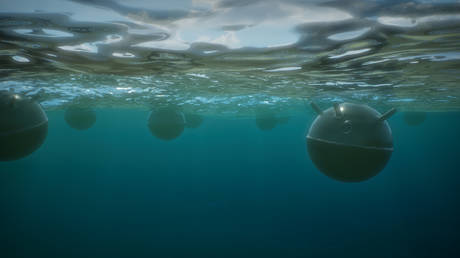
Iran’s mining strategy is governed by a favorable cost-asymmetry ratio. A standard moored contact mine, such as the EM-52 or the exported versions of the Soviet-era M-08, costs approximately $5,000 to $15,000 to manufacture and deploy. In contrast, a single MH-60S Sea Hawk helicopter or a dedicated mine countermeasures (MCM) vessel represents a capital expenditure of tens to hundreds of millions of dollars, with operational hourly costs exceeding the total value of the threat they are hunting.
Taxonomy of the Iranian Mine Arsenal
The threat profile is categorized by the level of technical sophistication and the "trigger logic" required to neutralize them:
- Level 1: Drifting/Contact Mines: These are low-tech, high-terror weapons. Their primary purpose is psychological. Because they drift with currents, they force the total suspension of night-time transits, as visual detection becomes impossible.
- Level 2: Bottom-Influenced Acoustic/Magnetic Mines: These sit on the seafloor and activate based on the specific acoustic signature or magnetic footprint of a passing hull. These require sophisticated "influence sweeping" to neutralize, where MCM vessels must mimic the signature of a tanker to trigger a controlled detonation.
- Level 3: Multi-Sensor Intelligent Mines: Modern Iranian variants utilize microprocessors to count "ship passes." A mine may be programmed to ignore the first three minesweepers that pass over it and only detonate when the fourth vessel—the high-value target—enters its kill zone.
The Kinetic-to-Cyber Feedback Loop
The deployment of mines is rarely an isolated event. In the Iranian operational doctrine, mining serves as the physical anchor for a broader multi-domain escalation. When a vessel is disabled by a mine, it creates a "static target" in a high-threat environment. This facilitates a secondary phase of the attack:
- Search and Rescue (SAR) Interdiction: Attempted rescue of a stricken tanker by Western forces provides a localized target for Iranian shore-based anti-ship cruise missiles (ASCMs) like the Noor or Ghadir.
- Information Operations: The delay between a strike and the verification of the weapon type allows for the proliferation of disinformation, heightening market volatility.
- Electronic Warfare (EW): Iran utilizes GPS jamming and AIS (Automatic Identification System) spoofing to lure tankers into shallow waters or closer to their coastline, where mining density is higher and recovery is more difficult.
Structural Bottlenecks in Counter-Mine Operations
The United States and its partners maintain a persistent MCM presence in Bahrain, but the capacity to clear the Strait is limited by physics and scale. Mine hunting is a "serial" process, not a "parallel" one.
The Search-to-Kill Ratio is the primary bottleneck. For every actual mine deployed, there are thousands of "mine-like objects" (MILCOs) on the seabed—old anchors, shipping containers, and rock formations. Each must be investigated by an Autonomous Underwater Vehicle (AUV) or a Remotely Operated Vehicle (ROV). If Iran sows 100 mines among 1,000 decoys, the time required to clear a safe "Q-route" (a cleared channel) expands exponentially.
$T_{clear} = \frac{(N_{mines} + N_{decoys}) \times t_{id}}{V_{mcm}}$
Where $T_{clear}$ is the time to clear, $t_{id}$ is the identification time per object, and $V_{mcm}$ is the number of active MCM units. As $N_{decoys}$ increases, the $T_{clear}$ quickly exceeds the strategic patience of global energy markets.
The Rationality of Iranian Risk Tolerance
Western analysts often view mining the Gulf as "economic suicide" for Iran, given their own dependence on the waterway. This perspective fails to account for the Resilience Gap.
The Iranian economy, already heavily sanctioned and accustomed to "resistance economy" protocols, is better structured to survive a 30-day total maritime shutdown than a highly leveraged, JIT (Just-In-Time) global economy. For Tehran, the risk of a military strike is outweighed by the strategic leverage gained. If they can prove that the U.S. Navy cannot guarantee the safety of the Strait, they effectively dismantle the "Carter Doctrine" (the policy that the U.S. will use military force to defend its interests in the Persian Gulf).
The second factor is internal political signaling. The IRGCN utilizes these operations to validate its budget and status within the Iranian power structure. A successful "denial operation" reinforces the narrative that unconventional, low-cost domestic technology can humiliate a "Great Power" adversary.
Strategic Constraints and Failure Points
Despite the potency of a mining campaign, Iran faces three critical failure points that limit the duration and effectiveness of this strategy:
- Bathymetric Limitations: Much of the Strait is relatively shallow, which aids mine-hunting sonar and makes it easier for divers to neutralize threats.
- International Isolation: Unlike a localized conflict, mining the Strait affects the energy security of China and India—Iran’s primary remaining economic partners. A prolonged blockage would likely alienate Tehran’s only diplomatic shields in the UN Security Council.
- Technological Obsolescence: The rapid advancement of drone swarms and side-scan sonar arrays is shifting the balance. Future MCM operations will likely rely on massive "mother ships" deploying dozens of disposable underwater drones, drastically reducing the time-to-clear constant.
The Impending Shift to Hybrid Mine Warfare
The next evolution of this threat involves "mobile mines" or underwater IEDs (UWIEDs). These are essentially low-speed torpedoes with long endurance that can be pre-positioned on the seabed and moved remotely to new locations. This eliminates the "static" nature of minefields, forcing the U.S. Navy to re-clear previously "safe" areas every 24 hours.
To counter this, the strategic play is not more minesweepers, but the "hardening" of the energy supply chain. This involves the expansion of the East-West Pipeline in Saudi Arabia and the Habshan–Fujairah pipeline in the UAE to bypass the Strait entirely. However, these pipelines currently lack the capacity to handle even 40% of the total volume transiting Hormuz. Until that infrastructure gap is closed, the naval mine remains the most cost-effective tool of geopolitical extortion in the modern era.
The focus must shift from "clearing mines" to "neutralizing the layer." This requires the pre-emptive targeting of mine-laying dhows and the destruction of coastal storage facilities before the first weapon enters the water. Once the mines are wet, the advantage shifts irrevocably to the disruptor.