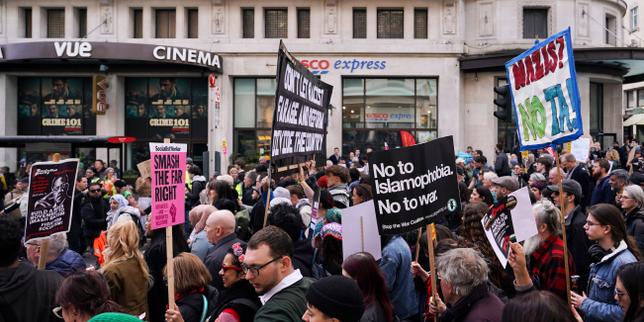
Thousands of people don't just show up on a Saturday morning in central London because they have nothing better to do. They show up because they're fed up. When you look at the sea of banners stretching from Piccadilly down to Whitehall, you aren't just seeing a crowd. You're seeing a massive, coordinated middle finger to the surge of anti-immigrant rhetoric that's tried to hijack the British narrative lately.
The recent "Stand Up To Racism" march wasn't a quiet affair. It was loud, it was messy, and it was exactly what the UK needed to see after a summer of tension. While certain political figures try to claim they represent the "silent majority," the streets of London just proved that the actual majority is anything but silent.
The Reality Behind the Numbers
The organizers claimed around 30,000 people joined the march. Even if you take the more conservative police estimates, the scale was undeniable. This wasn't a niche gathering of activists. It was a broad coalition of trade unions, faith groups, and families who felt that the riots in August—sparked by misinformation after the tragic Southport stabbings—required a permanent, visible answer.
Most people get this wrong. They think these protests are just about "being nice" or general platitudes. They aren't. They're tactical. By occupying the space between Regent Street and Parliament, these demonstrators effectively neutralized the momentum that figures like Tommy Robinson have tried to build. When the far right sees ten times their number staring back at them, the "popular uprising" they keep promising starts to look like a delusion.
Why the Counter Protest Movement is Winning
It's about presence. You can't fight an ideology solely on Twitter or in the comments section of a news site. The far right thrives on the idea that they own the physical space of the "working class." But the London march featured the very people who actually keep the city running. Nurses, teachers, and bus drivers were the ones holding the signs.
The energy on the ground was a mix of defiance and relief. There’s a specific kind of tension that happens when a country feels like it’s tipping toward division. That tension breaks when you see a grandmother in a hijab sharing a thermos with a punk in a denim vest. It sounds like a cliché, but when it’s happening in front of you, it’s a powerful deterrent to the "us vs them" narrative.
The Influence of Tommy Robinson and the Far Right
Let's talk about the elephant in the room. Stephen Yaxley-Lennon, known as Tommy Robinson, wasn't even there. He was sitting in a police cell. His absence was a glaring reminder that for all the noise his "Unite the Kingdom" movement makes, it's often built on a foundation of legal chaos and fleeing the consequences of their actions.
His supporters still gathered, but they were vastly outnumbered. This is a pattern we're seeing across Europe. The far right is excellent at gaming algorithms and creating viral moments, but they struggle to maintain a sustained, peaceful, and massive physical presence in the capital. Their movement relies on flashpoints of anger. The anti-racism movement relies on community infrastructure.
What the Media Misses About the August Riots
Most news outlets treated the August riots as a sudden explosion of "legitimate concerns" about immigration. That’s a lazy take. It ignores the years of deliberate radicalization happening in localized Telegram groups. The London march was a direct rebuttal to the idea that those riots represented the soul of the country.
I’ve seen how these things play out. When the smoke clears from a riot, the people left behind are the ones who have to live in those communities. The "Stop the Far Right" marchers weren't just from London; they traveled from places like Liverpool, Hull, and Belfast—cities that actually saw the violence firsthand. They came to London to tell the government that "clamping down" isn't enough. People want a positive vision, not just more policing.
The Government’s Delicate Balancing Act
The Labour government is in a tough spot. Keir Starmer has been quick to condemn "thuggery," but the protesters in London were asking for more than just law and order. They were asking for a total shift in how we talk about human beings.
If the government keeps using the same rhetoric about "stopping the boats" while trying to distance themselves from the far right, they're going to keep feeding the fire. You can’t tell people that immigrants are a problem on Monday and then act surprised when people get angry on Tuesday. The marchers made that point crystal clear with their chants. They want the policy to match the "Refugees Welcome" posters.
How to Actually Support the Movement Beyond Marching
Showing up is step one. But what happens on Monday? If you're looking to turn that energy into something that actually changes the local landscape, the work is much more boring than a massive march. It’s about local council meetings and supporting community centers that have had their funding slashed.
- Support the "Hope Not Hate" campaigns that track extremist groups before they reach your town.
- Join a local trade union. These organizations were the backbone of the London protest and remain the strongest defense against workplace discrimination.
- Fact-check your "local" news. A lot of the triggers for the summer riots came from fake accounts posing as local residents. Verify before you share.
- Volunteer with groups like the Refugee Council. Real-world interaction with the people the far right demonizes is the fastest way to kill prejudice.
The London protest wasn't a finale. It was a check-in. It proved that despite the loud, aggressive tactics of a few, the collective will of the city—and the country—still leans toward inclusion. Don't let the noise on your phone screen convince you otherwise. The streets told a different story.