The air inside a Lockheed C-130 Hercules doesn’t smell like a commercial flight. There is no scent of pressurized recycled air or faint lavender soap. Instead, it smells of hydraulic fluid, burnt JP-8 fuel, and the metallic tang of a machine that has been working too hard for too long. It is a loud, rattling cavern of grey aluminum. When you are one of 110 soldiers packed into the belly of this beast, shoulder to shoulder, your world shrinks to the vibrating floor beneath your boots and the steady, rhythmic drone of four Allison T56 turboprop engines.
In the skies over Colombia, that drone is the sound of safety. Until it stops.
The Colombian military's workhorse wasn't supposed to become a fireball. The Hercules is a legend of the skies, a rugged four-engine tactical transport designed to land on dirt strips and carry the weight of nations. But on a Tuesday that began like any other transport mission, the legend met the brutal reality of physics. As the plane crested the rugged terrain near the Apiay Air Base in Meta, the routine turned into a nightmare.
The Anatomy of a Descent
Imagine the cockpit in those final seconds. Pilots are trained for "engine out" scenarios. They practice the feathering of propellers and the management of glide slopes until the actions are hardwired into their muscle memory. But when a fire erupts—not a flicker, but a roar of orange flame licking back from the wing—the checklist changes. Time doesn't just speed up; it liquefies.
The Hercules was carrying a small city’s worth of human potential. One hundred and ten soldiers. These aren't just statistics or "personnel." These are sons from the barrios of Bogotá, fathers from the coastal heat of Cartagena, and young men who joined the infantry because the uniform offered a dignity that the streets did not. To have that many lives suspended in a single metal tube is a staggering responsibility. When the aircraft began its violent descent, the interior of that cargo hold likely transformed from a site of bored professional soldiering into a chaotic symphony of gravity and fear.
Centrifugal force pins you against the webbing of your seat. The gear you’ve spent years cleaning and maintaining becomes a collection of lethal projectiles. Through the small, thick portholes, the green canopy of the Colombian jungle rushes up to meet the fuselage at a speed the human brain isn't designed to process.
The Impact and the Miracle
The crash of a C-130 is not a quiet affair. It is a tectonic event. The sound of high-grade aluminum tearing against the earth mimics the scream of a dying predator. In the Meta department, witnesses watched as the grey giant clipped the terrain, the flame from its engines blooming into a massive pyre that sent black smoke billowing toward the clouds.
The "standard" outcome for a crash involving a fully loaded Hercules—carrying 110 people and thousands of gallons of fuel—is a total loss of life. History is littered with the charred remains of transport planes where the manifest and the casualty list were identical. Yet, as the smoke cleared over the wreckage near Apiay, a different story began to emerge.
It was a story written in the blood and sweat of the survivors.
Miracles in aviation are rarely about divine intervention and mostly about the structural integrity of the airframe and the frantic, last-second maneuvers of a pilot who refuses to give up on his passengers. The Hercules is built with a "box" structure. It is, essentially, a flying reinforced crate. When the plane hit the ground and erupted in flames, that structural cage held just long enough.
The Invisible Stakes of Military Flight
We often overlook the sheer frequency of these "bus runs" in the sky. To the public, a military plane is a weapon. To the soldier, it is a taxi. This specific flight was part of the logistical heartbeat that keeps the Colombian military functioning in a landscape defined by jagged mountains and dense, impenetrable rainforests.
When a plane like this goes down, it ripples through the entire defense infrastructure. It’s not just about the loss of a multi-million dollar asset. It’s about the psychological fracture that occurs when the most reliable tool in your shed breaks. If the Hercules can’t get you home, what can?
The technical investigation will eventually point to a singular cause. Perhaps it was a catastrophic fatigue crack in a turbine blade. Maybe a fuel line perished under the vibration of the jungle heat. Investigators will comb through the blackened "black boxes," looking for the exact millisecond where the metal gave way to the fire.
But for the families of those 110 soldiers, the "why" is secondary to the "how." How did they walk away? Reports indicated that despite the terrifying images of the plane engulfed in flames, the majority of those on board escaped the inferno. It is a testament to the crew's ability to keep the nose up and the speed controlled even as their world burned.
The Human Cost of Maintenance and Age
There is a quiet, simmering crisis in air forces across the globe: the aging of the fleet. The C-130 is a design from the 1950s. While the models flying today are updated, many have been pushed to their absolute limits by decades of constant use. In South America, where the climate is a cocktail of corrosive salt air and intense humidity, the metal lives a hard life.
Every takeoff is a gamble against entropy.
We want to believe that technology is a linear progression of safety, but the reality is a constant battle against the "bathrobe curve" of mechanical failure. New planes have "infant mortality" issues; old planes have "wear-out" failures. The Hercules sits in that middle-to-late stage where every bolt must be checked, and every seal must be perfect.
The soldiers on that flight didn't choose the tail number. They didn't inspect the engines. They trusted the system. They strapped in, leaned their heads back against the vibration, and waited to reach their destination. That trust is the most fragile cargo any pilot ever carries.
The Aftermath in the Jungle
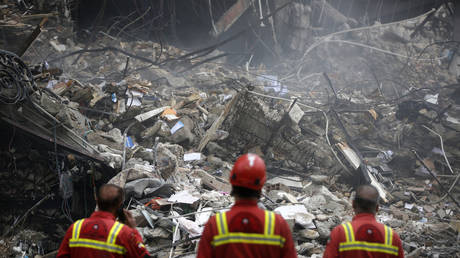
As the fire departments and rescue crews swarmed the site, the scene was one of surreal contrasts. The vibrant, lush green of the Meta region was scarred by a long, black streak of scorched earth. In the middle of it sat the broken spine of the aircraft.
Bloodied uniforms. The smell of singed hair. The dazed look of men who have peered into the abyss and been spat back out.
The Colombian military has faced many enemies—guerrilla factions, cartels, and political instability. But the most relentless enemy is the simple, unyielding force of gravity. On this day, gravity won the battle for the airframe, but it lost the battle for the souls inside.
The footage of the crash, circulating on social media like a digital wildfire, shows the plane on the ground, a skeleton of its former self, surrounded by a halo of orange light. It looks like a tomb. To see soldiers walking away from that wreckage is to witness a statistical impossibility.
Survival creates a unique kind of haunting. Those 110 men will carry the sound of that engine failure in their ears for the rest of their lives. They will feel the heat of the Apiay fire every time they close their eyes in a quiet room. They are the living evidence of a narrow escape, a group of humans who were momentarily written off by the laws of probability only to be reclaimed by a mixture of luck and engineering.
The fire is out now. The wreckage will be hauled away, piece by jagged piece, to a hangar where men in white lab coats will try to find the ghost in the machine. They will look for the flaw that turned a routine Tuesday into a headline.
But for the men who unbuckled their harnesses and ran through the smoke, the investigation doesn't matter. They are back on solid ground. They are breathing air that doesn't taste like hydraulic fluid. They are the 110 who fell from the sky and survived to tell the tale, standing as a living reminder that in the cold world of military logistics, the human heart remains the only thing that cannot be replaced.
A soldier stands by the perimeter of the crash site, his face smeared with soot, watching the last of the embers die out. He isn't looking at the plane. He is looking at the horizon, where the next transport is already scheduled to arrive.