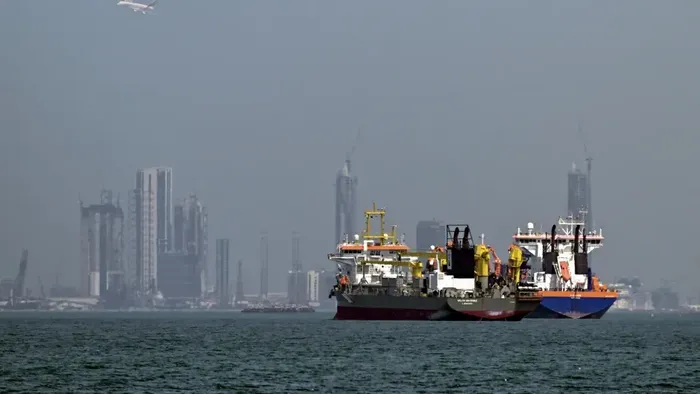
The air in Abu Dhabi usually tastes of salt and ambition. On a typical Tuesday at 3:00 AM, the only sound is the rhythmic hum of industrial cooling units and the distant, ghost-like shushing of tires on the E11 highway. But last night, the silence didn't just break. It evaporated.
Imagine standing on a balcony overlooking the Mangroves. You are reaching for a glass of water when the horizon decides to ignite. This isn't the soft, amber glow of a sunrise. It is a violent, electric violet. For three seconds, the desert floor is illuminated with the clarity of high noon, and then comes the sound—a chest-thumping crump that rattles the sliding glass doors in their tracks.
High above the Burj Mohammed bin Rashid, the sky became a graveyard for machines.
The Calculus of Kinetic Grace
We often talk about air defense in the dry language of procurement and "interception rates." We treat it like a box score in a sport no one wants to play. But there is a terrifying, beautiful physics to what happened over the UAE last night.
An Iranian-made ballistic missile is not a subtle thing. It is a skyscraper-sized needle made of aluminum and hate, hurtling through the thin air of the upper atmosphere at several times the speed of sound. To stop it, you cannot simply "hit" it. You have to solve a mathematical riddle in four dimensions while the target is actively trying to kill you.
The UAE’s defense umbrella—a sophisticated layer of THAAD and Patriot systems—had to track twenty-five separate suicide drones and four ballistic missiles simultaneously. Think of it as trying to hit a soaring hawk with a pebble, twenty-nine times in a row, without a single miss. Because in this game, a 96% success rate means a city block disappears.
The drones, or UAVs, are the different side of the same coin. They are slow. They are loud. They are cheap. They buzz like lawnmowers from hell, drifting across the Persian Gulf in a low-altitude swarm designed to confuse the "eyes" of the radar. They are the distractions meant to exhaust the defenders before the heavy hitters—the ballistic missiles—tear through the ceiling.
Last night, the math held.
The Invisible Shield
There is a specific kind of phantom limb syndrome that affects a city under a digital dome. You don't see the shield. Most of the time, you don't even think about it. You go to the Louvre Abu Dhabi, you watch the light filter through the geometric dome, and you forget that just twenty miles up, there are sensors scanning the vacuum of space for heat signatures.
When the sirens finally cut through the humidity, the transition from "cosmopolitan hub" to "front line" happens in a heartbeat.
Consider a father in a suburban villa in Al Ain. He isn't thinking about regional hegemony or the geopolitical friction between Tehran and Abu Dhabi. He is thinking about the weight of his sleeping daughter as he carries her to the windowless hallway. He is listening to the sky. He is waiting for the thud that signals a successful interception, a sound that in any other context would be terrifying, but tonight is the only thing that lets him breathe.
The 25 UAVs intercepted yesterday represent more than just downed hardware. Each one represents a "what if" that was successfully deleted from reality.
The Cost of a Quiet Morning
The technical achievement is staggering, but the emotional cost is a hidden tax on the soul. When a state-of-the-art interceptor rises to meet a threat, it leaves a jagged, white smoke trail that lingers in the humid air long after the explosion. These are the scars of a modern metropolis.
We live in a world where the distance between a high-end shopping mall and a kinetic combat zone is exactly the thickness of a radar wave. The sophistication of the UAE's defense isn't just about the hardware; it's about the terrifyingly narrow margins of error.
The debris from these twenty-nine threats fell into the empty quarters of the desert and the dark waters of the Gulf. By the time the sun actually rose, the street sweepers were out. The coffee shops in Dubai Marina were grinding beans. The stock market opened. To the casual observer, it was as if nothing had happened.
But the people who looked up at 3:00 AM know better.
They saw the kinetic firework show that happens when billions of dollars of technology collide in the stratosphere. They understand that the "dry facts" of a news ticker—25 UAVs intercepted—are actually twenty-five separate stories of catastrophe averted.
The miracle of modern life in the Gulf isn't the gold or the oil or the gleaming steel. It is the silence. It is the ability to wake up, look at a clear blue sky, and forget that for a few feverish minutes in the middle of the night, the stars were falling the wrong way, and someone, somewhere, made sure they never reached the ground.
The smoke trails have dissipated now, swallowed by the heat haze. The radar arrays continue their invisible, rotating vigil, staring into the shimmering horizon where the sea meets the sky. We return to our spreadsheets and our school runs, shielded by a math we don't see and a vigilance we only notice when it screams.
Would you like me to analyze the specific technical capabilities of the THAAD system used in these interceptions?