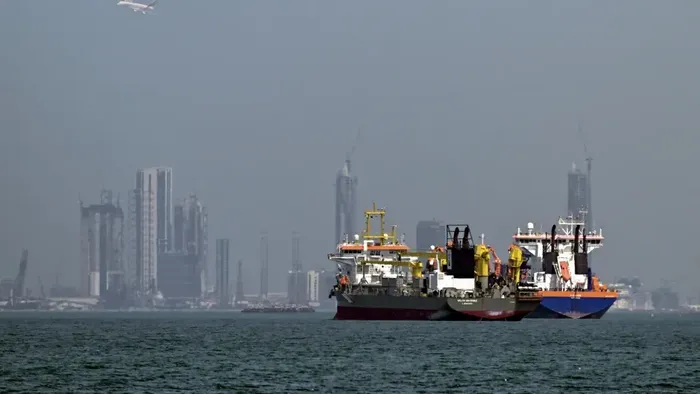
The Strait of Hormuz is a narrow stretch of water that keeps the global economy from collapsing. If you've looked at a map of the Middle East recently, you'll see a tiny chokepoint between Oman and Iran. Only 21 miles wide at its narrowest, this strip of ocean carries roughly 20% of the world's total petroleum liquids. It's a gold mine for some and a hostage for others. Right now, it's a powder keg.
Tensions are spiking because of a dual-pronged reality. You have a massive U.S. troop buildup in the region paired with aggressive rhetoric from Donald Trump. It's not just talk. The specter of a hot war in these waters is more real than it's been in decades. When people talk about "energy security," they're really talking about whether a tanker can sail through Hormuz without getting hit by a drone or seized by the Iranian Revolutionary Guard Corps (IRGC). You might also find this similar story useful: Strategic Asymmetry and the Kinetic Deconstruction of Iranian Integrated Air Defense.
Washington is Sending a Message with Heavy Metal
The Pentagon isn't just shuffling papers. They're moving hardware. We're seeing thousands of Marines and sailors moving into the area, backed by F-35s and A-10 Warthogs. This isn't a routine rotation. It’s a direct response to a string of ship seizures by Iran over the last year. Since 2021, Iran has harassed or attacked nearly 20 internationally flagged merchant vessels.
The U.S. strategy is clear. They want to put "boots on boats." There are active discussions about putting armed military personnel on commercial tankers to deter Iranian boarding parties. Think about that for a second. We’re talking about turning civilian oil tankers into floating fortresses. It’s a radical shift in how we protect global trade. If an Iranian fast boat approaches a tanker and sees U.S. Marines on the deck, the math of the encounter changes instantly. As reported in recent reports by NBC News, the results are significant.
But there's a flip side. Increasing the military footprint also increases the chance of a mistake. A nervous sailor or a misunderstood radio transmission could spark a firefight that nobody actually wants. It’s a high-stakes game of chicken where the losers are anyone who buys gas or uses electricity.
The Trump Factor and the Maximum Pressure Reloaded
Donald Trump has never been one for subtle diplomacy in the Middle East. His previous administration's "Maximum Pressure" campaign was defined by the withdrawal from the JCPOA (the Iran nuclear deal) and the assassination of Qasem Soleimani. Now, his recent threats suggest an even more aggressive stance. He’s signaled that he’s willing to use military force to ensure the "freedom of navigation" remains absolute.
Critics argue this rhetoric is reckless. They say it backs Tehran into a corner where they feel they have no choice but to lash out to prove they aren't intimidated. Supporters, however, believe that only a credible threat of force keeps the IRGC in check. They point to the relative quiet in the Strait during certain periods of high-intensity U.S. presence as proof that "peace through strength" works.
What's different now is the regional context. Iran isn't the isolated actor it was ten years ago. They’ve deepened ties with Russia and China. If a conflict breaks out in Hormuz, it won't stay a local skirmish. It has the potential to drag in global powers who are already at odds over Ukraine and Taiwan.
Why the World Cringes When Hormuz Gets Hot
Let's look at the numbers. They’re staggering. More than 20 million barrels of oil pass through the Strait every single day. That's more than the entire daily consumption of the United States.
If the Strait closes, even for a few days, oil prices wouldn't just rise. They would skyrocket. We’re talking about a jump from $80 a barrel to well over $150 or $200. The global supply chain, already fragile from years of disruptions, would likely snap.
The Iranian Playbook
Iran knows it can't win a conventional blue-water naval war against the U.S. Navy. They don't try to. Instead, they use asymmetric tactics.
- Sea Mines: Cheap, effective, and hard to find. They can sow these in the dark of night.
- Fast Attack Craft: Small boats armed with missiles and machine guns that swarm larger vessels.
- Drones: Low-cost suicide drones that can target a ship's bridge or sensitive equipment.
- Coastal Defense Missiles: Land-based batteries that can hit anything in the Strait from the Iranian shore.
Iran's goal isn't necessarily to sink the U.S. Fifth Fleet. It’s to make the cost of transit so high that insurance companies refuse to cover the ships. If you can't get insurance, you can't sail. If you can't sail, the oil stays in the ground, and the global economy starves.
Misconceptions About the U.S. Role
Many people think the U.S. is only there for its own oil. That's a myth. The U.S. has become a net exporter of energy thanks to the shale boom. A lot of the oil coming out of the Persian Gulf is actually headed to China, India, Japan, and South Korea.
So why does the U.S. care? Because oil is a global commodity. If the price goes up in Shanghai, it goes up in Chicago. The U.S. acts as the "global policeman" of the seas because it’s the only nation with the naval capacity to do it, and because the stability of the global financial system depends on it.
There's also a heavy dose of regional politics. Allies like Saudi Arabia and the UAE rely on the U.S. security umbrella. If the U.S. walks away from Hormuz, those nations will either have to build massive navies of their own or make deals with Iran that might not favor Western interests.
The Real Risk of Miscalculation
History is full of wars that started by accident. In 1988, the U.S. Navy accidentally shot down an Iranian civilian airliner (Iran Air Flight 655) during a period of high tension in the Gulf, killing 290 people. That tragedy happened because of the "fog of war" and high-pressure environments.
Today, the technology is faster and the weapons are more lethal. Cyber warfare adds another layer of complexity. What happens if an Iranian radar system is "spoofed" into thinking it's under attack? Or if a U.S. ship's navigation system is jammed? The window for human decision-making is shrinking.
Moving Toward a Solution or a Collision
Is there a way out? Some experts suggest a multilateral maritime task force that includes non-Western powers like India or Brazil. The idea is to make it a global effort rather than a "U.S. vs. Iran" showdown. This could lower the temperature and take away Iran's "anti-imperialist" talking points.
Others argue for a new diplomatic framework. But with the current political climate in both Washington and Tehran, that feels like a pipe dream. The reality is that we're likely headed for more friction.
You should watch the insurance markets and the "war risk" premiums for tankers. When those start to climb, it's a sign that the people with money on the line think something is about to break. Also, keep an eye on the deployment cycles of the U.S. carrier strike groups. If we see two carriers in the region simultaneously, the risk level moves from "concerning" to "critical."
Prepare for volatility. Whether it’s at the pump or in your investment portfolio, the ripples from the Strait of Hormuz reach everywhere. If you're a business owner or an investor, diversifying away from high-energy-dependency sectors or hedging against oil spikes isn't just a good idea—it’s a necessity in this environment.