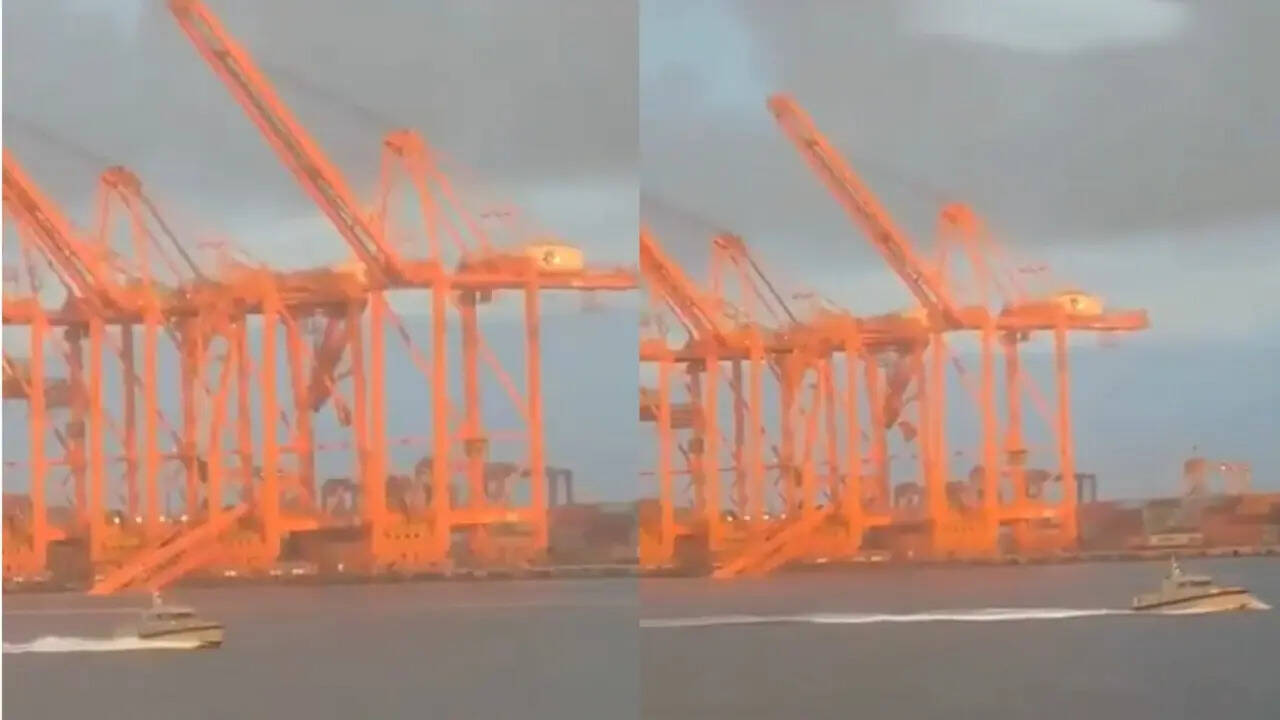
The sea off the coast of Salalah usually smells of salt and drying frankincense. It is a slow, rhythmic place where the Indian Ocean meets the jagged edge of the Arabian Peninsula. On a typical Tuesday, the only thing keeping the watchmen awake at the Port of Salalah is the low hum of crane motors and the distant, repetitive slap of water against concrete piers.
Then the sky screamed.
It wasn't the roar of a jet engine or the predictable whistle of a falling shell. It was the frantic, lawnmower-on-steroids buzz of a suicide drone—a sound that has become the terrifying soundtrack of modern warfare. When the impact finally came, it didn't just rattle the windows of the port authority office; it shattered the fragile illusion that Oman’s quiet neutral ground could remain a sanctuary from a region set ablaze.
The Ghost in the Logistics Chain
To a general in a distant war room, the vessel sitting in the harbor was a "logistics asset." To the sailors on board, it was home. To the global economy, it was a vital stitch in a thread that keeps your local grocery store shelves full. But when the Iranian military confirmed they had successfully targeted an American logistics vessel in Omani waters, the dry language of "strategic escalation" failed to capture the sheer, visceral chaos of the moment.
Think of a logistics ship as the unglamorous backbone of an empire. It doesn't carry the sleek missiles of a destroyer or the intimidating profile of a carrier. It carries the boring stuff: fuel, spare parts, food, and mail from home. It is a soft target. Targeting it isn't just a military move; it is a psychological strike meant to prove that nowhere is safe, not even the refueling stops that have functioned as the world's waiting rooms for decades.
The drone itself is a marvel of low-cost, high-impact engineering. These are not the multimillion-dollar predators controlled from air-conditioned trailers in Nevada. These are the "suicide" variants—essentially flying IEDs. They are cheap. They are replaceable. They are the terrifying democratization of air power.
Why Salalah Matters More Than You Think
Oman has long played the role of the quiet neighbor who refuses to take sides in the family feud. While the rest of the Middle East bristles with rhetoric and rivalries, Muscat has perfected the art of the "backdoor channel." Salalah, specifically, sits at a geographic crossroads that makes it a crown jewel of global shipping.
If you look at a map, Salalah is the last major stop before vessels enter the gauntlet of the Red Sea or head south toward the Cape of Good Hope. It is the pressure valve of the global supply chain. By striking here, the attackers didn't just hit a ship; they sent a message to every shipping conglomerate in London, Singapore, and New York.
The message: The safe zones are gone.
The escalation between the United States, Israel, and Iran has shifted from a shadow war of cyberattacks and high-seas seizures into something much more jagged. We are witnessing the death of the "contained conflict." In the past, a strike in the Gulf stayed in the Gulf. Now, a political decision made in a capital city ripples outward until a port worker in Oman is ducking for cover from falling debris.
The Invisible Stakes of a Broken Pier
We often talk about war in terms of territory. Who holds the hill? Who controls the border? But this conflict is about flow. It is about the ability to move things—be it oil, weapons, or Amazon packages—across a planet that is increasingly being carved into "no-go" zones.
When a port as efficient as Salalah is compromised, the math changes for every merchant sailor on the water. Insurance premiums for cargo ships don't just tick up; they skyrocket. Those costs aren't absorbed by the shipping giants. They are passed down, cent by cent, until you feel it at the gas pump or the checkout counter. This is the "hidden tax" of geopolitical instability.
But beyond the economics, there is the human cost of the "logistics war." Imagine being a merchant mariner. You aren't a combatant. You signed up to move freight, to see the world, to provide for a family thousands of miles away. Suddenly, you are a pawn in a game involving hypersonic calculations and ancient grievances. You are staring at a radar screen, wondering if the small blip approaching at two hundred knots is a flock of birds or a drone with your name on it.
The Geography of Anxiety
Modern warfare is no longer a front line. It is a series of nodes. A drone strike in Oman is a signal to a naval commander in the South China Sea. A response in the Mediterranean echoes through a server farm in Israel. The world is a spiderweb of consequences, and someone just threw a burning match onto one of the main strands.
Consider the perspective of a logistics officer aboard that American vessel. They are the managers of the mundane. They deal in spreadsheets, engine grease, and schedules. They are the mechanics of the machine. When that machine is hit, the noise is more than an explosion; it is the sound of the entire apparatus grinding to a halt.
It is a mistake to think this is just a regional skirmish. The "war with US-Israel escalates" part of the headline isn't just about troop movements. It is about the fundamental redesign of our world. We are moving from a world of open, global trade into one where every harbor is a fortress and every sea lane is a potential graveyard.
The Quiet That Follows the Bang
After the smoke clears from a strike like this, there is a specific kind of silence. It is the sound of the world recalculating. For Oman, the neutral ground has just been bloodied. For the US and Israel, the "rules of engagement" have been shredded by a low-cost, high-altitude killer.
There is no "returning to normal" after a drone rocks Salalah. The port will continue to operate, but the atmosphere has changed. The crane operators will look over their shoulders. The radar operators will double-check every blip. And the sailors on the logistics ships will know that their unarmored hulls are no longer a shield.
The real tragedy is that we are learning to live with this. We are becoming accustomed to the idea that a peaceful port can be transformed into a battlefield in an instant. The "invisible stakes" are precisely that: the loss of safety we once took for granted.
As the sun sets over the Port of Salalah, the water is calm. The Frankincense trees still hold their ancient scent. But the horizon is no longer empty. It is filled with the ghosts of drones and the growing shadows of a conflict that refuses to stay within its borders. We are all passengers on the same logistics ship now, and the sky is getting louder.
Wait for the next engine buzz. It is coming.