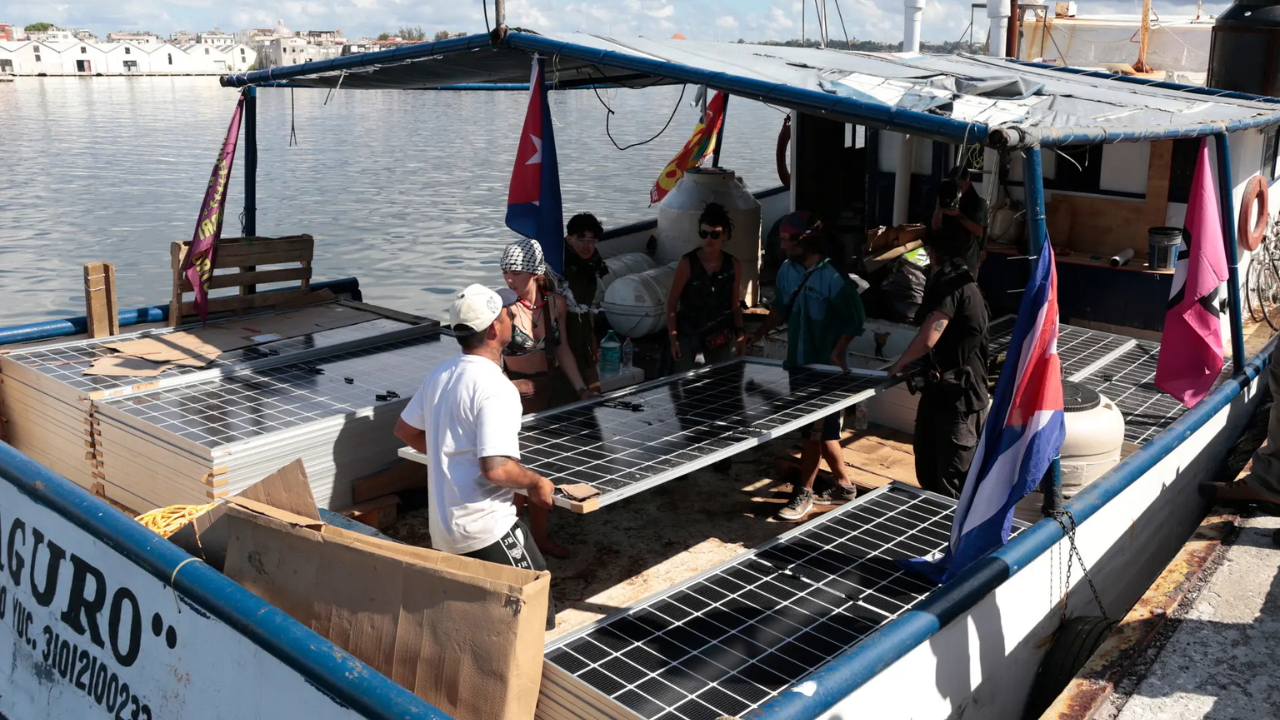
The recovery of two humanitarian aid sailboats, the Argos and the Maltese, by the Mexican Navy off the coast of Quintana Roo highlights a critical failure in maritime risk assessment rather than a simple case of navigational misfortune. When vessels carrying essential supplies transit the Yucatan Channel—a 120-mile-wide strait between Mexico and Cuba—they enter a high-gradient environment where the Florida Current, atmospheric volatility, and mechanical reliability converge. The successful rescue of the six crew members (four American, two Cuban) serves as a case study in the breakdown of redundant safety systems and the necessity of structural maritime protocols in non-commercial aid missions.
The Triad of Maritime Operational Failure
To understand why these vessels were lost for several days, one must deconstruct the operational variables. Maritime safety in the Caribbean basin relies on three distinct pillars. If any two pillars are compromised, the probability of a "vessel-lost" scenario increases by an order of magnitude.
- Mechanical Resilience and Fuel Management: Small sailboats (typically 30–50 feet) utilized for aid are often older hulls with limited fuel capacity. They rely on auxiliary diesel engines when wind conditions fail or when fighting the 2- to 4-knot northerly push of the Gulf Stream. A mechanical failure in the propulsion system or a fuel-to-range miscalculation creates immediate drift vulnerability.
- Communication Redundancy: The gap between "safe" and "missing" is defined by the interval of silence. Standard VHF radio range is limited to line-of-sight (approximately 20–25 nautical miles). Without Satellite Communications (SATCOM) or an Automatic Identification System (AIS) transponder actively broadcasting, a vessel becomes a ghost on civilian radar once it leaves the coastal shelf.
- Environmental Externalities: The Yucatan Channel acts as a funnel. Even in moderate weather, the current can displace a disabled vessel by 70–100 miles in a 24-hour period.
The Argos and the Maltese moved from a planned trajectory to a search-and-rescue (SAR) coordinate because they lost the ability to counteract the current, likely due to a combination of mechanical stasis and a failure to maintain a continuous data link with shore-based monitors.
Quantifying the Search and Rescue (SAR) Kinetic
When the Mexican Secretariat of the Navy (SEMAR) initiated the search, they utilized a probability-of-detection (POD) framework. SAR operations are not random; they are mathematical models based on "Leeway Diversion."
- Leeway Calculation: This is the motion of a vessel through the water caused by the wind acting on the exposed surfaces of the hull and superstructure.
- Vector Summation: The Navy must calculate the vector sum of the prevailing current (the Yucatan Current) and the local wind speed.
- Expansion of the Search Area: Because the precise time of engine or sail failure is often unknown, the "search box" expands at a squared rate relative to time. If a vessel is missing for 48 hours in a 3-knot current, the potential area for its location covers thousands of square miles.
The fact that the vessels were located near Isla Contoy—a small island north of Cancun—suggests the crew utilized the natural drift of the current to remain within the Mexican Exclusive Economic Zone (EEZ) rather than being swept into the open Gulf of Mexico. This positioning allowed for a more compressed search grid, eventually leading to their discovery by a naval patrol craft.
The Economic and Geopolitical Friction of Humanitarian Transit
Shipping aid to Cuba involves more than navigating water; it involves navigating the "Sanctions-Risk Constraint." Unlike commercial freight, aid missions often operate on shoestring budgets with volunteer crews. This creates a specific set of risks that do not exist for professional cargo lines.
The Maintenance Debt
Volunteer-led missions frequently suffer from "maintenance debt." The vessels used are often donated or purchased at low cost. In a maritime environment, the saltwater environment accelerates the oxidation of electrical components and the fouling of fuel systems. When these vessels encounter the heavy chop of the Yucatan Channel, these latent issues manifest as catastrophic failures.
The Information Asymmetry
There is a profound disconnect between the perceived safety of "coastal sailing" and the reality of crossing the Yucatan Channel. Many crews view the 90-to-120-mile hop as a short-duration trip. However, the channel is a deep-water trench with complex hydrodynamics. The information asymmetry—where the crew underestimates the environmental force relative to their vessel’s displacement—is the primary cause of distress calls in this corridor.
Structural Requirements for High-Risk Aid Corridors
To prevent the recurrence of the Argos and Maltese incident, humanitarian organizations must shift from a "voyage-by-voyage" mindset to a structured logistics framework. This requires the implementation of a Hardened Maritime Protocol (HMP).
- Active AIS Mandate: Every aid vessel must be equipped with a Class B AIS transponder. This allows both Mexican and Cuban authorities to track the vessel in real-time. The cost of such units is negligible compared to the $10,000+ per hour operational cost of a naval search aircraft.
- Dual-Layer Communication: Relying on cellular signals near the coast is a fatal flaw. A minimum requirement for these crossings is a global satellite messenger (e.g., Garmin inReach or Iridium GO!). These devices provide "heartbeat" tracking, sending a GPS coordinate to a land-based coordinator every 10 to 30 minutes.
- Reserve Power and Propulsion: A secondary "get-home" engine or a highly redundant sail inventory is necessary. In the case of the Cuba-bound sailboats, the inability to maintain steerage resulted in the vessels becoming "objects of drift" rather than "navigated craft."
The Mechanism of the Rescue
The Mexican Navy's intervention utilized the Sexta Región Naval (Sixth Naval Region) assets. This operation involved a coordinated sweep using interceptor boats and potentially a Persuader maritime surveillance aircraft. The rescue protocol follows a standardized sequence:
- Identification and Verification: Confirming the hull markings match the manifest.
- Medical Triage: Assessing the crew for dehydration and heat exhaustion, the two primary physiological threats in the Caribbean.
- Vessel Stabilization: Determining if the craft is seaworthy or if a tow is required to prevent further drift into shipping lanes.
The crews of the Argos and Maltese were found in good health, indicating that while their propulsion or navigation systems failed, their "life-sustainment" systems (water, food, and shelter) remained intact. This suggests the failure was technical, not a total loss of vessel integrity.
Strategic Recommendation for Caribbean Humanitarian Logistics
The recurring nature of "missing" aid vessels in the Caribbean points to a systemic lack of professional maritime standards among non-governmental organizations (NGOs). To mitigate future risk, NGOs must adopt a "Commercial-Lite" operational model.
The immediate action for any organization planning transit to Cuba or Hispaniola is the appointment of a land-based Duty Officer. This individual must hold a "dead-man’s switch" responsibility: if a vessel misses a scheduled 4-hour check-in, the Duty Officer triggers the Search and Rescue (SAR) mechanism immediately. This reduces the "Time-to-Search" (TTS) variable, which is the single most important factor in surviving a maritime emergency. Relying on family members or informal social media updates to signal a missing vessel is an amateurish failure that puts both crews and state naval assets at unnecessary risk.
Future missions must treat the Yucatan Channel not as a crossing, but as a high-stakes logistics corridor that demands the same rigor as an oceanic transit. Failure to do so ensures that the next "missing" vessel report may not end with a successful recovery near Isla Contoy.