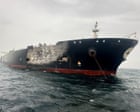
The sea at 3:00 AM usually feels like a cathedral. It is vast, silent, and indifferent. For the crew of the Al-Mubarak, a Kuwaiti oil tanker sitting low in the water at Dubai’s outer anchorage, the world was reduced to the steady hum of the engines and the rhythmic pulse of the radar screen. Steel groaned against the swell. Men slept in narrow berths, dreaming of the dry heat of Kuwait City or the green hills of Kerala.
Then, the silence tore.
It wasn't a roar at first. It was a high-pitched whine, a mosquito-like buzz that grew into a frantic scream. On the bridge, the night watch had seconds to register a shadow moving against the stars before the impact. A flash of white-hot light turned the deck into noon. The shudder that followed wasn't just a sound; it was a physical blow that threw men from their beds and sent coffee mugs shattering across the floor.
Fire followed. It licked at the vents and painted the Dubai skyline, visible in the distance like a shimmering mirage of safety, in hues of angry orange. This wasn't a mechanical failure. This wasn't a freak accident. This was a message delivered at three hundred miles per hour by a piece of plastic and circuitry no larger than a kitchen table.
The Ghost in the Machine
The drone—allegedly Iranian in origin, though the deniability remains as thick as the smoke—represents a terrifying democratization of destruction. We used to think of war as something involving billion-dollar destroyers and satellite-guided missiles launched from silos deep underground. That world is dead. Today, a few thousand dollars and a steady internet connection can buy enough lethality to paralyze a global shipping lane.
Consider the physics of the strike. The drone doesn't need to sink the ship. It only needs to pierce the skin. An oil tanker is a floating city of pressurized gasses and volatile liquids. When a "suicide" drone hits the superstructure, it targets the brain—the bridge, the communications array, the living quarters. It aims to blind and terrify.
The Al-Mubarak didn't go down. The hull held. But the psychological structural integrity of the Gulf has been compromised. Every captain now staring into the darkness of the Strait of Hormuz is wondering if the next star they see moving is a planet or a payload.
The Invisible Toll on the Deck
We talk about "geopolitics" and "energy markets" as if they are abstract games played on a board. They aren't. They are made of flesh and bone.
Take a sailor like "Malik"—a hypothetical composite of the dozens of men who were on that deck. Malik is forty-two. He has three daughters. He spends ten months a year on the water so they can go to a private school in Manila. When the drone struck, Malik didn't think about the price of Brent Crude. He thought about the smell of his youngest daughter’s hair and the fact that there was only a quarter-inch of steel between him and an inferno.
The "cold facts" say the fire was contained within four hours. The narrative of the human heart says Malik will never sleep through a sudden noise again. The crew members who fought those flames with foam and grit are the ones who bear the true cost of these shadow wars. When we read about a "hit" on a tanker, we should be reading about the shaking hands of a man trying to call his wife on a satellite phone that won't connect.
The Ripple on the Shore
Dubai’s port is a miracle of logistics, a gleaming testament to what happens when you turn a desert into a global crossroads. It relies on a single, fragile premise: the safety of the water.
When a drone hits a ship in the harbor, the shockwaves travel far beyond the splash zone. Insurance premiums for every vessel in the region spike instantly. Those costs aren't absorbed by the shipping giants; they are passed down to you. The gallon of milk in a London supermarket, the plastic toy in a Kansas toy store, the fuel in a tractor in Punjab—they all get a little more expensive because a drone found its mark in the dark.
Logistics is a thin thread. We have built a world that demands everything be everywhere, all at once, for the lowest possible price. This efficiency is our greatest achievement and our most glaring weakness. A single drone strike is a pair of scissors held against that thread.
The technology here is the real antagonist. These aren't the drones you see at weddings or being used to film sweeping shots of mountain ranges. These are loitering munitions. They are designed to "hunt." They can circle an area for hours, waiting for the right thermal signature, the right silhouette, the right moment of vulnerability. They are cheap to build and nearly impossible to track until they are too close to stop.
The Shadow of the Shoreline
The accusations leveled at Tehran are part of a long-running script. Denials are issued. Evidence is presented in grainy black-and-white photos. Sanctions are discussed in rooms with mahogany tables. But the reality on the water remains unchanged.
The Strait of Hormuz is a choke point. Nearly 20% of the world's oil passes through this narrow strip of water. It is a jugular vein. If you want to hold the world hostage, you don't need a nuclear bomb. You just need enough drones to make the insurance companies decide that the risk isn't worth the reward.
Imagine standing on the shore at Jumeirah Beach. You see the luxury hotels, the tourists tanning, the jet skis buzzing. Then you look out at the horizon, where the tankers sit like silent gray whales. The distance between those two worlds is only a few miles, but they exist in different dimensions. One is the world of leisure and "business as usual." The other is a front line where the weapons are getting smaller, smarter, and harder to find.
The Weight of the Silence
After the fire on the Al-Mubarak was extinguished, a heavy silence returned to the Dubai port. The tugs pushed the wounded giant toward a repair berth. The smoke cleared, leaving only the charred scent of burnt wiring and salt.
The world moved on. The news cycle shifted to a celebrity scandal or a political gaffe. But the sailors on the next ship in line didn't move on. They stood on the wing of their bridge, binoculars pressed to their eyes, scanning the sky. They weren't looking for storms or birds.
They were looking for a whine in the wind.
They were looking for the moment the horizon decides to explode again.
There is a specific kind of bravery required to sail a target through a shooting gallery. It isn't the loud, cinematic bravery of a Hollywood movie. It is the quiet, grinding courage of a person who knows the risks, knows the stakes, and goes back to work anyway because the world needs to keep turning. We owe it to those men to see this strike for what it really was: not just a "hit" on a tanker, but a jagged tear in the fabric of our collective security.
The drone is gone. The fire is out. But the water is no longer silent. It is waiting.