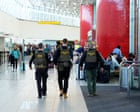
The immediate crisis at airport security checkpoints has slowed to a simmer, but the underlying rot remains. While the recent distribution of backpay to TSA workers provided a temporary relief valve for national travel arteries, the broader Department of Homeland Security shutdown continues to hollow out the infrastructure of American safety. It is a classic Washington shell game. The government has managed to bribe its own essential workforce back into the screening lanes using their own earned wages as leverage, yet the administrative machinery supporting these officers is still grinding into a halt.
We are currently witnessing a dangerous experiment in how long a skeleton crew can maintain the illusion of a functioning superpower. The optics of shorter lines do not equate to a secure border or a stable aviation system. By focusing exclusively on the visible "congestion" at the gates, we miss the systemic failure occurring in the back offices where intelligence is vetted and long-term threats are analyzed.
The Paycheck Bandage and the Hemorrhage of Talent
The decision to issue backpay was less an act of legislative grace and more a desperate attempt to prevent a total collapse of the aviation industry. TSA officers, who rank among the lowest-paid federal employees, were hitting a breaking point. When you cannot put gas in the car to get to the airport, the patriotic duty to screen luggage loses its luster.
But this isn't just about a missing check. It is about a fundamental breach of contract.
Veteran officers are walking away. This is the "hidden" attrition that no one in the administration wants to quantify. When a twenty-year veteran of the agency leaves because they can no longer trust the government to meet its basic payroll obligations, we lose more than a body in a blue uniform. We lose the institutional memory required to spot the anomalies that machines miss. The new hires replacing them—if they can even be recruited in this climate—lack the seasoned intuition that defines effective security.
The result is a brittle system. It looks fine on a Tuesday morning in Omaha, but it lacks the depth to handle a genuine surge or a coordinated threat. We are trading long-term stability for short-term political posturing.
The Shutdown as a Security Vulnerability
While the public fixates on the length of the queue at JFK or LAX, the real danger is manifesting in the departments that don't have "Customer Service" in their job descriptions. The DHS shutdown affects more than just the people checking your shoes.
- Cybersecurity Monitoring: The teams tasked with defending federal networks are working under immense strain, often with reduced support staff.
- Infrastructure Inspection: Safety audits for chemical plants and ports are being delayed, creating a backlog of unaddressed risks.
- Training and Development: Federal Law Enforcement Training Centers have seen disruptions, meaning the next generation of marshals and agents is currently sitting on the sidelines.
Terrorism doesn't wait for a budget resolution. By forcing the DHS to operate in this fractured state, the government has essentially provided a roadmap of our internal weaknesses to any adversary paying attention. We have signaled that our most critical security functions are subject to the whims of partisan brinkmanship.
The Economic Ripple Effect Beyond the Tarmac
The cost of this shutdown isn't found in a single line item. It is a distributed tax on the American economy. When travel becomes unpredictable, business slows down. Contracts aren't signed because the "fly-to-meet" culture is paralyzed by the fear of a four-hour security delay or a sudden flight cancellation.
The airline industry operates on razor-thin margins and precise schedules. A disruption at a major hub like Atlanta or Chicago doesn't stay local; it cascades through the entire global network. We saw a glimpse of this when air traffic controllers—working without pay—began to call out in numbers large enough to force ground stops. That was the moment the political class blinked. They realized that while they can ignore the plight of an individual worker, they cannot ignore the total cessation of interstate commerce.
However, the "fix" was a half-measure. By addressing only the most visible pain points, they have left the rest of the DHS to wither. Coast Guard members are still patrolling our waters without knowing when their next mortgage payment will be covered. Customs and Border Protection officers are managing record numbers of encounters with a support system that is effectively offline.
Why the Backpay Fix Fails the Future
The distribution of backpay is a cynical move designed to quiet the noise. It treats the symptom while the infection spreads.
What we are seeing is the professionalization of instability. If the government can shut down, withhold pay, and then "fix" it by simply paying what was already owed, they have established a precedent that the federal workforce is a variable cost rather than a fixed commitment. This will have devastating effects on recruitment for decades. Why would a top-tier cybersecurity expert or a high-level analyst choose a career at DHS when the private sector offers competitive pay and the basic guarantee that a check will arrive every two-week cycle?
We are effectively de-skilling our national defense. The people who remain are those who cannot afford to leave or those who are too close to retirement to quit. The ambitious, the mobile, and the highly skilled are looking for the exits.
The Logistics of a Failed State Function
To understand the absurdity of the current situation, one must look at the procurement side of the DHS. The shutdown doesn't just stop pay; it stops the acquisition of parts, the renewal of software licenses, and the maintenance of hardware.
Every day the shutdown drags on, the "maintenance debt" grows.
- X-ray machines that aren't serviced today will fail tomorrow.
- Databases that aren't updated today will provide stale intelligence tomorrow.
- Patrol vehicles that aren't repaired today will be out of commission when they are needed most.
The "congestion" that has eased is a mirage. It is the result of a temporary surge in worker attendance fueled by the arrival of backpay, but it is not supported by a functioning department. The administrative tail that wags the operational dog is dead. There are no HR representatives to process benefits, no IT specialists to fix broken terminals in a timely manner, and no policy experts to adapt to changing threats.
Beyond the Live Blog Mentality
Mainstream media covers these shutdowns like a sporting event, with "live updates" on the latest "clash" between leaders. This framing is a disservice to the public. This isn't a game of optics; it is a fundamental failure of the most basic duty of the state: to provide for the common defense and general welfare.
The real story isn't that the lines are shorter today. The real story is that the internal mechanisms of the American government are being intentionally degraded for political leverage. We are watching the intentional dismantling of the trust required to run a massive, complex security apparatus.
When the history of this era is written, the focus won't be on the specific dollar amounts of a border wall or a budget bill. It will be on the irreparable damage done to the soul of the civil service. We have told the people who keep us safe that they are pawns. We have told the traveling public that their safety is secondary to a soundbite.
The Next Breaking Point
The current "calm" is a transition period, not a resolution. As the "record shutdown" continues to drag on for other parts of the DHS, the pressure will shift. It might move from the airport to the seaports. It might move from the terminals to the digital borders of our financial systems.
The government cannot continue to operate by crisis management. The "essential" designation has been weaponized, used as a tool to force labor without compensation. This is not a sustainable model for a first-world nation.
We are currently relying on the inertia of the system to keep things moving. But inertia eventually yields to friction. Every day without a full budget, every day the DHS remains a political football, that friction increases. The next time the lines grow long, backpay might not be enough to bring the workforce back.
The security of the nation is being sold for the price of a temporary headline. Until the entire department is funded and the gamesmanship ends, every flight you take is a gamble on a system that is being held together by nothing more than the fading loyalty of a mistreated workforce. Stop looking at the wait times on your phone and start looking at the empty desks in the corridors of power. That is where the real congestion lies.