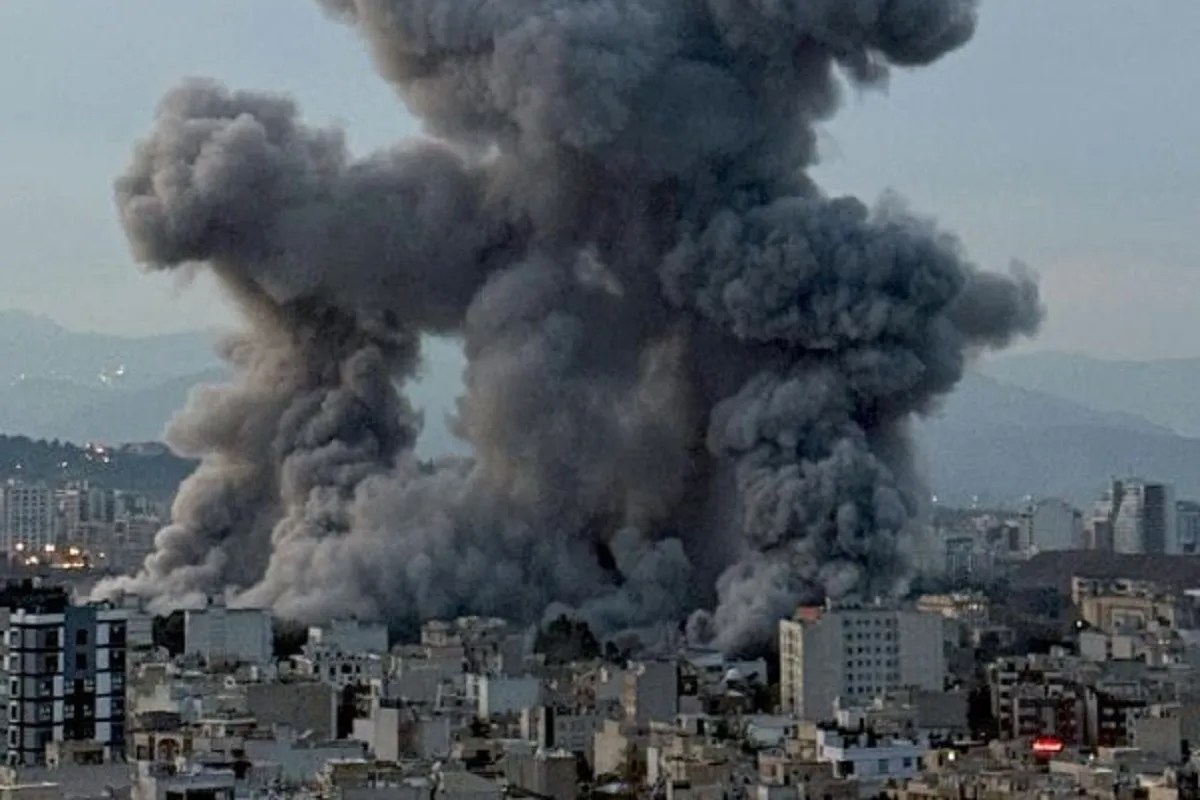
The sirens in Manama don't sound like the ones in London or New York. They have a sharper, more rhythmic quality, a mechanical wail that competes with the humid wind blowing off the Persian Gulf. For the engineers working the late shift at the Amazon data hub, the sound wasn't just a warning. It was the end of a world they had meticulously built out of silicon and cooling fans.
Imagine a technician named Elias. He isn't a government official or a military strategist. He is a man who keeps a photograph of his daughter taped to a server rack. In the moments before the sky turned a bruised purple, Elias was likely monitoring latency speeds, ensuring that a digital storefront in Dubai or a streaming service in Riyadh didn't lag by even a millisecond.
Then, the world shook.
The report from the Bahraini government was clinical, almost detached. It spoke of Iranian missiles, of confirmed trajectories, and of a direct hit on a primary commercial infrastructure. But the dry language of diplomacy fails to capture the smell of ozone and burnt plastic. It ignores the sudden, terrifying silence that follows a massive explosion when the hum of thousands of servers—the heartbeat of the modern Middle East—simply stops.
The Geography of Invisible Borders
We often think of the internet as a weightless thing. We imagine our data floating in a literal cloud, untethered to the messy reality of Earth. This is a lie. The internet lives in windowless concrete boxes. It lives in cooling pipes and heavy-duty electrical grids. And in the Middle East, these boxes sit on some of the most contested soil on the planet.
When Iran launched missiles at an Amazon headquarters in Bahrain, they weren't just targeting a company. They were targeting the nervous system of regional commerce. Amazon isn't just a place to buy books or household goods anymore; it is the backbone of the digital economy. Through its Web Services (AWS), it hosts the data of governments, the financial records of banks, and the private communications of millions.
The strike was a message written in fire. It said that in the new era of warfare, there is no such thing as a "civilian" tech target. If you host the data that allows a nation to function, you are a combatant.
The Cost of Digital Centralization
The problem with efficiency is that it creates single points of failure. We moved everything to the cloud because it was cheaper, faster, and more reliable than maintaining our own small servers. We traded resilience for scale.
Consider the local business owner in Manama who woke up the next morning to find her inventory gone. Not stolen by a thief, but evaporated because the server hosting her database was now a pile of charred metal. Consider the hospital systems that rely on cloud-based records to know which patient is allergic to penicillin.
When a missile hits a data center, it doesn't just destroy hardware. It destroys the continuity of life.
The Bahraini government’s confirmation of the attack sent ripples through the global markets, but for the people on the ground, the impact was visceral. There is a specific kind of helplessness that comes with realizing your entire digital existence is vulnerable to a physical projectile launched from hundreds of miles away. We have spent decades building firewalls and encryption protocols, yet we forgot that the most sophisticated code in the world cannot stop a piece of shrapnel.
The New Architecture of Fear
This isn't about one missile or one company. It is about a fundamental shift in how we perceive safety. For years, the tech giants operated under the assumption that their sheer utility made them untouchable. They were the neutral ground, the digital Switzerland where everyone did business.
That illusion died in the fire in Bahrain.
We are entering a period where the physical location of your data matters more than the encryption guarding it. If you are a multinational corporation, do you keep your servers in a region defined by ancient grievances and modern ballistic capabilities? If you are a government, do you trust a foreign provider whose headquarters might become a pawn in a geopolitical chess match?
The irony is that as we become more connected, we are forced to become more fragmented. The dream of a single, unified global web is being torn apart by the reality of borders. Companies are now looking at "sovereign clouds"—data centers built within the safety of their own borders, guarded by their own militaries.
The Human Toll of a High-Tech War
Back to Elias.
In the aftermath of the strike, the headlines focused on oil prices and stock fluctuations. They talked about "strategic provocations" and "regional escalations." They rarely talked about the people who had to walk into that smoldering ruin to see what could be saved.
Recovery in the digital age is a grim task. It involves sifted through debris to find hard drives that might still hold fragments of data. It involves the realization that some things—family photos stored on a local server, proprietary research, a decade of digital history—are simply gone. Deleted by a blast wave.
The Bahraini government has a difficult path ahead. To admit the vulnerability of such a high-profile target is to admit a gap in their own defense. For Iran, the act was a demonstration of reach, a way to show that they can touch the most modern, Westernized parts of their neighbors' infrastructure at will.
But for the rest of us, it is a wake-up call.
We have built our modern lives on a foundation of glass and silicon. We have outsourced our memories, our money, and our infrastructure to companies that we assume are too big to fail. We treat the internet as a utility, like water or electricity, forgetting that water and electricity are also targets in every war ever fought.
The sky over Bahrain eventually cleared. The smoke dissipated. The sirens stopped their wailing. But the silence that followed was different than the one before. It was a heavy, expectant silence. It was the sound of a world realizing that the cloud is not in the sky. It is on the ground, and it is flammable.
As the sun rises over the Gulf, the heat begins to bake the asphalt. In the distance, the skeletal remains of a data hub stand as a monument to our new reality. We are no longer just fighting for land or oil. We are fighting for the right to exist in the digital space, a space that is proving to be far more fragile than we ever dared to imagine.
The photograph of a young girl, once taped to a server rack, is now a piece of grey ash drifting toward the sea.