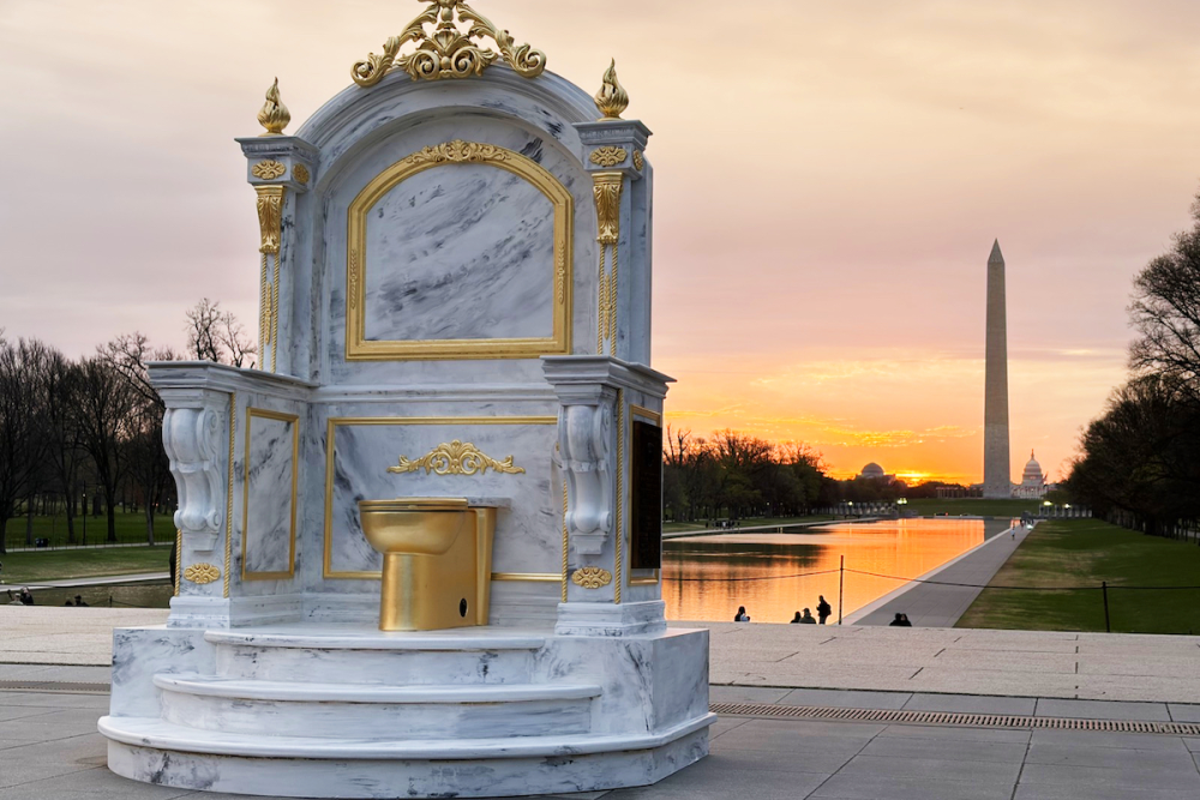
The sight of a 2,000-pound gold toilet sitting on the grass of the National Mall is not a mistake or a prank gone wrong. It is a calculated piece of guerrilla theater designed to force a visceral reaction from every passerby. This installation, titled "The Resolute Desk," is the latest provocation from the same anonymous collective responsible for the unsettling statues of Donald Trump and Jeffrey Epstein that appeared in major cities earlier this cycle. While the surface-level joke is obvious—a literal "throne" for a leader obsessed with excess—the deeper intent of the group is to expose the decaying state of American political discourse.
This isn't just about partisan mockery. It is about the industrialization of outrage. By placing a gleaming symbol of waste and narcissism in the direct line of sight of the U.S. Capitol, the organizers are betting that the public’s thirst for a "viral moment" will outweigh any actual debate about policy or leadership.
Guerrilla Art as a Political Weapon
The group behind these installations operates with a level of logistical precision that suggests significant funding and high-level planning. Moving a massive, metallic sculpture onto federal land without immediate intervention requires more than just a truck and a dream. It requires a deep understanding of the jurisdictional gaps between the National Park Service, the U.S. Park Police, and local D.C. authorities.
Historical precedent shows us that political art has shifted from the abstract to the literal. During the 1960s, protest art often relied on symbolism to convey messages of peace or civil rights. Today, the strategy is different. The goal is the "meme-ification" of the physical space. The gold toilet is designed to be photographed, shared, and weaponized within seconds of its discovery.
The anonymous nature of the group adds a layer of mystery that keeps the news cycle spinning. When an artist signs their work, they become the story. When they remain hidden, the work becomes a mirror for the viewer’s own biases. Supporters of the former president see it as a desperate attack by the "radical left," while critics see it as an apt metaphor for a political era defined by vanity. Both sides are playing exactly into the hands of the creators.
The Logistics of Public Defiance
You cannot simply drop a literal ton of sculpture on the National Mall and expect it to stay there. The "How" of this operation is as interesting as the "Why."
Most of these pop-up protests rely on a "flash-and-fade" tactic. The team arrives in high-visibility vests, looking like a standard maintenance or construction crew. They utilize heavy machinery that appears official. In a city like Washington D.C., where construction is a constant state of being, a crew moving a large object rarely draws a second glance until the tarp is pulled off.
Why the National Mall?
The National Mall is the most contested piece of real estate in the American psyche. It is where we go to celebrate, to mourn, and to demand change. By placing a toilet there, the group is engaging in spatial hijacking. They are taking a space reserved for the "sacred" and injecting the "profane."
- Lincoln Memorial: Represents the preservation of the Union.
- Washington Monument: Represents the foundation of the Republic.
- The Gold Toilet: Represents the perceived vulgarity of the current moment.
This contrast is the point. The sculpture functions as a giant exclamation point at the end of a long, exhausting sentence about the state of the nation. It forces a conversation about whether our institutions have become as disposable as the waste the sculpture is designed to handle.
The Epstein Trump Connection
To understand the toilet, you have to look back at the group's previous work. The statues of Jeffrey Epstein and Donald Trump were not just crude caricatures; they were attempts to link two figures in the public's mind through sheer visual association. Those statues were designed to be uncomfortable. They were intentionally hideous, focusing on the human form in its least flattering light.
The gold toilet is a pivot from the biological to the material. It moves away from the person and toward the lifestyle. It critiques the idolatry of wealth that has come to define modern success. In the eyes of the creators, the toilet is the logical conclusion of a culture that values the "gold-plated" over the "solid-gold."
A Nation Drowning in Irony
There is a exhaustion that comes with this kind of art. We have seen the "giant inflatable" protests, the "naked statues," and the "projection mapping" on hotel walls. At what point does the shock wear off?
The veteran analyst sees this as a sign of diminishing returns in political activism. When the discourse is already at a fever pitch, you have to keep raising the stakes to get noticed. A gold toilet is a high-stakes play because it risks being dismissed as juvenile. Yet, the fact that it is being discussed in the halls of power suggests that the "juvenile" is exactly where our political consciousness currently resides.
The real danger isn't the sculpture itself, but what its presence says about our ability to communicate. If we can only talk to each other through the medium of a 2,000-pound bathroom fixture, we have lost the ability to use our words. The sculpture is a tombstone for nuance.
The Cost of the Spectacle
Every time an installation like this goes up, it costs the taxpayer money.
- Removal fees: Specialized equipment must be brought in to move heavy materials without damaging the protected grounds.
- Police overtime: Crowds gather, requiring a constant security presence to prevent vandalism or physical altercations between opposing groups.
- Permitting and Legal: The subsequent investigations into who bypassed federal security protocols consume man-hours that could be spent on actual public safety.
The group behind the sculpture likely views these costs as a "fine" for their freedom of speech. To them, the price of the metal and the logistical headache is a small payment for the millions of dollars in "earned media" they receive.
The Myth of the Neutral Viewer
There is no such thing as a neutral observer of a gold toilet on the National Mall. You either find it hilarious or you find it an abominable desecration of national soil. This binary reaction is the engine that drives the group's success.
They are not trying to change minds. They are trying to harden positions. In an era of extreme polarization, art that offends one side and delights the other is the most effective way to go viral. The "Definitive Piece" isn't the toilet—it's the chaos that ensues around it.
As the sun sets over the Mall, the gold surface of the sculpture reflects the surrounding monuments. It catches the light of the Capitol dome, creating a jarring visual overlap. It is a reminder that in the modern world, the line between high office and low-brow theater has been erased. The toilet will eventually be hauled away by a crane, and the grass will grow back, but the image of the throne on the lawn will remain a permanent fixture of our digital history.
Stop looking for a deeper meaning in the metal and start looking at the crowd gathered around it with their phones out. That is the real sculpture.