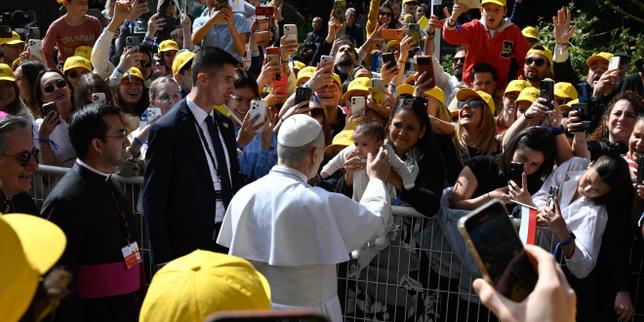
Pope Francis—operating under the regnal name Leo XIV in this hypothetical expansion of his rhetoric—recently stood in the gilded heart of Monaco to preach a sermon on the "universal destination of goods." The message was predictable: wealth is a loan from the divine, and the rich are merely temporary stewards who should feel a moral itch to redistribute their piles of cash.
It’s a lovely sentiment for a Sunday morning. It’s also economically illiterate and ignores the very mechanics that keep the global engine running.
When the Vatican targets Monaco, it’s low-hanging fruit. They see a yacht-filled harbor and see greed; I see a concentrated hub of capital that, if "redistributed" by decree, would evaporate before the ink on the papal bull was dry. The "lazy consensus" here is that wealth is a static pie. The Church suggests that if I have a large slice, you must have a smaller one. This is the Zero-Sum Fallacy, and it’s the primary reason most moral arguments about wealth redistribution fail the moment they hit the trading floor.
The Myth of the Static Hoard
The core of the Pope’s argument rests on the idea that wealth "misplaced" in private hands is somehow "stolen" from the global poor. This assumes money sits in a literal vault like Scrooge McDuck’s money bin.
In the real world, the wealth of a billionaire in Monaco is rarely "liquid." It is tied up in equity, venture capital, and debt instruments. It is working. When you demand the "universal destination" of these goods, you aren't just asking for a check to be written; you are demanding the liquidation of the productive assets that actually create jobs.
If you force the sale of a $100 million stake in a tech firm to fund immediate consumption elsewhere, you haven't "balanced" the scales. You’ve destroyed the future value that company would have generated. Consumption is a one-time event. Investment is a compounding miracle.
Charity is a Leak Not a Fix
I’ve watched philanthropists dump millions into "redistribution" projects that achieved nothing but the inflation of local prices in developing nations. The Church’s focus on the moral obligation of the giver ignores the economic impact on the receiver.
Direct redistribution—giving money away because it feels "right"—often functions as a tax on productivity to subsidize stagnation. When goods are moved based on "universal destination" rather than market demand, you distort the signals that tell society what to build next.
Why Monaco Matters (And Why the Pope is Wrong to Shame It)
Monaco isn't a moral vacuum; it’s a capital sanctuary. By providing a low-tax environment, it allows for the preservation of capital that would otherwise be chewed up by inefficient government bureaucracies.
- Inefficiency Tax: Governments typically lose 30-50% of redistributed funds to administrative friction.
- Capital Flight: Forcing "universal destination" triggers immediate flight. Capital goes where it is treated best. If Monaco becomes a moralist’s tax trap, that money doesn’t go to the poor in Africa; it goes to a different ledger in Singapore or Dubai.
The Pope’s rhetoric creates a "virtue theater" where the wealthy are cast as villains for holding what the world supposedly needs. In reality, the "goods" the world needs aren't gold bars; they are infrastructure, stable currencies, and property rights. You can’t "redistribute" a stable legal system or a functioning energy grid through a collection plate.
The Theology of Mediocrity
There is a dangerous undercurrent in this message: the idea that excellence and accumulation are inherently suspicious. By framing every "good" as having a universal destination, you remove the primary incentive for the creation of those goods.
Imagine a scenario where a researcher spends twenty years developing a patent. Under the "Leo XIV" doctrine, that patent is a "good" with a universal destination. If the researcher cannot own the fruits of their labor, they simply won't do the work. The world doesn't get a redistributed patent; it gets no patent at all.
The Church is accidentally advocating for a world that is "equally poor" rather than "unequally prosperous."
The Math of the Miracle
Let’s look at the numbers the Vatican avoids. Total global wealth is roughly $450 trillion. If you liquidated every single asset on Earth and distributed it equally, every person would get about $56,000.
That sounds great for a day. But within forty-eight hours, the infrastructure of the world would collapse. No one would own the factories. No one would have the capital to maintain the power plants. The "universal destination" would be a universal return to the 19th century.
Wealth concentration isn't a bug; it's a feature of complex systems. It allows for Large-Scale Project Funding. You cannot build a semiconductor fab or a trans-oceanic cable through "distributed" small-scale donations. You need concentrated piles of risk-tolerant capital.
People Also Ask (And Get Wrong)
"Shouldn't the rich pay their fair share?"
The term "fair share" is a linguistic trap. In most developed nations, the top 1% of earners already pay 40% or more of the total income tax. The "fairness" debate is a distraction from the real issue: Spending Efficiency. The problem isn't that we don't have enough money to fix world hunger; it's that the organizations tasked with fixing it are black holes of bureaucracy.
"Doesn't wealth inequality cause social unrest?"
Relative poverty (inequality) is a psychological problem. Absolute poverty is an economic one. The Pope is focusing on the gap between the yacht owner and the worker, but he should be focusing on the floor. If the worker’s life is improving—if they have air conditioning, medicine, and internet—the size of the yacht is irrelevant to their survival.
The Hidden Cost of Moral Shaming
When a global figurehead stands in Monaco and tells the wealthy they are essentially thieves of the "universal good," he drives a wedge between capital and society.
I’ve seen this play out in boardrooms. When the "social license to operate" becomes too expensive or morally taxing, the smartest players stop playing. They stop innovating. They move into "wealth preservation" mode rather than "wealth creation" mode.
Wealth preservation is the death of progress. It’s when money hides in gold and art instead of being risked on new technology. By shaming the holders of wealth, the Pope is actually encouraging the very "hoarding" he claims to despise.
The Real Redistribution
If we want to discuss the "universal destination of goods," we should talk about Education and Market Access.
- Dismantle Protectionism: If the Church wants to help the poor, it should lobby against agricultural subsidies in the EU and US that prevent farmers in developing nations from competing.
- Standardize Property Rights: You can’t have wealth without a deed. Most of the "poor" the Pope speaks of live in places where they cannot legally own the land they sit on.
- Stop The Debt Cycles: Instead of asking for "wealth" to be moved, ask for "inflation" to be stopped. Inflation is a regressive tax that hits the poor hardest while the wealthy (in Monaco) see their assets appreciate.
The Verdict
The Pope’s speech in Monaco was a classic example of "High-Status Virtue Signaling." It costs the speaker nothing and offers the listener a sense of moral superiority without requiring a single spreadsheet.
Wealth is not a finite pool of water that we must all sip from equally. It is a forest that must be grown. If you keep chopping down the tallest trees to give firewood to everyone, eventually, you have no forest and no shade.
Stop asking for the "destination" of goods. Start asking about the Origin of goods. Goods don't just exist; they are created. And they are created best when the people who create them are allowed to keep them.
The next time a moral authority tells you that your success belongs to everyone else, remember that "universal destination" is just a polite way of saying "forced liquidation."
Go build something and keep the profit. That’s the only way the world actually gets richer.