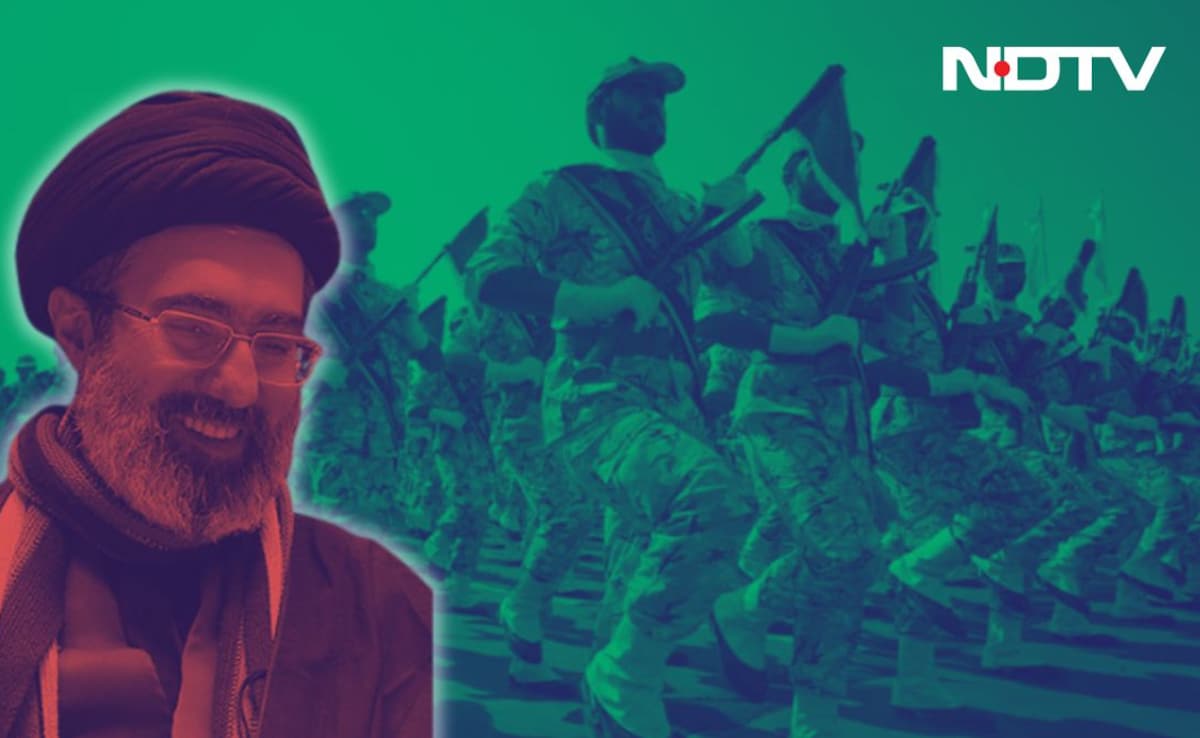
The stability of the Islamic Republic of Iran depends less on ideological purity than on the alignment of the Islamic Revolutionary Guard Corps (IRGC) with a successor capable of shielding their vast economic and paramilitary interests. The pivot toward Mojtaba Khamenei, the second son of Supreme Leader Ali Khamenei, represents a calculated move by the security apparatus to minimize transition friction. In a system where the "Deep State" is effectively the state itself, Mojtaba’s candidacy is not a product of simple nepotism but a functional requirement for institutional continuity.
The Tripartite Power Matrix
To understand why Mojtaba Khamenei has emerged as the frontrunner, one must analyze the three distinct pillars that support the office of the Rahbar (Supreme Leader).
- The Clerical Legitimacy Pillar: Traditionally, the leader must be a Marja’ (a source of emulation) or at least a high-ranking Mujtahid. While Mojtaba has been elevated to the rank of Ayatollah in state-aligned media, his religious credentials remain thin compared to the traditional clerical establishment in Qom.
- The Intelligence-Security Pillar: This is Mojtaba’s primary stronghold. For over two decades, he has operated as the "gatekeeper" to the Office of the Supreme Leader (Beit-e Rahbari). He manages the interface between the Leader and the intelligence services, specifically the IRGC Intelligence Organization.
- The Economic-Industrial Pillar: The IRGC controls an estimated 30% to 50% of Iran’s GDP through conglomerates like Khatam al-Anbiya. These entities require a successor who will not subject their "grey market" activities to transparency or civilian oversight.
The intersection of these pillars creates a "Succession Trap." A candidate with too much independent religious authority might challenge the IRGC’s economic dominance. Conversely, a candidate with no authority cannot hold the system together. Mojtaba occupies the precise center of this Venn diagram: he is sufficiently "institutionalized" to be predictable, yet lacks the independent popular mandate that would allow him to turn against his benefactors.
The IRGC Cost Function: Why Ebrahim Raisi’s Exit Changed the Calculus
The death of Ebrahim Raisi in a helicopter crash removed the primary "buffer" candidate. Raisi served as a low-risk placeholder—a loyalist who would follow the IRGC’s lead without possessing the charisma or intellect to deviate. His absence forced the IRGC to accelerate the Mojtaba timeline, shifting their strategy from "gradual introduction" to "forced consolidation."
From the perspective of an IRGC General, the cost of an unstable transition is measured in three variables:
- Capital Flight Risk: Sudden shifts in leadership could trigger internal panic among the bonyads (charitable foundations), leading to a massive exit of capital.
- Command Chain Fragmentation: Without a clear successor, different factions of the IRGC (e.g., the Quds Force vs. the Intelligence Wing) might back different candidates, leading to a breakdown in internal discipline.
- External Vulnerability: Any period of internal paralysis provides an opening for Israeli (Mossad) or American kinetic operations within Iranian borders.
Mojtaba Khamenei minimizes these three costs. Because he has already been managing the daily operations of the Beit-e Rahbari, his ascension would effectively be a "change in title" rather than a "change in management."
The Shadow Executive: Intelligence and the Ammar Headquarters
Mojtaba’s power base is codified through his relationship with the Ammar Headquarters (an ultra-hardline strategic center) and his influence over the security apparatus. He is widely credited with the suppression of the 2009 Green Movement, a pivotal moment that proved his willingness to use maximum force to preserve the system.
This "Security-First" approach creates a specific governance model. Unlike his father, who relied on a balance of different factions (Reformists, Technocrats, Hardliners), Mojtaba represents the "Purified" state. This model prioritizes:
- Surveillance Integration: Leveraging Chinese-style digital monitoring to preempt dissent.
- Economic Autarky: Moving toward a "resistance economy" that functions independently of Western sanctions, primarily through trade with the Eurasian bloc.
- Proxy Dependency: Doubling down on the "Axis of Resistance" (Hezbollah, Houthis, PMF) as the primary tool of foreign policy, rather than conventional diplomacy.
The Legitimacy Deficit and the Assembly of Experts
The primary hurdle for Mojtaba remains the Assembly of Experts, the 88-member body of clerics responsible for electing the Supreme Leader. While the IRGC can apply significant pressure, the constitutional requirement for religious seniority remains a friction point.
There is a documented tension between the "Security State" (IRGC) and the "Clerical State" (Qom). Many senior clerics view hereditary succession as a betrayal of the 1979 Revolution’s anti-monarchical roots. To mitigate this, the pro-Mojtaba faction has utilized a two-pronged strategy:
- Disqualification: Using the Guardian Council to prevent any moderate or independent clerics from entering the Assembly of Experts.
- Financial Patronage: Funneling state resources into specific seminaries that support the concept of Velayat-e Faqih (Guardianship of the Jurist) in its most absolute form.
Structural Bottlenecks in the Mojtaba Path
Despite the IRGC's backing, the transition to Mojtaba Khamenei is not guaranteed. Three structural bottlenecks could derail the process:
The Hereditary Stigma
The Islamic Republic was founded on the rejection of the Pahlavi dynasty. If Mojtaba takes over, the regime effectively admits it has become a "Religious Monarchy." This undermines the foundational myth of the republic and could alienate the remaining "Old Guard" revolutionaries who still believe in the elective (albeit restricted) nature of the system.
The "Sultanism" Trap
Political science defines "Sultanism" as a regime where the leader's personal whims supersede institutional rules. If Mojtaba leans too heavily on personal loyalty rather than institutional consensus, he may alienate mid-level IRGC officers who feel their upward mobility is blocked by a "clique" surrounding the Khamenei family.
Public Volatility
The "Woman, Life, Freedom" protests demonstrated a deep-seated resentment toward the status quo. A Mojtaba succession would likely be the catalyst for a new wave of unrest. The IRGC’s ability to suppress such a movement while simultaneously managing a leadership transition is an unproven capability.
Strategic Forecast: The Managed Transition
The most likely scenario is not a sudden announcement, but a "phased handover." We are currently seeing the first phase: the "normalization" of Mojtaba’s presence in high-level state meetings. The second phase will involve his formal appointment to a constitutional role—perhaps a return to the office of the President with expanded powers, or a newly created "Deputy Supreme Leader" position.
The IRGC will monitor the "Stress Test" of the next 12 to 24 months. If the system remains stable despite internal economic pressure and external Israeli strikes, they will move to finalize the succession. If the system shows signs of fracturing, they may pivot to a "Leadership Council," a body of three to five individuals that would include Mojtaba but prevent him from holding absolute power initially.
For global analysts and stakeholders, the key metric is not what the clerics say in Qom, but the movement of the IRGC’s "Intelligence Organization" (Sazman-e Ettela'at-e Sepah). If the leadership of this specific unit remains loyal to Mojtaba, the clerical objections will be relegated to a footnote. The transition is a technical operation, not a theological one.
The strategy for the Iranian security state is clear: consolidate the economy under the Guard, eliminate the "buffer" of moderate politics, and install a leader whose survival is inextricably linked to the Guard's own. Mojtaba Khamenei is the only candidate who fulfills all three criteria without requiring a fundamental redesign of the state’s internal architecture.