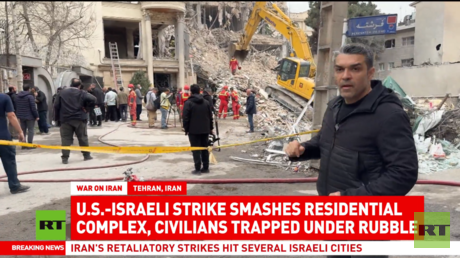
The headlines are screaming about an "unprecedented escalation." The pundits are dusting off their World War III maps. The mainstream media wants you to believe that Iran’s latest barrage of missiles into Israel is the beginning of the end.
They are wrong.
What we are witnessing isn't the start of a regional apocalypse. It is a highly choreographed, high-stakes piece of theater. It’s a violent ledger-balancing act where both sides are more afraid of winning than they are of fighting. If you think Iran is actually trying to wipe Israel off the map with these specific strikes, or that Israel is one move away from a "total victory" that brings regime change in Tehran, you’re falling for the surface-level narrative.
The Myth of the Suicidal State
The "lazy consensus" suggests Iran is a rational actor turned radical, throwing caution to the wind because they dismissed Donald Trump’s talk of negotiations. This assumes Tehran is blinded by ideology. It isn’t. The Islamic Republic is, above all else, a survivalist regime.
When Iran launches missiles, they aren't looking for a "Game Over" screen. They are looking for a "System Restore." They need to prove to their proxies—the "Axis of Resistance"—that the mothership still has teeth. But notice the math. They launch enough to saturate defenses and make a point, but they telegraph the moves just enough to ensure they don't accidentally trigger a nuclear response or a full-scale American intervention.
If Iran wanted a total war, they wouldn't use ballistic missiles alone. They would activate every sleeper cell and every short-range rocket battery in Lebanon and Syria simultaneously to overwhelm the Iron Dome by sheer volume. They haven't. They are playing a game of calibrated friction.
Why Israel Needs the Threat
On the flip side, the narrative that Israel is a victim purely reacting to unprovoked aggression misses the geopolitical utility of this conflict. For Benjamin Netanyahu, a state of "perpetual almost-war" is the ultimate political life raft.
A definitive end to the Iranian threat would actually be a strategic disaster for the current Israeli administration. Why? Because the moment the external existential threat vanishes, the internal fractures of Israeli society—the judicial reforms, the corruption trials, the demographic shifts—come back into sharp focus.
Israel’s defense industry also benefits from this live-fire testing ground. The Arrow 3 and David’s Sling systems are the most marketable defense assets on the planet right now because they have "combat-proven" data against Iranian tech. Peace doesn't sell interceptors.
Trump, Negotiations, and the Great Bluff
The Hindu and other outlets suggest Iran is "dismissing" Trump’s talk of negotiations. This is a fundamental misunderstanding of Persian diplomacy. Iran never dismisses a negotiation; they simply raise the price of admission.
By escalating now, Iran is attempting to build "escalation dominance." They want to enter any future room with the Trump administration—or anyone else—from a position of demonstrated power, not as a neutered regional power. They are creating leverage out of fire.
The idea that Trump’s "maximum pressure" or his "talk of deals" scares them into submission ignores forty years of history. Iran thrives under pressure because it justifies their internal security apparatus. They don't want a deal that opens their markets; they want a deal that guarantees their survival. Those are two very different things.
The Logistics of the "Paper Tiger" Exchange
Let’s talk about the hardware. Standard analysis says: "Iran sent $X$ amount of missiles, and Israel intercepted $Y$ percent." This is the wrong metric.
The real metric is the cost-exchange ratio.
- An Iranian Fattah missile costs a fraction of the interceptor used to bring it down.
- Israel spends billions of dollars in a single night of defense.
- Iran spends millions on the offense.
Iran is conducting a war of economic attrition disguised as a religious crusade. They know they can’t win a kinetic dogfight against the IAF. But they can try to bankrupt the Israeli interceptor stockpile while the global community begs for "restraint."
The Proxy Fallacy
Everyone talks about Hezbollah and the Houthis as "tools" of Tehran. This is a one-dimensional view. These groups have their own internal politics. Tehran is currently terrified of losing control over them. If Hezbollah gets dragged into a war they can't win, Iran loses its most expensive insurance policy.
The current missile exchanges are actually an attempt to prevent the proxies from doing something truly stupid that would force Iran’s hand. It’s a pressure release valve. By firing from Iranian soil, the IRGC is telling its proxies: "We’ve got this, stay in your holes."
The Intelligence Failure Nobody Admits
The biggest lie in the current coverage is that Western intelligence "sees everything coming." If they did, the region wouldn't be in this cycle. The reality is that we are witnessing a massive intelligence "black hole" regarding Iran’s internal stability.
Is the regime firing missiles because they are strong, or because they are terrified of a domestic uprising? I’ve seen analysts ignore the fact that every time a missile is launched, the Iranian Rial takes a hit. The regime is burning its own house down to keep the neighbors away. That’s not a position of strength. It’s a desperate gambit by a geriatric leadership that has run out of ideas.
Deconstructing the "People Also Ask"
Is this the start of World War III?
No. A world war requires Great Power participation. Russia is too busy sinking into the Ukrainian mud to help Iran, and China isn't going to risk its shipping lanes for a regime that can't even keep its own internet turned on. This is a regional brawl, not a global collapse.
Will Israel attack Iran’s nuclear sites?
They want to. They talk about it. But doing so without a green light from Washington is a logistical nightmare. Israel can hit them, but they can't destroy them without bunker-busters that only the U.S. possesses in sufficient quantity. This "threat" is a piece of diplomatic currency used to keep the U.S. engaged.
Why does this keep happening?
Because the "status quo of chaos" is profitable for the elites in Tehran, Jerusalem, and even Washington. It justifies defense budgets, it silences domestic dissent, and it keeps the oil prices exactly where the producers want them.
Stop Looking for a Hero
There are no "good guys" in this specific exchange. There are only actors trying to maximize their leverage while avoiding a total system crash.
The media wants you to feel a sense of impending doom because fear drives engagement. But look at the actual movements. Look at the flight paths. Look at the lack of ground troop mobilization on the borders that would actually matter for an invasion.
It’s a dance. A violent, expensive, and deadly dance, but a dance nonetheless.
If you want to understand what’s actually happening, stop reading the casualty counts and start looking at the central bank reserves and the diplomatic cables. Iran isn't dismissing negotiations; they are setting the stage for a shakedown. Israel isn't just defending itself; it’s reinforcing a regional order that keeps its current leadership in power.
The missiles are real. The explosions are real. But the "war" as described by the mainstream press is a fiction designed to keep you from seeing the cold, hard logic of state survival.
Stop waiting for the big explosion. We’re already living in the "war." This is what it looks like: a series of controlled burns designed to prevent a forest fire that nobody—not even the most radical cleric in Qom or the most hawkish minister in the Knesset—actually wants to fight.
Move your money out of the "fear trade" and realize that in the Middle East, the loudest bang usually comes from the emptiest barrel.
Would you like me to analyze the specific economic impact of the Red Sea shipping disruptions on this "controlled escalation" model?