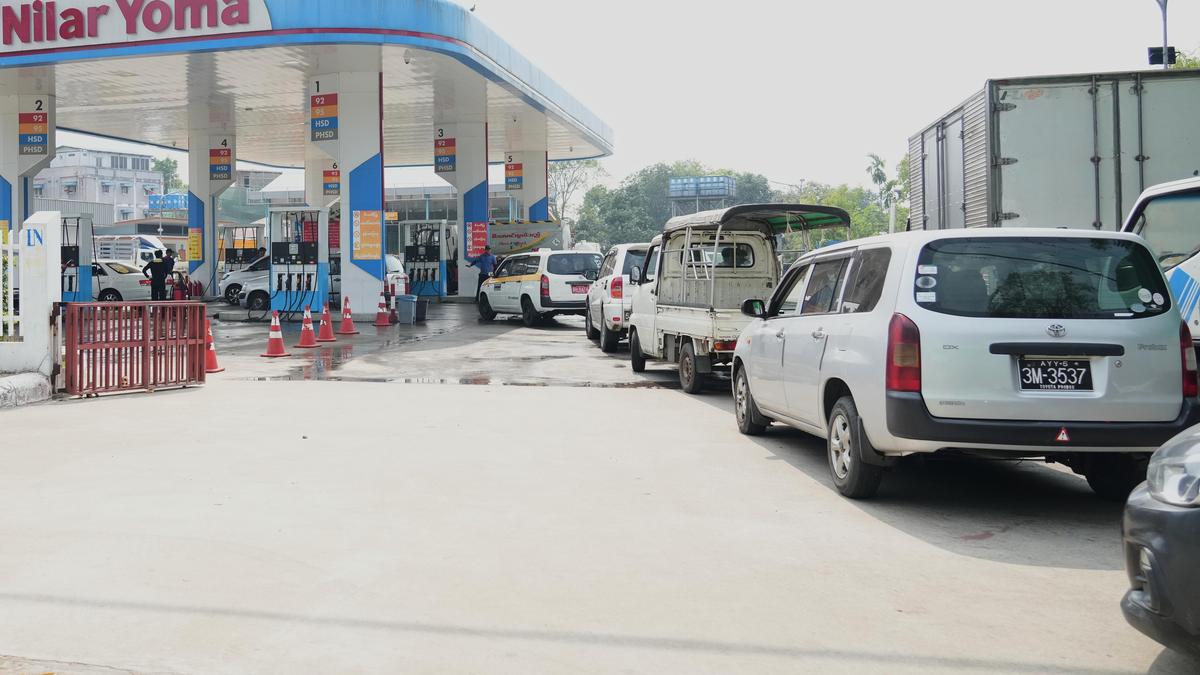
The Myanmar military administration’s decision to implement fuel rationing for private vehicles signifies a critical failure in the state’s midstream energy procurement and a terminal breakdown in the domestic foreign exchange cycle. While the administration cites maritime disruptions in West Asia—specifically the Red Sea security crisis—as the primary catalyst, an objective analysis of the regional energy supply chain reveals that these external shocks are merely accelerating a pre-existing structural insolvency. The current crisis is best understood through a three-factor model: the exhaustion of hard currency reserves, the collapse of the kyat-to-dollar exchange mechanism, and the physical degradation of logistics infrastructure.
The Tri-Factor Model of Energy Insolvency
To understand why a private vehicle owner in Yangon can no longer access unlimited 92-octane fuel, one must look past the geopolitical rhetoric of "shipping disruptions." The crisis is built upon three compounding variables that have rendered the previous importation model untenable.
1. The Currency Arbitrage Deadlock
Myanmar's energy market operates on a fundamental mismatch between procurement costs and retail pricing. Fuel is purchased on the global market in United States Dollars (USD) but sold locally in Myanmar Kyat (MMK). The Central Bank of Myanmar (CBM) maintains a fixed exchange rate that is significantly detached from the market-driven parallel rate. This creates a "Liquidity Gap" where importers cannot convert their MMK revenues back into enough USD to fund the next shipment.
When the CBM fails to provide subsidized dollars at the official rate, importers are forced to the black market. The resulting "Effective Cost of Fuel" rises above the state-mandated retail ceiling, forcing private companies to halt imports or face bankruptcy. Rationing is the state’s only tool to manage this deficit without allowing prices to float—which would trigger hyperinflation and civil unrest.
2. Logistics Fragility and the West Asia Variable
The administration’s claim regarding West Asia refers to the increased freight rates and insurance premiums associated with the Bab el-Mandeb Strait. However, for Myanmar, the impact is secondary rather than primary. Most of Myanmar’s refined petroleum products originate from Singaporean refineries.
The "West Asia" disruption affects the crude oil supply to those Singaporean hubs, which in turn raises the Mean of Platts Singapore (MOPS) benchmark. Myanmar is not a direct victim of a blocked shipping lane; it is a victim of a price floor increase that it can no longer afford to subsidize. The logistics bottleneck is internal: the Myanma Port Authority and domestic trucking networks are suffering from a lack of spare parts and high operational risks in conflict zones, making the final mile of fuel delivery exponentially more expensive than the ocean transit itself.
3. Systematic Prioritization of State Apparatus
The rationing of fuel for "private vehicles" indicates a strategic pivot toward "Secured Consumption." In a resource-constrained environment, the state must choose between civilian mobility and institutional survival. By throttling private consumption, the administration reallocates the remaining fuel stocks to:
- Military logistics and armored maneuvers.
- State-owned enterprises and heavy industry.
- Emergency services and high-priority government transport.
This is a transition from a market-based distribution system to a command-and-control energy economy.
The Cost Function of Rationing
Rationing is never a neutral administrative act; it carries an embedded economic cost that ripples through the Gross Domestic Product (GDP). We can quantify the impact of this fuel contraction using a Cost Function ($C_{total}$) where:
$$C_{total} = L_{productivity} + I_{transport} + E_{informal}$$
- $L_{productivity}$ (Productivity Loss): The hours lost by the workforce queuing for fuel. If a delivery driver spends four hours in a queue for a 20-liter ration, the economic output of that vehicle is reduced by 50% for that day.
- $I_{transport}$ (Inflationary Pressure): As fuel becomes scarce, the cost of transporting food and consumer goods increases. Even if the fuel price is capped, the scarcity premium is passed to the consumer through higher commodity prices.
- $E_{informal}$ (The Black Market Premium): Rationing inevitably births an informal economy. When the state limits a commodity below market demand, a secondary market emerges where fuel is sold at 200% to 300% of the official price. This drains wealth from the middle class and redirects it to illicit networks.
Structural Vulnerabilities in the Refined Product Pipeline
Myanmar’s reliance on imported refined products is an inherent strategic weakness. Unlike neighbors with significant refining capacity, Myanmar lacks the industrial base to convert crude into usable 95-octane or high-speed diesel at scale.
The Storage Buffer Problem
Commercial fuel stations in major hubs like Yangon and Mandalay typically operate on a "Just-in-Time" (JIT) delivery model. They hold between 3 to 7 days of inventory. When a shipment is delayed—whether due to a storm in the Bay of Bengal or a credit letter dispute—the buffer is exhausted almost instantly. The current rationing indicates that the national strategic reserve has reached a "Critical Minimum Threshold," where the state can no longer guarantee the 7-day buffer for the general public.
The Letter of Credit (LC) Bottleneck
International banks are increasingly hesitant to process Letters of Credit for Myanmar-based entities due to sanctions and jurisdictional risk. This creates a "Transaction Lag." Even if the funds are available in Kyat, the time required to clear the USD payment through intermediary banks has increased from days to weeks. During this lag, the physical vessels often sit idle off the coast of Thilawa, accruing "demurrage" charges (penalties for delayed unloading). These penalties are denominated in USD, further draining the very reserves the state is trying to protect.
Analyzing the "Private Vehicle" Exclusion
The specific targeting of private vehicles for rationing is a calculated move to protect the industrial and agricultural sectors, yet it fails to account for the "Interconnectedness of Mobility." In the Myanmar economy, the line between a "private vehicle" and a "commercial asset" is blurred. Small-scale entrepreneurs use private sedans for ride-sharing, and family-owned trucks are the primary movers of agricultural produce from the Magway and Mandalay regions to the southern markets.
By restricting private fuel, the administration is inadvertently:
- Stalling the Gig Economy: Thousands of drivers relying on app-based transport lose their primary income source.
- Increasing Post-Harvest Loss: Perishable goods rot at the farm gate because the "private" transport units used to move them are grounded.
- Depressing Urban Consumer Spending: Decreased mobility leads to decreased foot traffic in retail centers, further cooling an already stagnant economy.
Mapping the Downstream Escalation
The rationing phase is typically the penultimate step before a "Prioritized Shutdown." If the external factors—specifically the MOPS price and the Red Sea insurance premiums—do not normalize, the next phase of the energy contraction will involve:
- Zonal Blackouts: Shifting fuel from the power grid to the transport sector, or vice versa.
- Tiered Pricing: Introducing a two-tier system where "essential" users pay the capped price and "non-essential" users pay a significantly higher market rate.
- Industrial Quotas: Directing fuel only to factories that generate foreign exchange (e.g., garment manufacturing for export), effectively starving the domestic-oriented industry.
The administration’s attempt to frame this as a temporary disruption caused by West Asian geopolitics ignores the reality that Myanmar's energy security is now tethered to its ability to generate hard currency. Without a restoration of the foreign exchange inflow—either through increased exports or a resumption of international aid and investment—the rationing system will likely become a permanent fixture of the economic landscape.
The strategic imperative for businesses operating within this environment is to de-risk their energy dependencies. This requires an immediate pivot toward captive power generation (solar/battery storage) for fixed assets and the decentralization of logistics to reduce reliance on long-haul, fuel-intensive transport chains. The era of cheap, readily available petroleum in Myanmar has concluded; the new operational reality is one of "Extreme Resource Scarcity Management." Organizations must audit their "Energy-to-Revenue" ratio and prioritize operations that yield the highest margin per liter of fuel consumed. Failure to optimize for this constraint will lead to operational insolvency as the rationing windows inevitably tighten further.