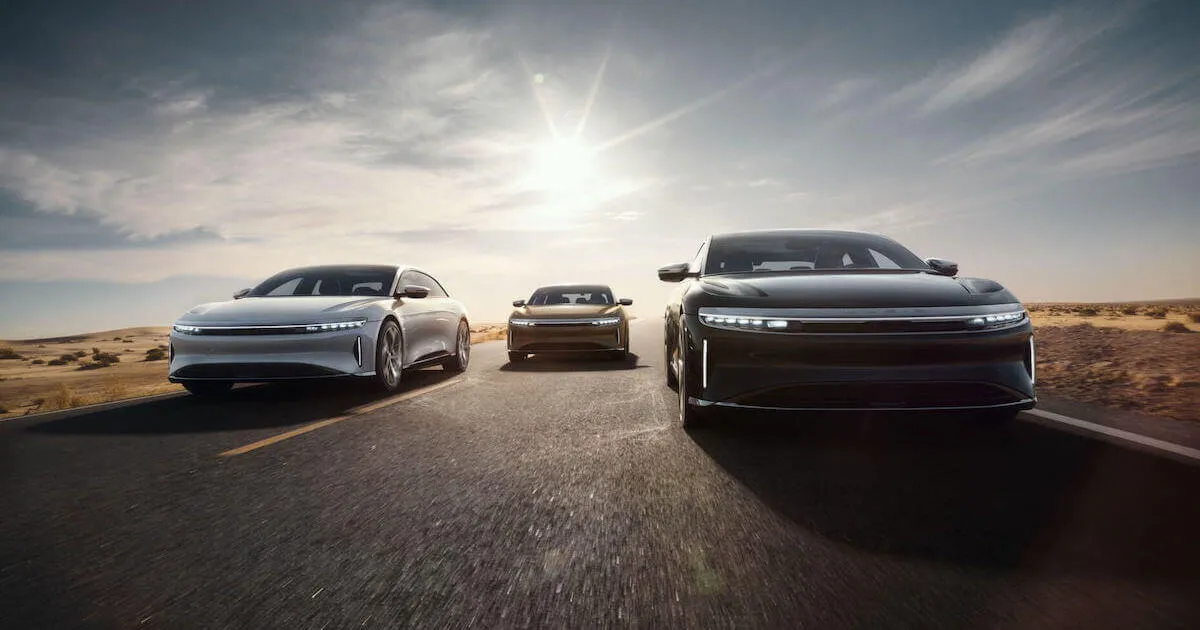
Lucid Motors is betting its entire future on a timeline that leaves no room for error. During its 2026 Investor Day, the California-based EV maker outlined a survival strategy that pivots away from being a mere luxury car manufacturer and toward becoming a vertically integrated mobility powerhouse. The core of this plan involves reaching positive free cash flow by the end of the decade, a feat they intend to achieve through a massive shift into robotaxis and a new, more affordable "Midsize" vehicle platform.
For an organization that has historically struggled with production bottlenecks and heavy cash burn, the next four years represent a brutal gauntlet. To bridge the gap, Lucid is relying on a deepened partnership with Uber and the continued financial life-support of Saudi Arabia’s Public Investment Fund (PIF). The roadmap is clear: survive the capital-intensive ramp-up of the Gravity SUV in 2026, launch the $50,000 Midsize platform in 2027, and achieve autonomy-driven profitability by 2029.
The Midsize Pivot and the $50,000 Threshold
Lucid’s survival depends on volume, a metric that has eluded the company since its inception. The newly revealed Midsize platform is the designated engine for this growth. Comprising three distinct models—headlined by the Lucid Cosmos and Lucid Earth—this platform is designed to compete directly in the high-volume segments currently dominated by the Tesla Model Y.
By targeting a starting price below $50,000, Lucid is attempting to shed its image as a niche boutique for the ultra-wealthy. However, the engineering challenge is significant. To make the economics work, Lucid introduced the Atlas electric drive unit, a smaller, lighter, and more integrated powertrain. The goal is to maintain the brand’s hallmark efficiency while slashing the bill of materials by nearly 60%. If Lucid cannot hit these cost targets, every "affordable" car sold will only accelerate the company's liquidity drain.
The Uber Alliance and the Lunar Robotaxi
Perhaps the most aggressive element of the strategy is the Lunar robotaxi concept. Built on the Midsize platform, the Lunar is a purpose-built, two-seat autonomous vehicle designed for maximum fleet utilization. Lucid is currently finalizing an agreement with Uber to deploy these vehicles at scale, moving beyond the 20,000 Gravity SUVs already earmarked for the ride-hailing giant.
The logic here is purely financial. Lucid’s leadership refers to software and autonomy as "golden revenues"—high-margin, recurring income that doesn't require the constant capital expenditure of manufacturing hardware. By 2029, Lucid aims to generate over $2 billion annually from robotaxi services and B2B technology licensing.
- Level 3 Autonomy (2028): Hands-free, "eyes-off" driving for retail customers.
- Level 4 Autonomy (2029): Fully driverless operations for the Uber fleet.
This timeline is ambitious, especially considering that competitors like Waymo are already operating driverless services and Tesla is pushing for volume production of its Cybercab this spring. Lucid is entering a crowded field late, banking on its superior battery efficiency to provide better "cost-per-mile" economics for fleet operators.
The Saudi Backstop and Financial Realities
Despite the optimism in New York, the numbers tell a story of extreme dependency. Lucid ended 2025 with $4.6 billion in liquidity, a sum the company believes will last into the first half of 2027. However, with a 2026 production guidance of just 25,000 to 27,000 vehicles, the company is still far from the economies of scale needed to self-fund.
The Saudi PIF, which owns more than 50% of the company, remains the only reason Lucid is still solvent. The "Made in Saudi" initiative, which includes a manufacturing plant in King Abdullah Economic City, cements Lucid as a domestic priority for the Kingdom’s Vision 2030. While interim CEO Marc Winterhoff has signaled a desire for more international funding, the reality is that the PIF is effectively the lender of last resort.
The path to 100,000 units by 2028 is not just a growth target; it is a requirement for existence. The company has essentially completed its heavy investment phase, and the shift to a maintenance-based capital expenditure model starting in 2027 is the only way the math for "late-decade profitability" begins to make sense.
Manufacturing Friction and the Path Forward
Execution remains the primary risk. Lucid revised its 2025 production totals downward after 538 vehicles failed final internal validation, a reminder that the transition from engineering masterpieces to mass-manufactured goods is fraught with difficulty. The 2026 focus is on "structural" improvements—stabilizing the production of the Gravity SUV and driving down unit costs through a radically simplified design-for-manufacturing philosophy.
This includes removing unnecessary aesthetic components, like traditional beltline moldings, to reduce assembly time. It is a pragmatic, if unglamorous, shift toward the "hard-core" manufacturing efficiency that defined the early success of its rivals.
The strategy revealed this week is a confession that being the "best" EV on the road is no longer enough. To survive until 2030, Lucid must prove it can be the most efficient business, turning its technical lead into a platform that Uber can't afford to ignore and the PIF can't afford to stop funding.
Would you like me to analyze the specific technical advantages of the Atlas drive unit against Tesla's current powertrain?