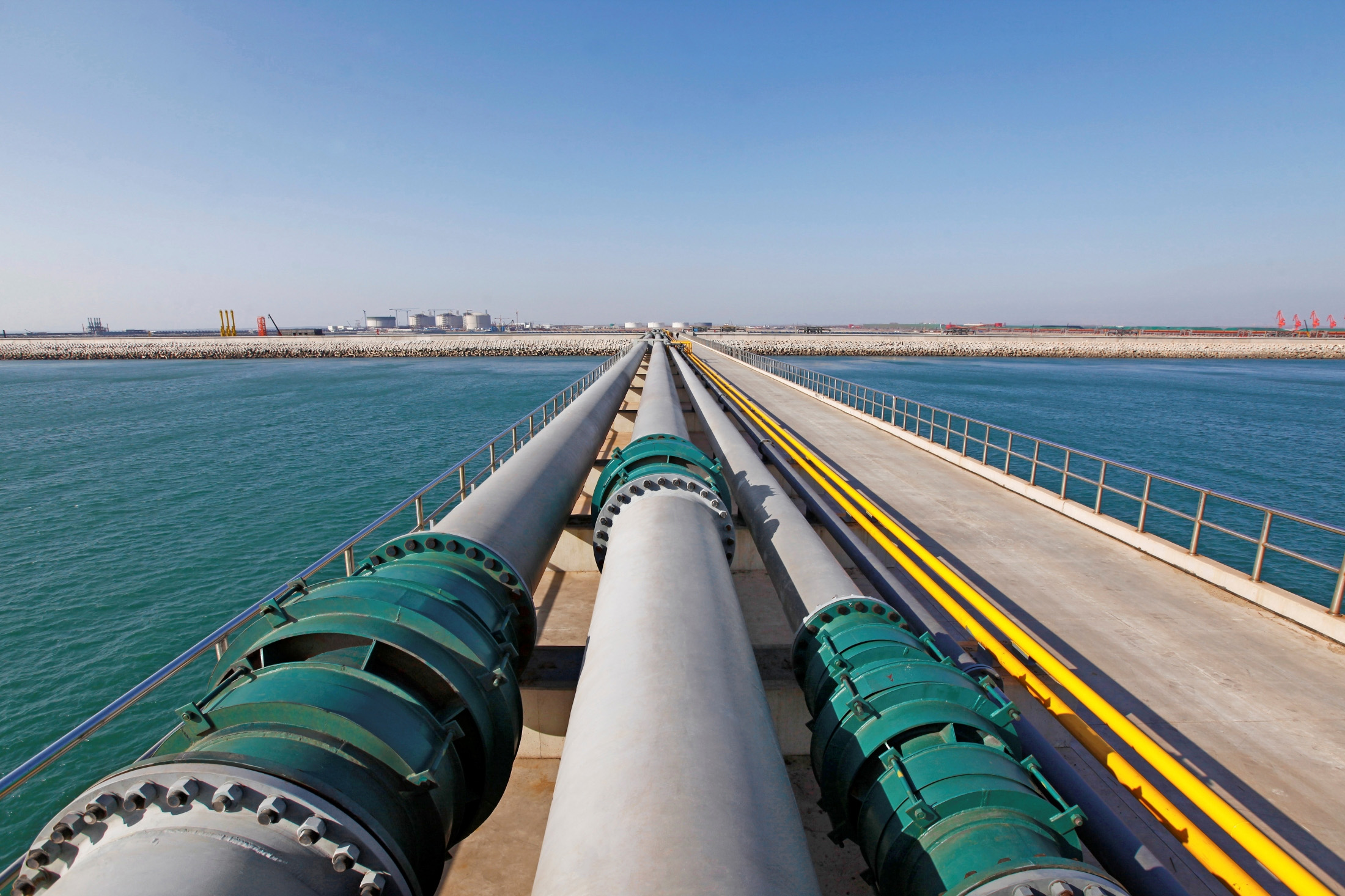
Energy analysts love a good map. They point to the Strait of Hormuz, draw a big red circle around it, and scream about the "chokepoint of the world." Then, they point to the East-West Pipeline in Saudi Arabia and the ADCOP line in the UAE and tell you the problem is solved.
They are wrong.
The narrative that these pipelines provide a "strategic bypass" to Iranian threats is a comforting lie sold to insurance underwriters and nervous oil traders. It’s a fundamental misunderstanding of how global energy markets, naval logistics, and modern missile technology actually work. If you think a few thousand kilometers of steel pipe buried in the sand can outrun a drone swarm or a regional war, you aren't paying attention to the math.
The Volume Fallacy
Let’s start with the most basic numbers that the "lazy consensus" ignores.
The Strait of Hormuz sees roughly 21 million barrels of oil pass through it every single day. That is about 20% of global consumption. Now, look at the bypass capacity. Saudi Arabia’s Petroline (the East-West Pipeline) has a nameplate capacity of about 5 million barrels per day (mb/d). The UAE’s Habshan-Fujairah line handles about 1.5 mb/d.
Even if these pipes were running at 100% efficiency—which they never are—you are looking at a maximum "escape route" for 6.5 mb/d.
Do the subtraction. If the Strait closes, 14.5 million barrels of oil per day simply vanish from the market. In a world where a 2-million-barrel disruption sends prices into a triple-digit vertical climb, a 14-million-barrel hole isn't a "challenge." It’s a global economic cardiac arrest.
The idea that these pipelines "bypass" the threat is like saying a single fire escape makes a skyscraper immune to a collapse. It might save a few people, but the building is still gone.
The Fujairah Bottleneck
Proponents of the UAE’s ADCOP pipeline point to Fujairah as the savior of the West. By pumping oil from Abu Dhabi’s desert fields to the Gulf of Oman, they claim to have escaped the Iranian shadow.
They haven't. They’ve just moved the target.
Fujairah is a massive, concentrated hub of storage tanks and loading terminals. It is a stationary, unblinking target. In the age of precision-guided munitions and cheap loitering munitions, a pipeline doesn't bypass a chokepoint; it just creates a new, more fragile one.
I’ve seen how these facilities operate. They rely on high-pressure pumping stations and complex cooling systems. You don't need to sink a supertanker to stop the oil. You just need to hit the manifold. If the Strait is "closed" due to conflict, do we really believe a terminal 100 miles away is a "safe zone"? It’s a tactical absurdity.
The Refined Product Trap
Here is the nuance the mainstream media misses: Oil isn't just "oil."
The Middle East has spent the last decade pouring billions into massive, integrated refineries like Jazan and Ruwais. They aren't just exporting crude anymore; they are exporting diesel, jet fuel, and chemicals. These refined products are much harder to "bypass" via pipeline than raw crude.
Crude pipelines are rigid. They go from Point A to Point B. But the global market for refined products is fluid. A refinery in Jubail might need to send a specific grade of jet fuel to Singapore one day and Rotterdam the next. When you force that volume into a pipeline destined for a single terminal on the Red Sea, you lose the "optionality" that makes the oil business profitable.
You aren't bypassing a threat; you are strangling your own supply chain.
The Red Sea Is Not a Safe Haven
The greatest irony of the Saudi East-West Pipeline is its destination: Yanbu.
For years, Yanbu was considered the "back door" to the world. But look at a map of 2024 and 2025. The Red Sea is no longer a tranquil pond. Between the instability in Sudan and the drone capabilities of the Houthis in Yemen, the Red Sea is arguably more volatile than the Persian Gulf itself.
By pumping oil to the Red Sea to avoid the Strait of Hormuz, Saudi Arabia is effectively jumping out of the frying pan and into a fire that is much harder to contain. A tanker leaving Yanbu still has to navigate the Bab al-Mandab strait—another chokepoint that is narrower, shallower, and much easier for non-state actors to harass.
The "bypass" is just a detour into a different theater of war.
The Maintenance Myth
Engineers will tell you that pipelines are reliable. As someone who has dealt with the reality of midstream infrastructure, I can tell you they are high-maintenance divas.
- Pressure Drops: Pumping millions of barrels across a burning desert requires massive amounts of energy and constant monitoring.
- Corrosion: The heat-cool cycle of the desert wreaks havoc on steel.
- Security: You cannot guard every inch of a 1,200 km pipe.
When a tanker in the Gulf is threatened, it can turn around. It can wait. It can take a different route. A pipeline is a fixed, vulnerable line in the sand.
The Disappearing Strategic Advantage
If we are brutally honest, the Strait of Hormuz is less of a physical chokepoint and more of a psychological one.
Iran knows it. The Saudi government knows it. The Americans know it.
Closing the Strait is the nuclear option of oil. It is a suicide pill. If Iran were to truly block the Persian Gulf, they would lose 100% of their own export revenue. It is the Mutually Assured Destruction of the energy world.
The pipelines in Saudi Arabia and the UAE are not "strategic bypasses." They are expensive optics. They exist to tell the world, "We have an alternative," when everyone in the industry knows the alternative is about 30% of the volume.
The real question we should be asking is not "How can we bypass the Strait?" but "Why are we still pretending the Middle East is the only energy game in town?"
The Cost of the "Safety" Illusion
These pipelines cost billions. They are massive capital expenditures (CapEx) that will take decades to amortize.
By pouring that money into the ground to build a "safe" route for oil that will still be sold into an inherently unstable market, these nations are doubling down on a dying business model. Every dollar spent on the East-West line is a dollar not spent on the hydrogen economy or the regional power grid.
It’s a classic case of fighting the last war. The "safe" pipeline is a monument to 20th-century thinking in a 21st-century theater of drone warfare and cyber-sabotage.
The Strait of Hormuz remains the only game that matters. Everything else is just expensive plumbing.