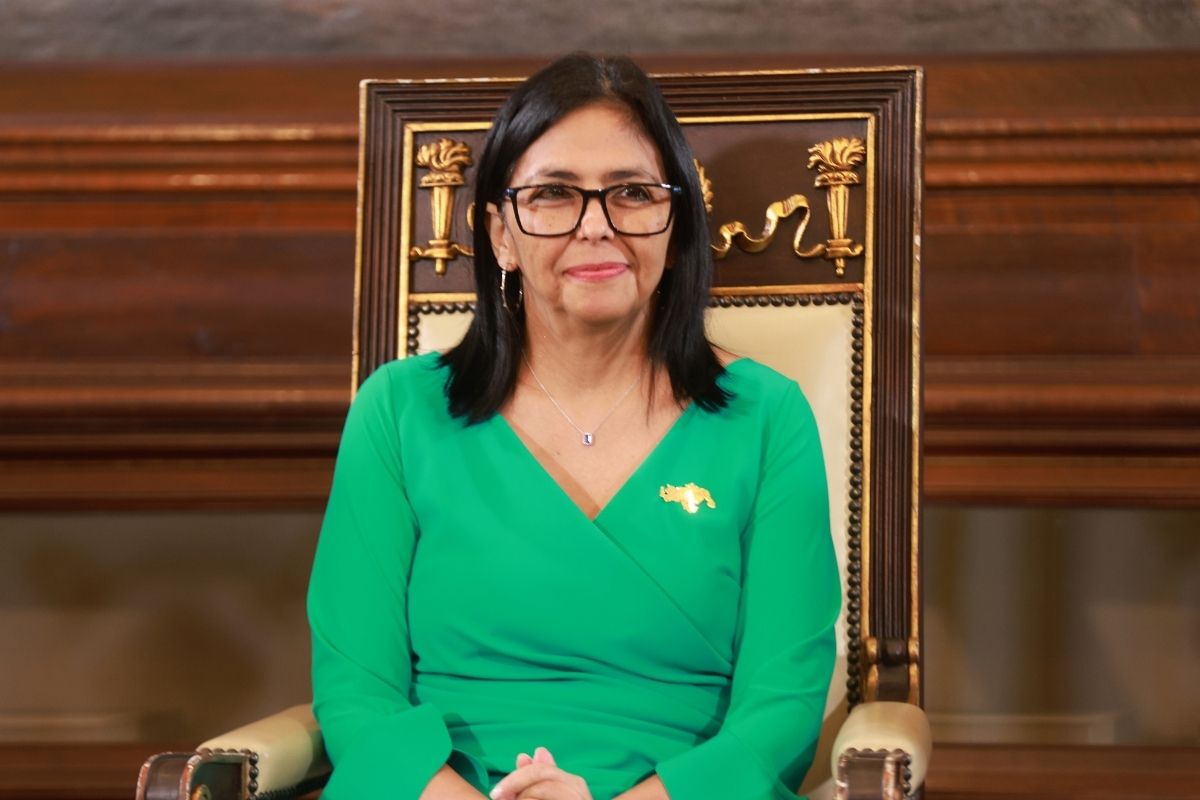
The ink on a government decree is odorless. It does not carry the scent of the heavy, tropical air in Caracas, nor does it smell of the metallic tang of machinery sitting idle in the oil fields of Maracaibo. Yet, a few strokes of a pen in Washington D.C. have just altered the daily gravity for millions of people who will never see the inside of the White House.
The United States government recently announced the lifting of specific sanctions on Venezuela’s acting president. On the surface, it reads like a dry update in a foreign policy ledger. Bureaucracy in action. But shift your gaze away from the press releases. Look instead at the quiet, agonizing chess game that has defined this South American nation for years.
Sanctions are often discussed as if they are precise surgical instruments. They are not. They are blunt blockades. When a superpower decides to cut off the financial oxygen of a government, the suffocation is rarely felt by the elites at the top first. It is felt by the woman trying to buy powdered milk with a stack of currency that loses value between the time she enters the store and the time she reaches the register.
To understand why this sudden shift matters, we have to look past the political theater and into the actual machinery of survival.
The Weight of the Frozen Dollar
Consider a hypothetical shop owner in Mérida, let's call him Carlos. Carlos does not care about geopolitics. He cares about spare parts for his refrigerator. Under the heavy blanket of absolute sanctions, Carlos cannot easily import those parts. The bank processing the transaction sees the word "Venezuela" and freezes the funds out of fear of American retaliation.
This is the chilling effect. It turns every routine business transaction into a high-stakes gamble.
The United States strategy for years was simple: apply maximum pressure until the structure crumbles. The sanctions targeted the state oil company, government assets, and the personal finances of key political figures. The goal was to force a return to democratic norms by making the cost of maintaining the status quo unbearable.
But pressure does not always cause a breakthrough. Sometimes, it just causes hardening.
While the political stalemate dragged on, the human cost mounted. Hyperinflation became a living monster. Stories emerged of doctors performing surgery by the light of cell phones because the power grid, starved of maintenance and imported parts, simply gave up. Millions of people packed whatever they could carry and walked across borders, sparking one of the largest migration crises in the Western Hemisphere.
The lifting of sanctions on the acting president is not a total surrender or a sudden declaration of friendship. It is something much more pragmatic. It is the turning of a single, heavy key.
The Geometry of the Pivot
Why now? The answers lie in a complex web of global energy needs and quiet diplomatic maneuvering.
The world is hungry for oil, and Venezuela sits on the largest proven reserves on the planet. But those reserves are heavy, sour crude that requires complex refining and massive investment to extract. You cannot just stick a straw in the ground. You need capital. You need technology. You need the very things that sanctions strictly forbid.
By easing restrictions on the acting presidency, the U.S. is signaling a willingness to negotiate, to create a release valve. It is an acknowledgment that the strategy of total isolation has hit a wall of diminishing returns.
Think of it as a game of high-stakes poker where both sides have been staring at each other for hours, refusing to blink. This move is the equivalent of one player sliding a small stack of chips toward the center. It is not showing the hand, but it is an invitation to keep playing instead of flipping the table.
But the real problem lies elsewhere. The tragedy of international sanctions is that they are incredibly easy to impose and agonizingly difficult to unwind.
Even when a legal barrier is removed, the psychological barrier remains. International banks and corporations have long memories. They are not going to rush back into a market the moment the green light flashes. They will wait. They will watch. They will calculate the risk of the wind changing direction once again.
The Echoes in the Street
If you walk through the streets of a major city outside of the political bubble, the lifting of these sanctions does not trigger immediate celebration. There is a profound, weary skepticism.
The people have heard promises of relief before. They have seen accords signed in foreign hotels while their own kitchens remained empty. To them, progress is not measured in policy shifts; it is measured in the reliability of the water running from the tap and the price of a bag of cornflour.
Let us be clear about the mechanics here. The U.S. Treasury Department does not act out of pure altruism. These decisions are cold, calculated moves designed to advance specific national interests, whether that is stabilizing regional migration or securing future energy corridors.
The acting presidency in Venezuela represents a specific legal and political entity in the eyes of international law. By removing the personal financial handcuffs from this office, the U.S. is effectively greasing the wheels for future dialogue. It allows for the movement of funds that were previously frozen, potentially opening up avenues for humanitarian aid or debt restructuring that were legally impossible just weeks ago.
It is a concession, yes. But it is a concession born of a stalemate that both sides are tired of funding.
Consider what happens next. The eyes of the region now turn to the Venezuelan government. The ball, as the cliché goes, is in their court. The lifting of these sanctions was conditioned on steps toward free and fair elections, on the release of political prisoners, on a return to a table where both sides actually speak instead of shouting.
If those steps are not taken, the sanctions can be snapped back in place with another odorless stroke of a pen. The door that just cracked open can be slammed shut before anyone has a chance to walk through it.
The Human Ledger
We often talk about nations as if they are single, sentient organisms. "America decided." "Venezuela responded."
This language masks the truth. Nations are mosaics of millions of individual wills, fears, and desperate hopes. When we analyze the macroeconomics of sanctions relief, we are really talking about whether a father can afford antibiotics for his daughter without having to sell his wedding ring.
The true test of this policy shift will not be found in the fluctuating line of a graph showing oil production barrels per day. It will not be found in the triumphant speeches of politicians claiming victory.
It will be found in the quiet corners. In the return of a family that fled to Bogota or Lima, deciding that maybe, just maybe, there is a future back home worth building. It will be found in the reopening of a small factory that finally managed to import the ball bearings it needed to stop the grinding silence of its assembly line.
The lifting of the sanctions is a gamble. It is an admission that the old way was not working well enough, and that a new, uncertain path must be forged. It is a moment of profound vulnerability for all involved, a step into a fog where the destination is anything but guaranteed.
For years, the story of this region has been written in the ink of conflict and deprivation. Today, a few lines of that story have been erased. What gets written in their place depends entirely on whether the hands holding the pens have finally learned the cost of holding them still.