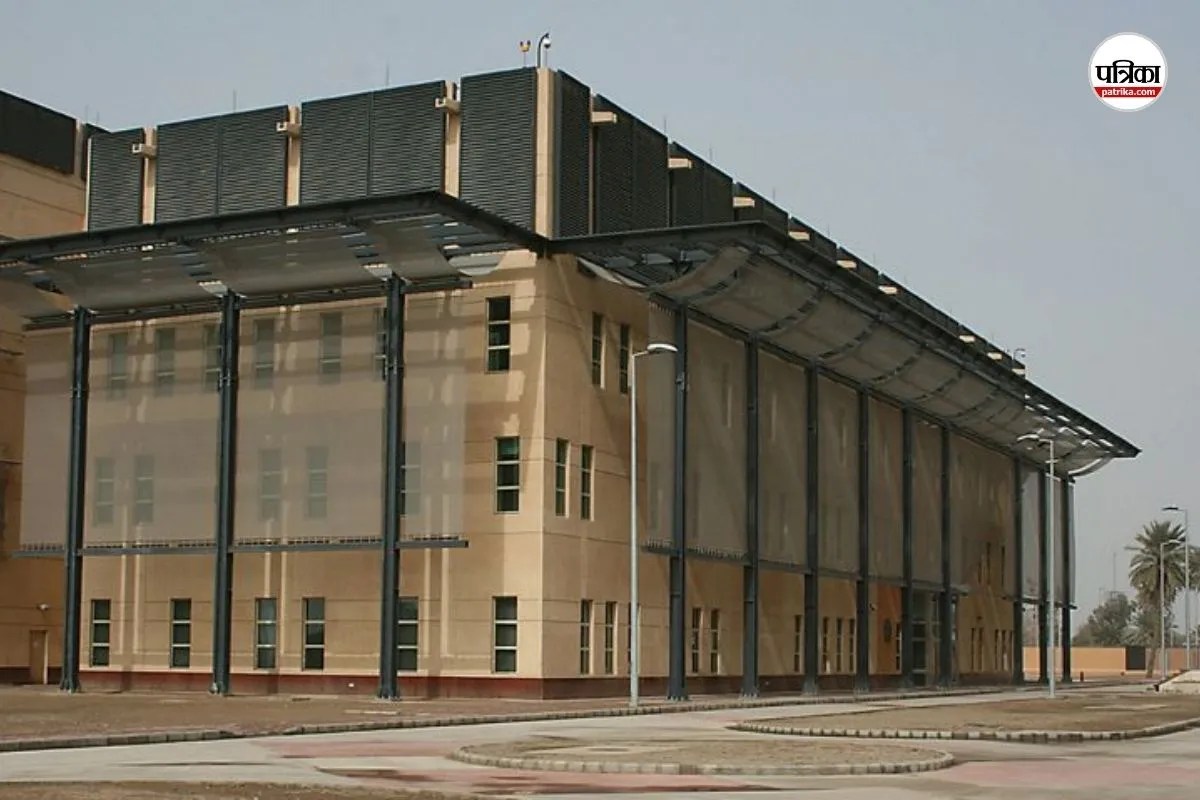
The tea in the Al-Mansour district usually tastes of cardamom and history. But today, the steam rising from the small, waist-pinched glasses carries a different scent. It is the metallic tang of adrenaline. It is the silent vibration of a city holding its breath.
In Baghdad, the news doesn't always arrive via a push notification or a flickering television screen. Sometimes, it arrives in the way a street vendor packs his cart twenty minutes early. It arrives in the way a mother grips her son’s hand a little tighter as they cross the street near the International Zone. The air has changed. The American Embassy has issued a warning, a stark, clinical sentence that has rippled through the palm-lined boulevards: a terror attack is imminent within the next 48 hours. For another look, read: this related article.
High alert.
It sounds like a setting on a machine. In reality, it is a father deciding whether the risk of a grocery run outweighs the emptiness of the pantry. It is the sudden, jarring appearance of concrete T-walls and the clicking of rifle bolts at checkpoints that were yesterday manned by bored soldiers scrolling through their phones. Baghdad is a city that has mastered the art of the "almost," but these 48 hours feel different. They feel heavy. Related coverage on the subject has been provided by The Guardian.
The Architecture of Anxiety
To understand the weight of a 48-hour warning, you have to look past the diplomatic cables and the strategic maps. You have to look at the Green Zone. To the world, it is a fortress of geopolitics. To the people living in its shadow, it is a barometer of their own safety. When the gates tighten, the rest of the city feels the squeeze.
Imagine a shopkeeper named Ahmed. He has seen empires rise and fall from his small storefront near the Tigris. For Ahmed, the American warning isn't just a security update; it’s a disruption of the fragile normalcy he has spent years weaving together. When the "High Alert" status is declared, his customers vanish. The vibrant chaos of Baghdad’s traffic—a symphony of honks and shouted greetings—is replaced by a hollowed-out silence.
The facts are cold: intelligence suggests a coordinated strike. The targets are predictable, yet the timing is designed to maximize psychological erosion. But the statistics never capture the way a neighbor looks at a neighbor when the threat remains nameless. Is it a car? A vest? A drone? The lack of detail is the sharpest part of the blade. It turns every idling vehicle into a potential catastrophe.
The Invisible Clock
We often think of time as a steady river. In a high-alert zone, time becomes a countdown.
Every hour that passes without a bang is a victory, but it is an exhausting one. The human nervous system wasn't designed to stay at a "High" setting for two days straight. Soldiers at the checkpoints, sweating under heavy ceramic plates and Kevlar, start to see ghosts in the heat haze. Their eyes ache from scanning faces, looking for the one that doesn't fit the rhythm of the street.
The embassy’s warning creates a strange, localized vacuum. Inside the blast walls, diplomats and security details move with a rehearsed, grim efficiency. They have the bunkers. They have the protocols. Outside, in the "Red Zone"—which is just "life" for millions of Iraqis—the protection is thinner. It is made of luck and prayer.
There is a specific kind of bravery required to go to work when you know a timer is running somewhere in your city. It isn't the cinematic bravery of a hero charging a line; it’s the quiet, stubborn persistence of a teacher opening her classroom door or a taxi driver picking up a fare. They are reclaiming their city, one hour at a time, from the shadow of the threat.
The Logic of the Warning
Why 48 hours? Why not 24, or a week?
Intelligence is rarely a complete picture. It’s a mosaic of intercepted signals, human whispers, and satellite flickers. By the time a warning reaches the public, the "window of opportunity" for an attacker has been identified. The goal of the announcement is twofold: to harden the target and to flush out the hunters.
By declaring the alert, the embassy forces the hand of those in the shadows. It disrupts the logistics. If a group was planning to move a vehicle through a specific intersection at noon, the sudden appearance of a double-manned checkpoint ruins the math. Security isn't just about stopping a bullet; it’s about changing the environment so the bullet is never fired.
But this tactical chess game has a human cost. It breeds a culture of hyper-vigilance that is hard to switch off. Even when the 48 hours expire and the "all clear" is unofficially felt, the residue remains. It’s the phantom limb of fear. You keep checking the rearview mirror. You keep avoiding the crowded plazas.
The Tigris Still Flows
As the sun sets over the city, casting long, orange shadows across the water, the 48-hour window reaches its midpoint.
The mosques call for prayer, the sound echoing over the hum of generators and the distant rumble of armored convoys. There is a profound resilience in the way Baghdad absorbs these shocks. The city is a palimpsest—history written over history, trauma layered over beauty.
A warning of a terror attack is a reminder of how quickly the mundane can become the monumental. A morning coffee, a commute, a phone call to a friend—these things are the fabric of peace. When that fabric is threatened, its value becomes blindingly clear.
The 48 hours will pass. The alert status will eventually be lowered. The T-walls might even be pushed back a few inches. But for those living through the countdown, the world has shifted. They have looked into the eyes of the "High Alert" and chosen to keep walking.
Tonight, the lights in the houses across Baghdad stay on a little longer. People are talking. They are watching the news, but they are also watching each other. In the silence between the reports, there is a collective, unspoken hope that the only thing the next morning brings is the ordinary, beautiful heat of another day.
The city waits. Not in defeat, but in a state of fierce, quiet defiance. The clock is ticking, but the heart of Baghdad beats louder.